Introduction
The mailbox rental market is growing steadily — and the numbers back it up. With 75% of employed adults in telework-capable jobs working remotely at least some of the time as of late 2024, and Q1 2026 e-commerce sales hitting $326.7 billion — up nearly 10% year over year — the need for secure, professional mailing addresses keeps growing alongside it.
That growth translates directly to opportunity — but for entrepreneurs and investors, the core question remains: what can a mailbox rental business actually earn? Revenue varies based on location, service mix, box occupancy, and how involved the owner is day-to-day.
This guide breaks down realistic revenue benchmarks, the income streams that matter most, the factors that separate high-earning stores from average ones, and how multi-service centers like ShipMate+ in Vista, CA structure their offerings to maximize recurring income.
Key Takeaways
- Independent mailbox rental businesses typically gross between $50,000 and $300,000+ annually.
- Mailbox rental fees ($15–$50/month per box) anchor recurring revenue, while shipping and packing services drive the bulk of income at mature stores.
- Owner-operators average 30–35% of gross revenue as discretionary earnings; absentee owners average around 20%.
- US Business Service Centers — the broader category — reached roughly $15 billion in 2024 and continues to grow.
- Stores are typically valued at 1.5x–2.5x average annual owner's discretionary earnings.
What Is the Average Annual Revenue of a Mailbox Rental Business?
There's no single national average for independent mailbox and pack-and-ship stores — the range is wide. Here's what the available data actually shows.
Revenue Range by Store Type
| Store Type | Approximate Annual Gross Revenue |
|---|---|
| Entry-level independent store | $50,000–$80,000 |
| Established independent store | $150,000–$300,000+ |
| High-volume independent store (broker examples) | $500,000–$860,000 |
| The UPS Store franchise (FY2024 average) | $719,842 |
Active broker listings on BizBen show real-world variation: one San Jose, CA mailbox and shipping center listed $580,000 in gross income with $155,000 adjusted net profit, while a Panorama City location showed $210,000 in revenue. A separate listing showed approximately $860,000 in gross revenue with ~$300,000 in seller's discretionary earnings. These are individual data points, not averages — but they confirm the ceiling is higher than most people expect.
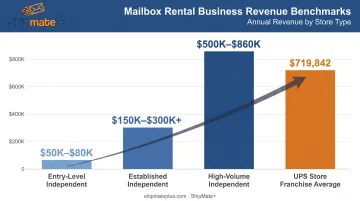
The UPS Store's FY2024 average of $719,842 per location is a useful franchise benchmark, though that performance comes with a $240,950–$508,472 total investment — a different starting point than a lean independent setup.
The Math on Mailbox-Only Revenue
The rental income calculation is straightforward:
- 150 rented boxes × $25/month average = $3,750/month
- $3,750 × 12 months = $45,000/year in base rental income
That's a solid, recurring foundation — but it rarely tells the whole story. At most mature stores, shipping, packing, printing, and ancillary services grow to represent the majority of total revenue. Mailbox rentals typically account for 20–30% of total revenue at established stores; the rest comes from services.
The broader US Business Service Centers category provides useful context. IBISWorld reports the industry at roughly $15 billion in 2024, with over 25,700 businesses operating in the sector. Mailbox and pack-and-ship stores are a niche within this category, but they share the same tailwinds: rising business formation, e-commerce volume growth, and remote work fueling demand for professional mailing addresses.
Revenue Streams: Where Mailbox Rental Businesses Actually Make Money
Mailbox Rental Fees
The recurring base. Monthly rates typically range from $15 to $50 for standard boxes, with premium or larger boxes commanding more. Real-world examples confirm this:
- Union Grove, WI operator: $14–$16/month depending on term length
- Las Vegas, NV operator: $25–$29.50/month depending on term length
Annual prepayment discounts are common and improve cash flow predictability — customers who pay upfront churn less and cost less to retain.
A real street address (rather than a P.O. Box) is a key differentiator. ShipMate+ in Vista, CA offers mailbox renters a real street address on West Vista Way, which matters to small businesses and home-based operators who need a professional address for clients, legal filings, and registered agent purposes.
Shipping and Carrier Services
Stores authorized to ship through FedEx, UPS, and USPS earn through convenience fees and carrier program economics on every transaction — and shipping is typically the highest-volume revenue driver in the business.
ShipMate+ holds all three major carrier authorizations — FedEx Authorized ShipCenter, UPS Authorized Shipping Outlet, and USPS Approved Shipper — which means customers can compare rates and ship through whichever carrier fits their deadline and budget in a single visit. FedEx's Authorized ShipCenter program provides participants with parcel discounts, drop-off incentive checks, and fee/surcharge waivers. Exact commission rates are not publicly disclosed, but the program economics are structured to reward volume.
Packing Supplies and Materials
High-margin retail with a natural sales trigger — most customers shipping something also need supplies. ShipMate+ stocks over 20 corrugated box sizes, bubble wrap sold by the foot or roll, packing peanuts, poly tape, tape guns, mailing tubes, padded envelopes, and specialty boxes for fragile or oversized items. Bundle pricing is available for larger orders.
Because the purchase decision happens at the counter while a customer is already shipping, conversion rates on supply sales are high without any active selling effort.
Ancillary Business Services
The services that raise average transaction value per customer visit:
- Notary public — California caps fees at $15 per signature for acknowledgments and jurats. ShipMate+ offers on-site notary Monday through Saturday.
- Document shredding — Local retail pricing typically runs $1.00–$1.50/lb. ShipMate+ offers by-the-pound and by-the-pallet options.
- Live Scan fingerprinting — Required for employment background checks, professional licensing, and regulated industries. ShipMate+ transmits directly to CA DOJ and FBI. Government processing fees include $32 DOJ and $17 FBI for general employment checks, plus the provider's rolling fee.
- Passport photos and expediting — ShipMate+ offers same-day photos and passport expediting in as little as one business day.
- Registered agent and auto registration services — Higher-value, lower-frequency transactions that serve business owners and vehicle owners avoiding DMV lines.
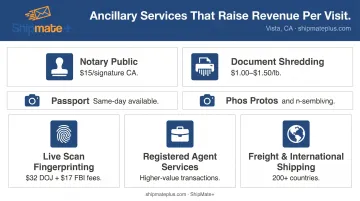
Individually these services are modest; combined, they meaningfully lift revenue per customer visit — particularly for locations that develop a steady base of business clients.
Freight and International Shipping
For stores that develop this capability, freight and LTL shipping opens access to business customers moving oversized or palletized shipments. ShipMate+ works with over 40 freight, LTL, air cargo, and sea container carriers — serving local businesses relocating offices, moving trade show equipment, or shipping industrial goods internationally across more than 200 countries. These are higher-ticket transactions with meaningful per-shipment revenue.
Key Factors That Affect Mailbox Rental Business Revenue
Location and Foot Traffic
Proximity to small businesses, coworking spaces, apartment complexes, and busy commercial corridors drives both mailbox demand and walk-in shipping volume. High-visibility locations in commercial strips can also support premium pricing that quieter strip malls cannot.
ShipMate+ sits on West Vista Way in Vista, CA — a commercially active corridor in North San Diego County — serving customers across Vista, Oceanside, Carlsbad, San Marcos, and Escondido.
Box Count and Occupancy Rate
Revenue scales directly with mailbox occupancy. Here's why it matters:
- 150 boxes at 60% occupancy = 90 rented × $25/month = $27,000/year
- 150 boxes at 90% occupancy = 135 rented × $25/month = $40,500/year
That's a $13,500 annual difference from identical physical infrastructure, achieved entirely by improving fill rate. One BizBen listing showed a location with 450 mailboxes at 75% occupancy, demonstrating the revenue potential when box count scales up.
Retention features directly support high occupancy by reducing churn. ShipMate+, for instance, offers 24-hour secured lobby access, email and text arrival notifications, and free package receiving — all of which give renters fewer reasons to leave.
Service Breadth and Upsell Capability
Businesses offering shipping, fingerprinting, passport photos, notary services, shredding, and packing supplies generate significantly more revenue per customer visit than those offering mailboxes alone.
The customer who arrives to ship a package can also pick up packing tape, get a document notarized, and drop off shredding — all in one stop. That bundled service model is what separates $80,000 stores from $200,000+ stores.
Pricing Strategy
Monthly rental rates vary by region. Undercutting local competitors on price alone erodes margin without necessarily driving volume — customers choosing a mailbox service typically weight convenience, security, and trust more heavily than a $2–$3 monthly price difference.
Knowing local rates sets your floor. Winning on reliability, amenities, and service keeps customers renewing year after year.
Active vs. Absentee Owner: How Involvement Affects Revenue
The data here is clear. According to BizBen's mailbox and packaging store industry guidance, active owner-operators average 30–35% of gross revenue as discretionary earnings, while absentee owners who rely on staff average around 20%.
On a store grossing $150,000 annually, that gap looks like this:
| Ownership Model | Discretionary Earnings | Annual Total |
|---|---|---|
| Active owner (30–35%) | $45,000–$52,500 | $150,000 gross |
| Absentee owner (20%) | $30,000 | $150,000 gross |
| Difference | $15,000–$22,500/year | — |
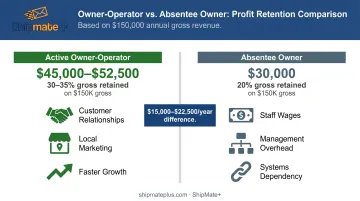
Active ownership drives faster revenue growth too — through stronger customer relationships, local marketing, better service quality, and quicker problem-solving. Over two to three years, repeat customers and word-of-mouth referrals tend to widen that gap further.
Absentee ownership becomes more viable once systems are established and a trained operator is in place, but the transition requires reinvesting some margin into staff wages and management overhead. A practical signal: many owners begin transitioning once monthly revenue stabilizes and a reliable part-time or full-time employee can handle daily operations independently.
How Long Until a Mailbox Business Turns Profitable?
Most mailbox rental businesses reach profitability within 1–2 years, though this varies significantly based on startup costs and how quickly mailbox occupancy ramps.
What Drives Faster Profitability
- Securing a location with existing foot traffic from day one
- Pre-opening marketing to build a waitlist of mailbox customers before launch
- Keeping fixed costs lean relative to what the location can support
The Fixed Cost Reality
Ongoing fixed costs are the primary drag on reaching breakeven:
- Rent: Varies widely — one BizBen San Jose listing showed $2,250/month plus triple net
- Utilities: Typically $300–$800/month
- Staff wages: Variable based on owner involvement
The real hurdle is scaling occupancy and service revenue fast enough to cover these fixed costs before cash reserves run thin. Once occupancy crosses 70–80% and service revenue flows consistently, margins improve quickly.
Startup costs also shape how long that climb takes. The UPS Store franchise runs $240,950–$508,472 at the high end. Independent operators with a lean buildout can often get open for $40,000–$75,000 — meaning breakeven arrives considerably sooner.
Frequently Asked Questions
Is a mailbox business profitable?
Yes — mailbox businesses are often profitable once past the startup phase. Active owner-operators can retain 30–35% of gross revenue as discretionary earnings. The biggest drivers: location quality, mailbox occupancy rate, and a diversified service mix beyond basic rentals.
Why do people rent mailboxes?
The main reasons: privacy (keeping a home address off public records), a professional business address for home-based and small businesses, secure package receiving to prevent theft, and mail forwarding convenience for travelers and remote workers.
How much can you make owning a mailbox rental business?
Independent stores typically gross $50,000–$300,000+ annually, with some high-volume locations exceeding that range. Actual take-home is highly dependent on store revenue volume.
How many mailboxes do you need to be profitable?
A store with 100–150 actively rented boxes at market rates can typically cover core operating expenses. Add-on services — shipping, notary, shredding, fingerprinting — are usually what pushes the business into healthy profit margin territory.
What services make a mailbox rental business the most money beyond rentals?
Shipping through multiple carriers is typically the single biggest revenue amplifier. Packing supplies, notary services, document shredding, and fingerprinting all contribute meaningfully — and each raises the average transaction value per customer visit.
How is a mailbox rental business valued if I want to sell it?
The standard multiple is 1.5x–2.5x average annual owner's discretionary earnings from the prior three years, per BizBen category guidance. The multiple is influenced by lease terms, location quality, equipment condition, and revenue consistency.