

Introduction
You've just dropped off a Priority Mail package — or you're about to — and you need to know when it will actually arrive. The "1–3 business days" estimate on USPS's website sounds simple enough, but the real answer depends on where the package is going, when it enters the USPS system, and whether you're using the right tool to look up your specific route.
This guide covers what USPS's delivery estimates actually mean, how to use the Priority Mail Delivery Map to get a location-specific answer, current Flat Rate pricing, and the most common causes of delays — plus how to avoid them.
Priority Mail has been one of USPS's most-used domestic services since launching in 1968. Knowing exactly how it works means fewer missed expectations and smarter shipping decisions.
Key Takeaways
- USPS Priority Mail estimates 2–3 business days delivery; nearby destinations may qualify for 1-day delivery
- The Priority Mail Delivery Map shows expected delivery zones from your specific ZIP code
- Priority Mail is not guaranteed — USPS does not refund postage for late deliveries
- Includes free tracking, Saturday delivery, and up to $100 insurance at no extra charge
- Two pricing options: Flat Rate (fixed by box size) or weight-and-zone (based on weight and distance)
What Is USPS Priority Mail?
Priority Mail is USPS's domestic shipping service for packages up to 70 lbs. It sits between First-Class Mail (slower, lighter packages only) and Priority Mail Express (faster, guaranteed, pricier). It's the middle-ground option: 1–3 day delivery without paying for an overnight guarantee.
The service has been available since January 7, 1968, and it remains one of the most widely used USPS products because of what's bundled into the base price:
- Free USPS Tracking on every shipment
- Up to $100 in insurance on most shipments
- Saturday delivery at no extra surcharge
- Free carrier pickup from home or office
- Free Flat Rate packaging available at no charge from USPS
These are included at no extra cost, whether you're shipping a small envelope or a large box. That bundled value is a big reason Priority Mail holds up well against UPS and FedEx on everyday domestic shipments.
USPS Priority Mail Delivery Times: What the Estimates Actually Mean
The 2–3 Day Service Objective
USPS's official service objective for Priority Mail is 2 to 3 days, as stated in the USPS Domestic Mail Manual (DMM 123). The Priority Mail Delivery Map expands on this by showing expected 1-, 2-, or 3-day delivery areas depending on origin and destination — so short-haul shipments may arrive in one day, while cross-country packages typically take two to three.
These are estimates, not commitments. USPS does not guarantee Priority Mail delivery time, and postage is not refunded if a package arrives late.
How Shipping Zones Affect Transit Time
USPS divides the country into zones — designated "Local" or 1 through 9 — based on the distance between the origin and destination ZIP codes. Zone assignments are how USPS calculates postage for weight-and-zone pricing, and they also correlate to transit time:
- Nearby zones (Local/1–2): Shorter distances, often 1-day delivery
- Mid-range zones (3–5): Regional shipments, typically 2 days
- Longer zones (6–9): Cross-country routes, usually 2–3 days
The exact zone for any origin-destination pair is available via the USPS Domestic Zone Chart. Don't rely on rough mileage estimates — use the tool with your actual ZIP codes.
When the Clock Starts
A critical detail many shippers miss: the delivery window begins when USPS receives and scans the package, not when the label is printed. A "Shipping Label Created" or "Pre-Shipment" status means USPS hasn't yet accepted the package into the mailstream.
For example, dropping a package at ShipMate+ in Vista before the 11:00 AM USPS pickup gets it into the system that day. Drop it off after 11:00 AM, and it enters the system the next business day — adding a full day to your timeline.
USPS counts Monday through Saturday for Priority Mail (Saturday delivery is included). So a 2-day estimate on Thursday means expected delivery by Saturday — not the following Monday.
How Priority Mail Compares to Other USPS Services
| Service | Delivery Estimate | Guaranteed? | Tracking Included |
|---|---|---|---|
| Priority Mail Express | 1–2 days by 6 PM | Yes (money-back) | Yes |
| Priority Mail | 2–3 days | No | Yes |
| First-Class Mail | 1–5 days | No | Yes (packages) |
| USPS Ground Advantage | 2–5 days | No | Yes |
For shipments with a hard deadline, Priority Mail Express is the right choice. For everyday domestic shipping where a guaranteed date isn't required, Priority Mail delivers solid speed without the premium price — making it the most practical option for most packages.
How to Use the USPS Priority Mail Delivery Map
The Priority Mail Delivery Map at usps.com/priority-mail/map/ is the most accurate way to estimate delivery time from your specific origin ZIP code. It's updated by USPS and reflects actual expected transit times — not generic zone tables.
Step-by-Step
- Navigate to usps.com/priority-mail/map/
- Enter your origin ZIP code (3 or 5 digits) in the search bar
- Read the color-coded map — darker shading indicates 1-day delivery areas, medium shading shows 2-day zones, and lighter shading indicates 3-day areas across the U.S.
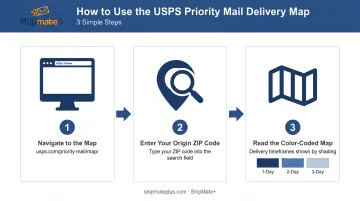
For a Vista, CA origin ZIP (92083), the map typically shows:
- Most of California and the Southwest in the 1–2 day range
- Mountain West and parts of the Midwest at 2 days
- East Coast and Southeast at 2–3 days
A location-specific view beats any generic "1–3 day" estimate — especially when you're deciding whether Priority Mail is fast enough or whether to upgrade to Priority Mail Express.
Important Limitations
The map shows estimated delivery under normal conditions only. It does not account for:
- Federal holidays
- Weather events or natural disasters
- Peak shipping periods (November–December)
- Packages that miss the daily USPS cutoff
Use it as a planning guide, and for a sharper estimate, pair it with the USPS Service Standards tool — input your origin/destination ZIPs and drop-off date to get a more refined transit window.
USPS Priority Mail Pricing Overview
Priority Mail offers two pricing structures. Choosing the right one can meaningfully affect what you pay.
Flat Rate vs. Weight-and-Zone
- Flat Rate: You pay a fixed price regardless of package weight (up to 70 lbs) or destination, as long as it fits in USPS-supplied Flat Rate packaging. Best for heavy items going long distances.
- Weight-and-zone: Cost is calculated based on the package's actual weight and how far it travels (zone). Can be cheaper than Flat Rate for light packages or short-distance shipments.
Neither is universally cheaper — it depends on your specific shipment. Run the numbers on both before you commit, especially if you're shipping frequently.
Current Flat Rate Prices (Effective April 26, 2026)
| Packaging Option | Retail Price | Commercial Price |
|---|---|---|
| Flat Rate Envelope | $12.90 | $11.12 |
| Small Flat Rate Box | $13.65 | $12.10 |
| Medium Flat Rate Box | $24.80 | $21.17 |
| Large Flat Rate Box | $34.00 | $31.00 |
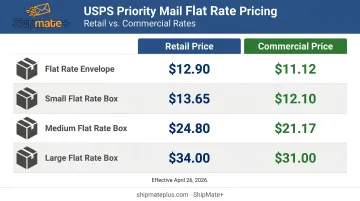
Source: USPS Notice 123, effective April 26, 2026. Rates are subject to change — verify current prices at USPS.com before shipping.
Commercial rates are available through USPS-approved shippers and platforms — including pack-and-ship locations like ShipMate+ in Vista, CA. The savings add up quickly: the difference on a Medium Flat Rate Box alone is over $3.50 per shipment.
What Can Delay Priority Mail — and How to Avoid It
Even with 90.9% on-time performance in FY2023 (per the Postal Regulatory Commission), roughly 1 in 10 Priority Mail packages misses its service window. These are the most common reasons why:
- Incorrect or incomplete addresses — Missing apartment numbers, wrong ZIP codes, or unrecognized street names trigger returns or re-routing. USPS flagged 4.2 billion undeliverable-as-addressed pieces in FY2023 alone.
- Missing the daily cutoff — Packages that aren't scanned into the USPS system by the carrier's daily pickup don't start their clock until the following business day.
- Peak season volume — November and December holiday periods can push transit times a day or two beyond standard estimates.
- Weather and facility disruptions — Significant weather events and sorting facility issues can push packages outside the 3-day window with no refund available.
Prevention Checklist
Before dropping off any Priority Mail package:
- Double-check the full delivery address, including apartment/suite numbers and ZIP+4 codes
- Drop off before the local USPS pickup cutoff for same-day entry into the system
- Ship early in the week to avoid Thursday/Friday drop-offs that can bleed into the following week
- Use USPS Tracking to monitor progress and catch any issues early
For Vista, CA residents and businesses, ShipMate+ (1929 W Vista Way Suite F) accepts USPS Priority Mail drop-offs Monday–Friday 9AM–6PM and Saturday 9AM–1PM. The daily USPS pickup is at 11:00 AM, Monday through Saturday — so anything dropped off before that cutoff enters the system the same day.
The team can verify your packaging and flag labeling issues on the spot, before your shipment leaves the building. That extra check is often what keeps a package off the delay list.
Frequently Asked Questions
How fast is USPS Priority Mail shipping?
USPS Priority Mail has a service objective of 2–3 business days, though the Delivery Map shows 1-day delivery for nearby destinations. Transit time depends on your origin-to-destination zone. Delivery is not guaranteed.
How much does 2-day USPS Priority Mail cost?
There's no separate "2-day Priority Mail" product or fixed price. Whether you pay $12.90 (Flat Rate Envelope) or more depends on which pricing model you use and your destination. Use the USPS price calculator for a specific estimate.
Does USPS Priority Mail guarantee delivery time?
No. USPS's service objective is 2–3 days, but there is no money-back guarantee. For guaranteed delivery with a refund option, you need Priority Mail Express.
Does Priority Mail deliver on Saturdays?
Yes — Saturday delivery is included at no extra surcharge. Sunday delivery is not included unless you use Priority Mail Express with the optional Sunday/holiday add-on.
What happens if my Priority Mail package is delayed?
Check USPS Tracking first. If there's no movement after 5 business days, contact USPS customer service. Late Priority Mail deliveries don't qualify for a postage refund.
What is the difference between Priority Mail and Priority Mail Express?
Priority Mail Express is faster (1–2 days by 6 PM), includes a money-back guarantee, and offers 7-day delivery including Sundays and holidays for an added fee. A Flat Rate Envelope via Express runs $35.90 vs. $12.90 for standard Priority Mail — worth it when guaranteed delivery matters, unnecessary when it doesn't.