This guide breaks down the six most important things Vista residents need to know about vehicle registration in California. You'll learn exactly what documents to bring, how to avoid late fees, and—here's the good news—how to skip the DMV entirely by using local services that handle the process for you. Let's cut through the confusion and get your vehicle registered the right way.
TLDR: 6 Things to Know About Vehicle Registration in Vista
- Register within 20 days of establishing California residency; private-party buyers have just 10 days
- Gather Form REG 343, title, proof of insurance ($30,000/$60,000/$15,000 minimums), smog certificate, and valid ID
- Most vehicles over 4 years old need a smog check; electric, newer, and pre-1976 vehicles are exempt
- Expect a $73 base registration fee plus VLF, CHP, and TIF charges that vary by vehicle value
- Late registration triggers penalty fees on top of standard costs—renew before your expiration date to avoid extra charges
- Skip DMV lines completely using ShipMate+ at 1929 W Vista Way Suite F, Vista — open Mon–Fri 9AM–6PM and Sat 9AM–1PM
California Has Strict Registration Deadlines
California doesn't give new residents much breathing room. Once you establish residency here, you have 20 days to register your out-of-state vehicle with the DMV. Residency kicks in the moment you meet any of these triggers:
- Accepting a job in California
- Signing a lease or purchasing a home
- Enrolling your kids in school
- Registering to vote
- Applying for a California driver's license
Private-party vehicle purchases operate on an even tighter timeline: 10 days from the date of sale. This applies whether you're a longtime California resident buying from a neighbor or a new arrival purchasing locally. The seller also has obligations—they must notify the DMV within 5 days of the sale to protect themselves from liability.
Private sellers aren't the only ones with skin in the game — dealers have their own process. When you buy from a licensed dealer, they handle the registration paperwork and issue a temporary operating permit so you can legally drive while your registration processes. You won't face the same tight deadlines, but confirm the dealer submitted everything correctly before driving off the lot.
What Documents You'll Need for Registration
Core Registration Forms
Form REG 343 (Application for Title or Registration) is your starting point for any registration transaction—new resident, private-party purchase, or ownership transfer. All listed owners must sign this form. If you've lost the original vehicle title, you'll also need Form REG 262 (Application for Duplicate or Paperless Title) to complete the transfer.
For used vehicle purchases, the seller must sign over the title to you. Make sure this happens at the time of sale. A missing signature will stall the entire registration process.
Proof of Insurance
California requires minimum liability coverage of:
- $30,000 bodily injury per person
- $60,000 bodily injury per accident
- $15,000 property damage per accident
These minimums doubled in recent years, so if you're moving from another state, verify your policy meets California's requirements before registering. Your insurance company must electronically report your coverage to the DMV—policies from out-of-state carriers may need adjustment.
Smog Certificate and Odometer Disclosure
A valid smog certificate is required for most vehicles and cannot be expired past 90 days at the time of registration. We'll cover exemptions in the next section, but plan to obtain this before heading in.
For vehicles under 10 years old, federal law requires an odometer disclosure. This is typically recorded directly on the title certificate or on a separate odometer disclosure statement at the time of sale.
Out-of-state registrants should bring both their out-of-state title and current registration documents to complete the process.
Most Vehicles Require a Smog Check
California's smog inspection requirement catches many newcomers off guard. Vehicles over 4 years old generally need a valid smog certificate before registration or renewal, and that certificate is only valid for 90 days from the inspection date.
Who Gets a Pass?
Not every vehicle needs smog testing. These categories are exempt:
| Vehicle Type | Exemption Rule |
|---|---|
| Electric vehicles | Fully exempt |
| Gasoline vehicles (newer) | First 8 model years exempt for renewal; first 4 model years exempt for ownership transfer |
| Gasoline vehicles (vintage) | 1975 model year and older fully exempt |
| Diesel vehicles (older) | 1997 model year and older exempt |
| Diesel vehicles (heavy) | Gross vehicle weight over 14,000 lbs exempt |
| Motorcycles | Fully exempt |
| Trailers | Fully exempt |
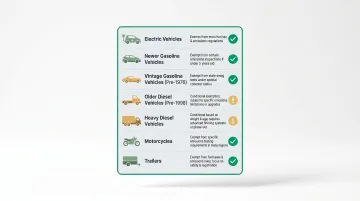
Important note: Hybrid vehicles follow the same rules as gasoline vehicles—they're not automatically exempt just because they use electric power part-time. Newer diesel vehicles (1998+) with a gross vehicle weight of 14,000 lbs or less do not qualify for the 4- or 8-year exemptions.
Who's Responsible?
Smog certificate responsibility depends on your situation:
- Private-party sales: The seller must provide a valid smog certificate at the time of sale. If the vehicle is less than 4 model years old and exempt, the buyer pays a smog transfer fee instead.
- Out-of-state vehicles: New residents must obtain a California smog certificate before the DMV will issue plates—unless the vehicle qualifies for one of the exemptions listed above.
- Not sure where to go? Any state-licensed Smog Check station can perform the inspection. Bring your registration paperwork and allow 30–45 minutes.
Registration Fees in California — What to Expect
Two Vista residents registering different vehicles will pay dramatically different amounts. Registration costs vary based on vehicle value, type, age, and county-specific fees. Here's what makes up your total bill:
Fee Components Breakdown
| Fee Component | Amount | Notes |
|---|---|---|
| Base registration fee | $73 | Includes $3 Alternative Fuel/Technology fee |
| California Highway Patrol (CHP) fee | $34 | Standard for non-commercial vehicles |
| Vehicle License Fee (VLF) | 0.65% of market value | Depreciates over an 11-year schedule |
| Transportation Improvement Fee (TIF) | $33 - $231 | Tiered by vehicle value (see below) |
| Smog abatement fee | $20 | For vehicles exempt from biennial smog inspection |
| Smog transfer fee | $8 | For ownership changes on vehicles under 4 model years |
Transportation Improvement Fee Tiers
| Vehicle Market Value | TIF Amount |
|---|---|
| $0 - $4,999 | $33 |
| $5,000 - $24,999 | $66 |
| $25,000 - $34,999 | $132 |
| $35,000 - $59,999 | $198 |
| $60,000+ | $231 |
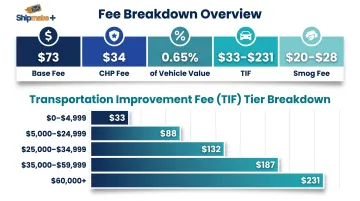
County-specific fees also apply. Vista is located in San Diego County, which adds its own district charges to the state fees above.
Use Tax for Out-of-State Vehicles
If you're registering an out-of-state vehicle in California for the first time, you may owe use tax based on the purchase price and San Diego County's tax rate. You can receive credit for sales tax already paid to another state, but the calculation depends on timing and where you bought the vehicle.
Use the California DMV's online fee calculator to get an accurate estimate before you pay — enter your vehicle details and Vista zip code (92083) for a personalized breakdown. If you'd rather skip the DMV line entirely, ShipMate+ on W Vista Way processes vehicle registration renewals in-store for Vista residents.
You Don't Have to Go to the DMV — Here's What Vista Residents Can Do
Standard Registration Options
California offers three traditional methods to register or renew:
- In-person at a DMV field office - Appointments reduce wait times but don't eliminate them entirely
- By mail - Available for renewals and certain transactions, but processing takes weeks
- Online through the CA DMV website - Works only if your smog certificate is already on file, your insurance company reports electronically to the DMV, and you have the last 5 digits of your VIN
That online option has real conditions attached. Many out-of-state insurance carriers don't report coverage electronically, and not all smog stations transmit results directly to the DMV.
The Third-Party Registration Alternative
California authorizes private businesses to process vehicle registrations on behalf of the DMV. These providers handle most common transactions, including:
- Renewals and transfers of ownership
- Replacement plates, stickers, and registration documents
- Duplicate title requests and VIN verifications
Salvage title processing and certain initial out-of-state transfers still require a DMV visit.
ShipMate+, located at 1929 W Vista Way Suite F, Vista, CA 92083, offers auto registration services designed to skip DMV lines entirely. They're open Monday–Friday 9AM–6PM and Saturday 9AM–1PM, with no appointment needed. Their staff handles the paperwork so you can complete the process in one visit.
Services available through ShipMate+ include:
- Registration renewals
- Transfer of ownership
- Replacement plates, stickers, and registration documents
- Electronic report of sale
- Non-operation (PNO) filings
- DMV record lookups
- Duplicate title requests
- VIN verification
- Custom license plates
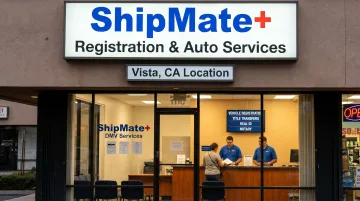
What still requires a DMV visit? Salvage vehicle registrations and some initial out-of-state transfers may need in-person DMV processing. ShipMate+ can clarify which transactions they handle when you call (760) 295-1074.
Bonus: If you need a notary for title signing or document copies to complete your registration, ShipMate+ offers those services on-site too, so you can cross multiple tasks off the list in one stop.
Late Registration Comes With Real Penalties
California doesn't offer grace periods. Penalties kick in the day after your registration expires.
DMV Administrative Penalties
Late fees combine three components: a percentage of your Vehicle License Fee (VLF), a registration late fee, and a CHP late fee. Here's how they stack up:
For Registration Renewals:
| Time Overdue | VLF/Weight Fee Penalty | Registration Late Fee | CHP Late Fee | Combined Fixed Fees |
|---|---|---|---|---|
| 1–10 days | 10% | $10 | $10 | $20 |
| 11–30 days | 20% | $15 | $15 | $30 |
| 31 days–1 year | 60% | $30 | $30 | $60 |
| 1–2 years | 80% | $50 | $50 | $100 |
| More than 2 years | 160% | $100 | $100 | $200 |
For Original Registration (Never Registered in CA):
| Time Overdue | VLF/Weight Fee Penalty | Registration Late Fee | CHP Late Fee | Combined Fixed Fees |
|---|---|---|---|---|
| 1 year or less | 40% | $30 | $30 | $60 |
| 1–2 years | 80% | $50 | $50 | $100 |
| More than 2 years | 160% | $100 | $100 | $200 |
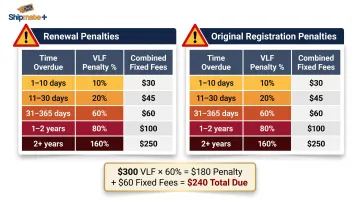
These percentages apply on top of the fixed fees, so if your VLF is $300 and you're one year late, you'll pay the $60 in fixed fees plus 60% of $300 ($180) for a total penalty of $240—on top of your regular registration cost.
Traffic Citation Fines (Separate from DMV Penalties)
Driving with expired registration is a separate violation under California Vehicle Code Section 4000(a)(1). If you're pulled over, the financial hit goes beyond DMV fees:
- Base penalty: $50, with total bail (including mandatory assessments) reaching $281
- Correctable offense: Register the vehicle and show proof to the court, and the fine may reduce to a $25 dismissal fee
- DMV penalties still apply: Court relief doesn't erase what you owe the DMV
California law does provide limited relief: officers generally cannot cite you solely for expired registration until approximately 60 days after expiration. The math, though, is straightforward — the longer you wait, the more you owe on both fronts. Vista residents can skip the DMV trip entirely by handling renewals through ShipMate+, which processes auto registrations on-site.
Frequently Asked Questions
What to bring for vehicle registration in California?
Gather these before you go:
- Completed Form REG 343
- Vehicle title (signed by seller, if applicable)
- Proof of California-compliant insurance ($30,000/$60,000/$15,000 minimums)
- Valid smog certificate (if required, not expired past 90 days)
- Out-of-state title and registration (new residents only)
- Valid photo ID and payment for all fees
How long do I have to register my car after moving to Vista, CA?
You have 20 days after establishing California residency—triggered by employment, signing a lease, enrolling in school, or similar actions. If you purchase a vehicle from a private party, you have just 10 days from the sale date to complete the transfer, regardless of residency status.
How much does it cost to register a vehicle in California?
Fees vary by vehicle value, age, and county. These charges stack: at minimum, expect a $73 base fee, $34 CHP fee, 0.65% VLF (based on market value), and a TIF ranging from $33–$231. Use the CA DMV's online fee calculator for an accurate estimate based on your specific vehicle.
Do I need a smog check to register my car in Vista?
Most vehicles over 4 model years old need a valid smog certificate (good for 90 days). Fully exempt vehicles include EVs, motorcycles, gas vehicles from 1975 or earlier, and diesel vehicles from 1997 or earlier. Gasoline and hybrid vehicles in their first 8 model years skip the smog check but pay an abatement fee instead.
Can I renew my vehicle registration without going to the DMV in Vista?
Yes. You can renew online (if your smog and insurance are on file), by mail, or through a local authorized provider like ShipMate+ at 1929 W Vista Way Suite F. ShipMate+ handles renewals, transfers, and most registration services during extended hours (Mon–Fri 9AM–6PM, Sat 9AM–1PM) with walk-in availability.
What happens if I drive with expired registration in California?
You risk a traffic citation under VC 4000(a)(1) with fines totaling up to $281 (including court fees), plus separate DMV late penalties ranging from $20 (1–10 days overdue) to $200+ (over 2 years late). Both penalties apply together if you're cited while driving unregistered.