

The answer is yes — and it's often the smartest option you're not using.
Canada shares a 5,500-mile land border with the US, but it's still an international shipment. That means customs paperwork, potential duties, and a few extra steps compared to domestic shipping. What it doesn't mean is that you need to default to expensive air services. Ground shipping to Canada is legitimate, cost-effective, and faster than most people expect.
This guide covers carrier options (FedEx, UPS, USPS), what shipments actually cost, Canadian customs requirements, prohibited items, and how to get a package moving without unnecessary stress.
Key Takeaways
- FedEx International Ground and UPS Standard both deliver to all Canadian addresses in 2–7 business days
- Ground shipping is almost always cheaper than air — ideal for non-urgent or heavier shipments
- Every Canada-bound package requires a Commercial Invoice; shipments over CAD $2,500 need additional export documentation
- Under USMCA, courier shipments valued under CAD $40 are duty- and tax-free
- Compare rates across all three carriers and drop off your package at one location — ShipMate+ in Vista, CA
Why Ground Shipping to Canada Is Worth Considering
Ground shipping to Canada is faster and cheaper than most shippers expect — and the geography explains why.
Statistics Canada's 2016 census data confirms that 66% of Canadians live within 100 km of the US border — concentrated in a narrow band along the southern edge of the country. That geographic reality is what makes ground transit times competitive. A package from San Diego to Toronto or Montreal doesn't need to cross a vast distance; most major Canadian population centers are reachable by road in two to four days.
Ground Rates Beat Air for Heavy Packages
Ground shipping to Canada is consistently the most budget-friendly international option. For heavier packages — where air freight rates climb quickly — the savings add up quickly. That makes ground shipping particularly attractive for:
- Small businesses shipping regular orders to Canadian customers
- Individuals sending gifts or personal items
- E-commerce sellers looking to reduce per-shipment costs on lower-margin products
- Anyone with a non-urgent delivery window
Reduced shipping cost is only part of the equation — customs friction matters too. That's where USMCA comes in.
USMCA Raised Canada's Duty-Free Thresholds
The United States-Mexico-Canada Agreement (USMCA, known in Canada as CUSMA) took effect July 1, 2020, and it raised Canada's de minimis thresholds for courier shipments from the US, making low-value packages cheaper to receive:
- Under CAD $40: duty- and tax-free
- CAD $40–$150: duty-free, but taxes apply
- Over CAD $150: both duties and taxes apply
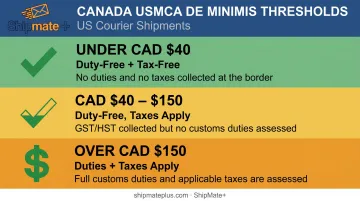
For low-value e-commerce shipments and personal packages, this reduces friction significantly. The CBSA's official de minimis page has the full details, including important notes on courier-only scope (mail shipments have a lower $20 threshold).
Ground Shipping Carrier Options for US-to-Canada Shipments
Three carriers dominate US-to-Canada shipping: FedEx, UPS, and USPS. Each has different service names, transit windows, and pricing. Here's how they compare.
FedEx International Ground
FedEx International Ground is designed specifically for cross-border ground shipping to Canada. Key facts:
- Delivers to 100% of Canadian business and residential addresses
- Transit time: 2–7 international business days depending on origin and destination
- Customs clearance is included with every shipment
- Flexible brokerage options available, including FedEx International Broker Select
For shippers based in Southern California, a package to British Columbia or Alberta typically lands in the lower end of that range. Ontario and Quebec add a day or two.
UPS Standard to Canada
UPS Standard is UPS's ground-based cross-border service for Canada. Key facts:
- Day-definite delivery in 2–7 business days — you get a specific delivery date, not just a window
- Delivers to 100% of Canadian addresses, business and residential
- Full tracking included throughout transit
- A reliable option when you need predictability without paying for air service
USPS International Options
USPS doesn't offer a true ground international service to Canada. Its international options — including Priority Mail International and First-Class Package International Service (for packages up to 4 lbs with declared value up to $400) — are not ground-based services.
USPS can still make sense in specific situations:
- Lightweight packages (under 4 lbs) where USPS rates are competitive
- Lower declared values where the simplified mailing process works fine
- When the recipient's address doesn't require commercial carrier delivery
For most Canada shipments, FedEx International Ground or UPS Standard will offer better tracking, more predictable transit, and clearer customs handling.
Choosing Where to Drop Off Your Shipment
One practical challenge: FedEx, UPS, and USPS each have separate drop-off locations. Driving to three different facilities to compare rates isn't realistic.
ShipMate+ in Vista, CA is an authorized outlet for all three — holding official designations as a FedEx Authorized ShipCenter, UPS Authorized Shipping Outlet, and USPS Approved Shipper. Staff can help you compare carrier rates for your Canada shipment and get documentation ready before it ships. All three carriers pick up daily from the location. If your package needs proper sizing or professional packing before it crosses the border, the team handles that on-site as well.
What Determines the Cost of Shipping to Canada
The rate on a carrier's calculator is rarely what you'll actually pay. Understanding "total landed cost" — everything from origin to delivery, including duties and brokerage fees — is how shippers avoid getting caught off guard.
Package Weight and Dimensions
Carriers charge based on whichever is greater: actual weight or dimensional (DIM) weight. DIM weight penalizes oversized packaging relative to what's inside.
The formula: multiply length × width × height (in inches), then divide by 139 for FedEx and UPS international shipments at daily rates.
A 12" × 12" × 12" box calculates to a DIM weight of about 12.5 lbs — regardless of what's inside. That gap between actual and billed weight adds up fast. Right-sizing your box is one of the simplest ways to control shipping costs — ShipMate+ stocks over 20 box sizes so you can match packaging to your product without paying for empty air.
Service Level and Transit Time
Choosing a faster service costs more — sometimes significantly more. FedEx International Priority versus FedEx International Ground can differ by 30–50% or more depending on the package. Use each carrier's online rate calculator to compare before committing.
Duties, Taxes, and Brokerage Fees
All shipments entering Canada go through customs assessment. Three tax types apply depending on province:
| Tax Type | Rate | Applies In |
|---|---|---|
| GST | 5% federal | All provinces |
| HST | Replaces GST | New Brunswick, Newfoundland, Nova Scotia, Ontario, PEI |
| PST/QST | 6%–9.975% | BC, Manitoba, Quebec, Saskatchewan |
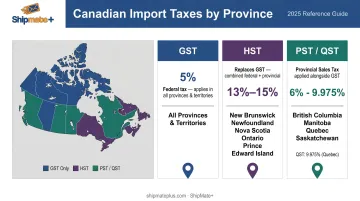
Brokerage fees may apply on top of those taxes. For FedEx International Ground and UPS Standard, customs clearance is typically included — but verify this before shipping. Third-party broker fees can appear on higher-value shipments and won't always show up in the initial rate quote.
Fuel Surcharges and Additional Fees
Both FedEx and UPS adjust fuel surcharges weekly based on national diesel price indexes. Residential delivery fees, address correction fees, and oversized package surcharges can also apply. Check each carrier's current surcharge page before you ship.
Navigating Canadian Customs: Documents, Duties, and Taxes
Missing or inaccurate paperwork is the single most common cause of delays and unexpected costs on Canada-bound shipments. Here's what you need to get right: the required documents, how duties are calculated, and the small habits that keep shipments moving.
Required Customs Documents
Every non-document international shipment needs a Commercial Invoice (CI). No exceptions. The CI must include:
- Accurate item descriptions (specific, not vague)
- Quantities and unit values
- Country of origin
- Total declared value in the shipment currency
For shipments valued over CAD $2,500, additional invoice documentation — including potentially a completed Canada Customs Invoice (Form CI1) — may be required. Review the CBSA's invoice requirements memorandum directly for the latest thresholds.
How Duties and Taxes Are Calculated
Duty rates are determined by:
- The Harmonized System (HS) code for the product
- The product's country of origin
- The declared value converted to Canadian dollars
The CBSA provides an online duty and tax estimator — useful for getting a rough estimate before you ship, though it's designed for personal imports.
Tips to Avoid Customs Delays
- Be specific on descriptions: "clothing" is not sufficient; "men's cotton t-shirts, size L" is
- Declare the true value: undervaluation triggers delays, fines, and potential seizure
- Attach documents to the outside of the package in a clear pouch — not buried inside
- Use electronic submission when the carrier supports it (FedEx and UPS both offer this)
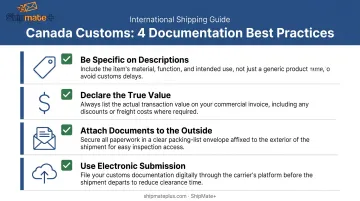
The staff at ShipMate+ assists customers with Commercial Invoices, Pro Forma Invoices, and Electronic Export Information forms before packages leave the store. Catching a documentation error before the package leaves is far easier than correcting it mid-transit.
Items You Cannot Ship to Canada
Shipping a prohibited item to Canada can result in seizure, return, or destruction of the shipment — and the shipper may be held liable for the associated costs.
Common Prohibited Items
These items are generally not accepted for standard parcel shipping to Canada:
- Tobacco products, including gifts — undeclared tobacco is subject to seizure
- Currency, bank notes, and bank bills (explicitly prohibited by carriers like UPS)
- Food, plant, and animal products that haven't been declared to CBSA — many are restricted due to invasive species and disease risks
- Unauthorized copyrighted materials
Always verify against the specific carrier's prohibited items list, as FedEx and UPS each maintain their own:
Restricted Items Requiring Extra Documentation
"Restricted" is different from "prohibited." Restricted items can ship — but only with the right permits, carrier approval, or special handling:
- Perishable food items may require import permits and are subject to CBSA inspection
- Live animals are accepted by some carriers (like UPS) only under prescribed conditions on a contractual basis
- Plants and seeds require declaration and may need supporting import documentation
- Alcohol is generally only shippable through licensed entities with carrier-specific contractual approval
If you're unsure whether your item falls into a restricted category, check with the carrier directly or ask at a staffed shipping center before packing.
Frequently Asked Questions
Can I ship FedEx Ground from the US to Canada?
Yes. FedEx International Ground delivers to all Canadian business and residential addresses with a transit window of 2–7 international business days. Customs clearance is included, and flexible brokerage options are available. Note that this is a separate service from standard FedEx Ground, which is domestic-only.
How much does it cost to ship a package from the US to Canada?
Costs vary based on package weight, dimensions, service level, destination province, and additional charges like duties, taxes, and fuel surcharges. Use each carrier's rate calculator for an accurate estimate. Ground services (FedEx International Ground, UPS Standard) are consistently the most affordable option for non-urgent shipments.
Is Canada considered international for FedEx?
Yes. Despite sharing a land border, Canada is treated as an international destination by FedEx. All shipments require customs documentation and may be subject to duties and taxes.
What documents do I need to ship a package to Canada?
All non-document shipments require a Commercial Invoice with accurate item descriptions, quantities, and declared value — shipments over CAD $2,500 need additional invoice documentation. Your shipping label must also include correct item descriptions on all packages.
How long does ground shipping to Canada take?
FedEx International Ground and UPS Standard both deliver in 2–7 business days depending on the distance between origin and destination. Add time for customs clearance, which is typically quick for properly documented shipments but can vary.
What items are prohibited when shipping to Canada?
Key prohibited items include tobacco products, currency and bank notes, and certain food, plant, and animal products. Always check the carrier's current prohibited and restricted items list before shipping — rules can vary slightly between FedEx and UPS, and Canada's import regulations are updated regularly.