
Introduction
Canada sits right next door, shares a long trade history with the US, and often feels like the logical first international shipment. That familiarity leads most people to assume the process works like domestic shipping — same forms, same rules, just a longer drive.
It doesn't. Despite the proximity, Canada is a fully international destination. Customs documentation is required, duties and taxes may apply, and carrier rules differ entirely from domestic shipping. A package missing the right forms — or with an inaccurate declared value — can sit at the border for days or come back to you entirely.
Here's what you need to know before you hand that package over the counter.
Key Takeaways
- Every package to Canada requires customs forms, regardless of carrier
- USPS is cheapest for packages under 4 lbs; UPS and FedEx suit heavier or time-sensitive shipments
- Canada's de minimis thresholds are $20 CAD (mail) and $150 CAD (courier) before duties and taxes apply
- Prohibited items include alcohol, firearms, and certain agricultural goods
- Multi-carrier centers like ShipMate+ let you compare FedEx, UPS, and USPS rates in a single stop
What You Need Before Shipping to Canada
Proper preparation determines whether a package clears customs in hours or gets held for days. Every piece of documentation must be complete and accurate before the package leaves your hands.
Documentation Requirements
Identify which customs form applies to your shipment:
- USPS packages: Require PS Form 2976 or 2976-B
- FedEx and UPS shipments: Require a commercial invoice, submitted electronically through each carrier's platform
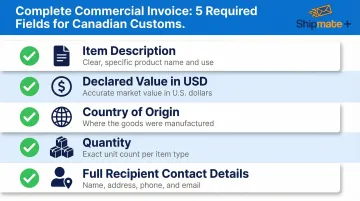
A complete commercial invoice must include:
- Clear item description (not vague terms like "gift" or "merchandise")
- Declared value in USD
- Country of origin
- Quantity
- Recipient's full contact details including province and postal code
For US-manufactured goods, a USMCA Certificate of Origin may qualify the shipment for reduced or eliminated duties. There is no prescribed format — it can appear on an invoice or separate document, as long as it includes the minimum data elements outlined in Annex 5-A.
Importers, exporters, or producers must keep these records for five years.
Packaging Requirements
International shipments go through more handling points than domestic ones. Use a new, rigid box, adequate inner cushioning, and reinforced tape on all seams.
All major carriers use dimensional weight pricing. Measure length, width, and height — then weigh the packed box — before heading to the counter to avoid billing surprises.
Compliance and Carrier Readiness
Verify that your specific items are not on Canada's prohibited or restricted list before packing. This check takes minutes and can prevent a complete loss of postage and contents.
If you're unsure about packaging standards, documentation, or which carrier to use, ShipMate+ in Vista, CA handles packaging, carrier rate comparison, and form completion as an authorized FedEx, UPS, and USPS shipper — all in a single stop.
How to Ship to Canada: Step-by-Step
Step 1: Confirm Your Items Are Admissible
Cross-reference your items against the Canada Border Services Agency (CBSA) admissibility guidelines and each carrier's prohibited item list before doing anything else.
Specific categories require additional permits or special packaging:
- Food products
- Plants
- Electronics with lithium batteries
- Veterinary products
Step 2: Classify Your Items and Declare an Accurate Value
Research the correct Harmonized System (HS) tariff code for your product using the US International Trade Commission's HTS tool. This code is used by Canadian customs to determine the applicable duty rate.
The declared value must reflect the actual transaction value or fair market value. Underdeclaring to minimize duties is a customs violation that can result in package seizure, fines, or a return-to-sender outcome.
Step 3: Complete Your Customs Documentation
Fill out all required customs forms completely before arriving at the carrier. Missing fields such as the HS code, item description, or country of origin are the leading cause of customs clearance holds.
For FedEx and UPS commercial shipments, submit the commercial invoice electronically through:
Electronic submission cuts paper handling and lets customs agents review your documents before the shipment even arrives at the border.
Step 4: Pack, Label, and Attach Documentation
Pack contents securely in an appropriately sized box. Attach the shipping label and any physical customs forms to the outside of the package — never place customs documentation inside the box where customs officers cannot easily access it.
Double-check that the recipient's complete address is included: Canadian postal format includes a province abbreviation and a 6-character postal code. Incomplete addresses are a common cause of failed delivery.
Step 5: Compare Rates, Pay, and Drop Off
Before committing to a carrier, compare rates by:
- Weight — heavier packages shift price rankings between carriers quickly
- Destination province — remote areas carry surcharges that urban rates don't
- Delivery speed — express vs. economy pricing gaps vary widely by carrier
A 5 lb package to Toronto will have noticeably different pricing across USPS, UPS, and FedEx.
Drop off at an authorized shipping center where staff can verify your forms are complete and catch documentation gaps before the package ships.
ShipMate+ in Vista, CA operates as an authorized shipper for all three carriers, allowing customers to compare services and complete drop-offs in a single visit. Daily carrier pickups are scheduled at 11:00 AM for USPS and 4:30 PM for FedEx and UPS (12:00 PM Saturday).
Choosing the Right Carrier for Shipping to Canada
No single carrier is the best choice for every Canada shipment. The right option depends on package weight, budget, destination, and how quickly the package needs to arrive.
USPS
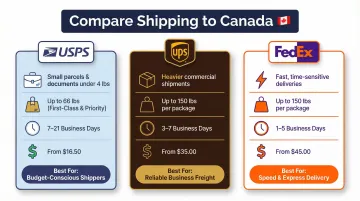
USPS is the most cost-effective option for packages under 4 lbs. First-Class Package International Service and Priority Mail International offer accessible entry-level pricing, though USPS hands delivery off to Canada Post at the border, which limits tracking visibility.
Pricing and transit times:
- First-Class Package International Service: Starts at $19.40
- Priority Mail International: Starts at $32.65, 6–10 business days
Best for non-urgent, lightweight shipments where cost matters most.
UPS
UPS Standard to Canada is a strong ground option for packages up to 70 lbs, with 2–7 business day door-to-door delivery and no mid-journey carrier handoff — a meaningful advantage for tracking and liability.
For urgent shipments:
- UPS Worldwide Expedited: 2–5 days with money-back guarantee
- UPS Worldwide Express: Next business day to major cities with money-back guarantee
FedEx
FedEx International Ground provides day-definite delivery and competes closely with UPS Standard on pricing. FedEx covers 100% of Canadian addresses, including rural destinations that can be harder to reach.
Service options:
- FedEx International Ground: 2–7 business days, day-definite delivery
- FedEx International Priority: 1–3 business days for time-sensitive shipments
Not sure which carrier fits your shipment? ShipMate+ is an authorized shipper for FedEx, UPS, and USPS — you can compare rates and drop off with any of them at one location in Vista, CA.
Understanding Canadian Customs: Duties, Taxes, and Prohibited Items
Canada applies a 5% federal Goods and Services Tax (GST) to most imported goods, with additional provincial taxes (HST or PST) varying by destination province. Both affect the total landed cost a recipient will pay.
Provincial Tax Rates
| Province/Territory | Tax Type | Total Tax Rate |
|---|---|---|
| Alberta, Northwest Territories, Nunavut, Yukon | GST | 5% |
| British Columbia | GST + PST | 12% (5% + 7%) |
| Manitoba | GST + PST | 12% (5% + 7%) |
| Saskatchewan | GST + PST | 11% (5% + 6%) |
| Quebec | GST + QST | 14.975% (5% + 9.975%) |
| Ontario | HST | 13% |
| Nova Scotia | HST | 14% |
| New Brunswick, Newfoundland & Labrador, PEI | HST | 15% |
De Minimis Thresholds
Under USMCA, courier shipments from the US are duty-free up to $150 CAD (taxes still apply on amounts above $40 CAD). Mail shipments lose both duty and tax exemption above $20 CAD — a $20 CAD threshold that catches many casual shippers off guard. Canada Post also tacks on a $9.95 CAD handling fee whenever it collects duties and taxes on USPS-delivered mail, adding to the recipient's total.
Prohibited Items
Key prohibited items include:
- Alcohol
- Firearms and ammunition
- Counterfeit goods
- Non-refillable lighters
- Certain vaping products
- Radioactive materials
- Prison-made goods
Restricted items requiring permits or certificates include:
- Meat and poultry
- Eggs for hatching
- Veterinary biological products
- Certain drugs and medicines
- Plants and seeds
Check the CBSA prohibited and restricted goods list before shipping — rules change, and your carrier can flag items that may be held at the border.
Common Mistakes When Shipping to Canada
Incomplete or Inaccurate Customs Declarations
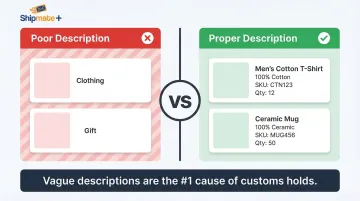
Describing items vaguely instead of providing specific descriptions with HS codes and accurate values is the most common reason packages are held at the border.
Poor description: "Clothing" or "Gift"
Proper description: "Men's cotton polo shirt, 100% cotton, SKU 12345, qty 1" or "Aluminum bicycle handlebar, 31.8mm dia, qty 1"
Choosing the Wrong Carrier for the Package Weight or Urgency
USPS is not cost-effective above 4 lbs, and using an express service for a non-urgent shipment wastes money. Match carrier selection to package weight and timeline to avoid both overpaying and underdelivering.
Ignoring the Total Landed Cost
Beyond carrier selection, the final cost your recipient pays is often the biggest surprise in cross-border shipping. Failing to account for Canadian GST/HST, provincial taxes, and carrier brokerage fees catches many shippers off guard — and sometimes their recipients even more so.
DDU (Delivered Duty Unpaid): Recipient pays duties at delivery
DDP (Delivered Duty Paid): Shipper prepays all duties upfront
DDP creates a smoother experience for recipients. Note: If a recipient refuses a DDU shipment, carriers like UPS can recover those unpaid charges from the original shipper.
Frequently Asked Questions
How much does it cost to ship to Canada?
Costs vary by carrier, package weight, and service level. USPS starts under $20 USD for small parcels, while UPS and FedEx typically start from $35+ for a 5 lb package to Toronto. Fuel surcharges and remote area fees may apply on top of base rates.
What is required to ship from the US to Canada?
A completed customs declaration form (PS Form 2976 for USPS or a commercial invoice for FedEx/UPS), accurate declared value, HS code for commercial shipments, and full recipient address including province and postal code are required.
How do duties and taxes work?
Canada levies federal GST (5%) plus applicable provincial taxes on most imports. USMCA courier thresholds allow duty-free entry up to $150 CAD, while mail shipments lose duty and tax exemption above $20 CAD.
Can the US still ship to Canada?
Yes. US-to-Canada shipping continues normally through all major carriers. Parcel and package services remain fully operational, and no cross-border shipping suspensions are in effect.
What am I not allowed to bring into Canada?
Common prohibited categories include:
- Alcohol and tobacco
- Firearms and ammunition
- Counterfeit goods
- Agricultural and animal products (without proper certification)
- Radioactive materials
- Specific vaping products
Confirm the full list with CBSA before shipping.
What is the customs duty limit in Canada?
Mail shipments are duty- and tax-exempt under $20 CAD. Courier/express shipments from the US are duty-free up to $150 CAD under USMCA (taxes still apply above $40 CAD). Gifts sent by mail from friends or family are exempt up to $60 CAD.