
Introduction
Miss the Live Scan deadline as a notary applicant, and you may have to retake the exam from scratch. For Vista, CA residents working through the notary application process, getting fingerprinted on time isn't optional — it's a legal requirement that determines when your commission gets issued.
Most first-time applicants aren't sure what Live Scan involves, which form to bring, or where to go — and that confusion costs time. California Government Code Section 8201.1 mandates fingerprinting before any commission is granted, so this is one step you can't afford to delay or get wrong.
This guide covers what Live Scan is, what to bring, how much it costs, and where to get it done in Vista.
Key Takeaways
- Live Scan fingerprinting is mandatory for all California notary applicants, and prints must be submitted within one year of passing the state exam
- The process electronically captures and transmits fingerprints to the CA Department of Justice and FBI for criminal background checks
- Applicants need the Secretary of State-specific "Request for Live Scan Service" form, valid photo ID, and payment
- Clean background checks typically process in 48–72 hours, but name checks can take up to four weeks
- Your notary commission will not be issued until both DOJ and FBI background checks clear
What Is Live Scan and Why Is It Required for California Notary Applicants?
Live Scan is an inkless, electronic fingerprinting system used in California that digitally captures all ten fingerprints and transmits them directly to the CA Department of Justice and the FBI for criminal background verification. This method replaced the older ink-and-paper system, providing faster and more reliable results.
Legal Requirement for Notary Applicants
California Government Code Section 8201.1 mandates that all notary public applicants be fingerprinted before a commission is granted. The Secretary of State uses the background check to verify applicants meet the fitness standards required to hold the position. This includes determining whether the applicant has been convicted of any disqualifying crimes.
The statute requires:
- Fingerprint images and related information submitted to the DOJ for state criminal records
- DOJ forwarding of fingerprints to the FBI for federal conviction/arrest records
- DOJ compilation and transmission of results back to the Secretary of State
- Subsequent arrest notification service for each commissioned notary
Critical One-Year Deadline
Fingerprints must be submitted within one year of the notary exam date. Failing to meet this deadline means the applicant must retest. Miss it, and you're back to square one. The California Secretary of State sends reminder letters at four, eight, and twelve months from the exam date — but don't wait for a nudge. Schedule your Live Scan as soon as you pass the exam.
Live Scan vs. Traditional Ink Fingerprinting
While ink (FD-258) cards are used for some out-of-state or federal purposes, the California Secretary of State accepts only electronic Live Scan submissions for notary commission applications. That makes Live Scan the only valid method for this application. Compared to ink cards, the electronic system offers clear advantages:
- Faster transmission directly to the DOJ and FBI
- Higher print quality with fewer rejected submissions
- Immediate confirmation of receipt upon submission
- No risk of smearing or degraded prints during transit
What You Need Before Your Live Scan Appointment
The Request for Live Scan Service Form
The required form is the "Request for Live Scan Service" (form SOS/BCII 8016) specific to the California Secretary of State. This form contains the ORI number (A0084) — the unique identifier for the Secretary of State's office — and the Applicant Type.
Important details:
- The notary-specific version is available on the CA Secretary of State's website as a fillable PDF
- Complete the Applicant Information section (name, date of birth, address) before arriving
- The form is pre-filled with agency information including code section "8201.1 GC" and job title "NOTARY PUBLIC"
- Live Scan operators cannot legally provide this form — you must bring the SOS-specific version
What to Bring to Your Appointment
Required items:
- Completed Request for Live Scan Service form
- Valid government-issued photo ID: California driver's license, California ID card, U.S. passport, or military ID
- Payment for both government processing fees and the operator's rolling fee
Confirm accepted payment methods before you go. ShipMate+ in Vista accepts both cash and cards, but policies vary by location — a quick call saves you a wasted trip.
Keep Your Proof of Submission
Once your fingerprints are scanned, ask for a copy of your completed form before you leave. Hold onto it until your notary commission arrives — it proves the submission went through if any questions come up later.
A few things worth knowing at this stage:
- No mailing required: the DOJ transmits results to the Secretary of State electronically
- Keep the form somewhere easy to find, not just in your email
How the Live Scan Process Works — Step by Step
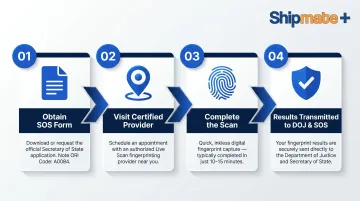
Live Scan is a fast, 10–15 minute procedure from start to finish. All ten fingerprints are digitally captured, transmitted electronically to the DOJ and FBI, and results go directly to the Secretary of State — no follow-up action required on your end.
Step 1: Obtain the Correct Request for Live Scan Service Form
This is the essential first step and a common stumbling block. The Live Scan operator cannot legally provide the form or generate a blank general form for a notary application. You must obtain the Secretary of State-specific version from the CA SOS website.
Fill out your information (name, date of birth, address). The ORI number specific to the SOS (A0084) must already be printed on the form. Using the wrong form means results will be sent to the wrong agency, requiring you to repeat the entire process.
Step 2: Locate a Certified Live Scan Provider
California applicants can find authorized Live Scan locations through the DOJ's online location finder, filtering by county.
For notary applicants in Vista, CA, ShipMate+ (located at 1929 W Vista Way Suite F, Vista, CA 92083) offers Live Scan digital fingerprinting services:
- Monday through Friday: 9:00 AM – 6:00 PM
- Saturday: 9:00 AM – 1:00 PM
- Phone: (760) 295-1074
- Email: info@shipmateplus.com
Walk-ins are welcome, though calling ahead to confirm payment methods and current rolling fees is recommended.
Step 3: Attend the Appointment and Complete the Scan
The process takes 10–15 minutes and requires no ink. Here's what happens:
During the appointment:
- The operator verifies your identity and form completeness
- All ten fingerprints are digitally captured
- You pay the government processing fee and rolling fee
- Print quality may be affected by dry skin, scarring, or age — operators may retry certain fingers
- You receive an ATI (Applicant Transaction Identifier) number for tracking
Step 4: Results Are Transmitted and Reviewed
Results are transmitted electronically by the DOJ to the CA Secretary of State. Processing timelines vary:
No criminal history match: Results typically process within 48–72 hours after receipt by the DOJ.
Criminal history match found: A DOJ technician must manually review the RAP sheet (record of arrest and prosecution), which takes an unpredictable amount of time.
Name-check processing: This component runs separately from fingerprint matching and can take up to four weeks.
Applicants can check background check status at applicantstatus.doj.ca.gov using their ATI number and date of birth.
Fees and Processing Times for Live Scan Fingerprinting
Two-Part Cost Structure
Live Scan involves two separate fees collected at the time of your appointment:
1. Government Processing Fee
According to the official CA DOJ fee schedule, the current government processing fees are:
- $32 DOJ (state) processing fee
- $17 FBI (federal) processing fee
- Total government processing fee: $49
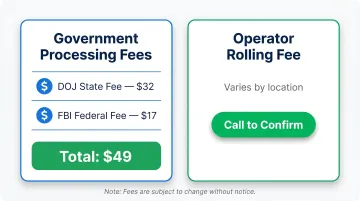
These fees are subject to change, so verify current amounts with your Live Scan provider.
2. Operator's Rolling Fee
The rolling fee (also called a service fee) varies by location. This fee is charged directly by the Live Scan operator for conducting the scan. Contact your chosen Live Scan site to confirm the rolling fee amount and accepted payment methods.
Processing Timeline
| Scenario | Estimated Timeframe |
|---|---|
| No fingerprint match found | 48–72 hours (CA DOJ) |
| Criminal history match (manual review) | Indeterminate; no status updates until complete |
| Name check through DOJ | Up to approximately 4 weeks (SOS FAQ) |
Commission Issuance Contingent on Clearance
The CA Secretary of State will not issue a notary public commission until reports from both the DOJ and FBI confirm no disqualifying criminal history. If criminal history is identified, the commission is held pending review.
Given these timelines, scheduling Live Scan as early as possible after passing the exam is the safest approach — especially for applicants renewing their commission or working against a deadline.
Common Issues and Mistakes to Avoid
Arriving Without the Correct Form
The most common error is arriving without the Secretary of State-specific "Request for Live Scan Service" form with the correct ORI number (A0084) pre-filled. Using a blank form or a form meant for a different agency will result in results being sent to the wrong entity, requiring the process to be repeated.
Download the correct form before your appointment and complete the applicant information section.
Waiting Too Long After Passing the Exam
Many applicants assume they have plenty of time, but the one-year fingerprint deadline is firm. If fingerprints are not submitted within 12 months of the exam date, the applicant forfeits exam results and must retest.
Schedule your Live Scan appointment as soon as exam results arrive — don't let the deadline sneak up on you.
Misunderstanding Criminal Background Check Impact
Some applicants believe any prior criminal record automatically disqualifies them from becoming a notary. The Secretary of State evaluates each case based on the nature and circumstances of the offense — not a blanket rule.
Common disqualifying offenses include:
- Forgery, embezzlement, and tax evasion
- Assault, theft, and drug sales
- Most misdemeanors within five years of completing probation
- Felonies within ten years of completing probation
Applicants with prior records should still proceed with the Live Scan and allow the review process to determine eligibility. You have the right to appeal a recommended denial through an administrative hearing.
Frequently Asked Questions
How do I check my DOJ Live Scan results?
Applicants can check the status of their background check online at applicantstatus.doj.ca.gov using their ATI number and date of birth. The DOJ cannot answer inquiries about delayed transactions, so monitor the portal and await communication from the Secretary of State.
What form do I need for a Live Scan as a California notary applicant?
Notary applicants need the "Request for Live Scan Service" form (SOS/BCII 8016), issued by the California Secretary of State. Fill in your applicant information and confirm the ORI number (A0084) before arriving at the Live Scan location.
How much does Live Scan cost for a notary application in California?
The total cost has two components: the government DOJ/FBI processing fee (currently $49 based on the DOJ fee schedule) plus the operator's rolling fee charged by the Live Scan provider. Contact your chosen location to confirm the rolling fee and accepted payment methods.
Do I need to redo Live Scan for every notary commission renewal?
Yes, California notary applicants must submit one set of classifiable fingerprints for each notary public commission term, meaning the Live Scan process must be repeated upon each renewal. It is not a one-time lifetime requirement.
How long does it take to get Live Scan results for a notary background check?
Results are typically processed within 48–72 hours when no criminal history is found. The name-check portion can take up to four weeks, and any criminal history match requires manual review — with no set timeline for completion.
What happens if my Live Scan fingerprints are rejected due to poor quality?
Poor print quality (due to age, dry skin, scarring, or wear) can result in rejected prints. The operator will retry affected fingers on the spot; in rare cases, a second appointment may be needed. If you have concerns about your skin condition, call the Live Scan site before you come in.
Ready to complete your Live Scan fingerprinting for your California notary application? ShipMate+ in Vista, CA offers walk-in service Monday–Saturday, with staff focused on getting your fingerprints captured accurately and your paperwork processed without delay. Call (760) 295-1074 or visit 1929 W Vista Way Suite F, Vista, CA 92083 to get started today.