This guide covers why Vista volunteers need Live Scan, what the process involves, what gets checked, and how to get it done conveniently right here in Vista, CA.
TLDR:
- California AB 506 requires fingerprint-based Live Scan checks for routine volunteers working with minors (16+ hours/month or 32+ hours/year)
- Live Scan submits digital fingerprints to CA DOJ and FBI, checking criminal history and sex offender registries
- Results go directly to your organization within 2–3 business days, not to you
- Each organization requires its own separate Live Scan — results cannot be transferred
- Get it done locally at ShipMate+ in Vista with walk-in or appointment options
Why Volunteers in Vista Need a Live Scan Background Check
California Assembly Bill 506 (AB 506)
California Assembly Bill 506 (AB 506), which took effect January 1, 2022, mandates Live Scan fingerprint-based background checks for administrators, employees, and routine volunteers at youth-serving organizations throughout the state — including Vista. This law applies to churches, schools, daycares, sports leagues, and nonprofits that work with minors.
Who qualifies as a "routine volunteer" under AB 506?
You're subject to the requirement if you meet all three criteria:
- 18 years of age or older
- Direct contact with or supervision of children
- More than 16 hours per month OR 32 hours per year of service
If you're helping occasionally at a fundraiser or attending a single event, you likely won't trigger the threshold. But if you're a regular soccer coach, Sunday school teacher, or tutoring volunteer, AB 506 applies to you.
AB 506 isn't the only reason Vista volunteers get fingerprinted. Many organizations serving vulnerable adults — or operating within school districts — require Live Scan regardless of whether children are involved. Common examples include:
- Libraries and reading programs
- Senior centers and elder care organizations
- Community health and wellness programs
Each has its own fingerprinting policy, which can extend the requirement well beyond AB 506's youth-specific focus.
Why Fingerprint-Based Checks Are More Reliable
Fingerprints are unique identifiers that surface criminal records regardless of name changes, aliases, or identity fraud. A name-based background check might miss records if someone has used different names or has a common name that creates false matches. Live Scan eliminates these gaps — which is why California law mandates it for any role involving direct access to vulnerable populations.
The Non-Transferability Rule
Your Live Scan results cannot be shared between organizations. Each organization receives its own results directly from the California Department of Justice (DOJ) under strict confidentiality rules outlined in Penal Code 11105.3(g). This means if you volunteer at both your child's school and your church youth group, you'll need to complete separate Live Scans for each organization — even if both are checking the same databases.
What a Live Scan Background Check Actually Looks For
Databases Searched
Live Scan submits your digitized fingerprints to both the California Department of Justice (DOJ) and the FBI's national database. The CA DOJ searches statewide criminal records, while the FBI component surfaces federal records and information reported by other states.
What Gets Checked
The check returns three main categories of information:
- Arrests, convictions, and case dispositions from criminal history records
- Sex offender registry status across California and national databases
- Identity confirmation against existing government fingerprint records
For AB 506 compliance, the primary focus is identifying individuals with a history of child abuse or related offenses. Any disqualifying record surfaces before a volunteer is placed with minors.
What Live Scan Does NOT Cover
Without the FBI add-on, Live Scan pulls California-based data only. If you lived in another state and were arrested there, that record may not appear on a CA DOJ-only check — which is why federal processing matters.
Some organizations pair Live Scan with commercial tools to close coverage gaps:
- AYSO requires both Live Scan and a separate Sterling Volunteers check for fuller nationwide coverage
- Other youth-serving groups may use similar layered screening depending on their liability standards
Confidentiality and Results
Results go directly to the requesting organization — not to you. To get a copy for yourself, you'd need to submit a separate request through the DOJ's Record Review process. Organizations cannot legally share your results with other groups, which is why each volunteer placement typically requires its own scan.
How the Live Scan Process Works: Step by Step
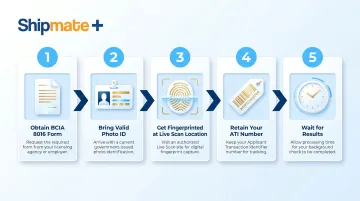
Step 1 — Obtain the Request for Live Scan Service Form
The requesting organization (your nonprofit, school, or employer) provides you with a BCIA 8016 form. This form contains critical information including:
- The agency's ORI number (unique identifier assigned by the DOJ)
- Mailing address and mail code for results delivery
- Your personal information and working title
Don't show up without this completed form: operators cannot process your fingerprints without it.
Step 2 — Bring Valid Government-Issued Photo ID
Your identification must be:
- Current and unexpired (expired IDs are not accepted)
- Government-issued with photo
- Matching the exact legal name on your form
Accepted IDs include:
- California driver's license or state ID
- U.S. passport or passport card
- Military ID
Step 3 — Get Fingerprinted at a Live Scan Location
The operator captures all ten fingerprints electronically using inkless digital scanning technology. The prints transmit directly to the DOJ (and FBI if required) in real time — the whole appointment takes 10–15 minutes.
Digital scanning is far more reliable than the old ink-on-paper method, reducing errors and giving agencies clean, readable prints.
Step 4 — Retain Your ATI Number
After the scan, the operator writes an ATI (Applicant Transaction Identifier) number on your form. Photograph it or store the form somewhere safe. Both you and your organization can use it to track submission status through the DOJ's online portal at applicantstatus.doj.ca.gov.
Step 5 — Wait for Results to Reach the Organization
The DOJ sends results electronically to the requesting agency, not to you. Typical turnaround is 2–3 business days for clear results. If your fingerprints match records requiring manual review, processing takes longer. Federal (FBI) checks can add additional time.
Once the agency receives your clearance, they'll contact you with next steps to start volunteering.
Live Scan vs. Standard Background Check: What's the Difference?
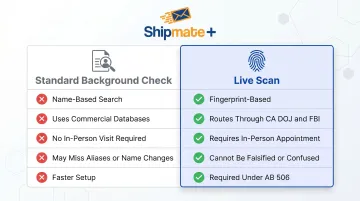
Standard (Name-Based) Background Check
A standard background check searches commercial databases, county court records, and sex offender registries using personal identifiers like name, date of birth, and Social Security number. It's faster to set up and doesn't require in-person fingerprinting, but it can miss records tied to aliases, name changes, or common names.
Live Scan (Fingerprint-Based) Check
Live Scan routes through official government repositories: the CA DOJ and FBI fingerprint databases. It's the method required under AB 506 precisely because of its higher accuracy standard. Fingerprints cannot be faked, changed, or confused with someone else's identity.
Some Organizations Require Both
AYSO in California requires both — an AB 506 Live Scan and a separate Sterling Volunteers background check. Live Scan covers California DOJ and FBI criminal records, while Sterling adds Enhanced Nationwide Search, 50-state sex offender registries, and federal watch lists. Check directly with your organization before scheduling — some Vista nonprofits and youth programs require both, and missing one can push your start date back by weeks.
What to Expect: Costs, Timing, and What to Bring
Costs
Live Scan fees are split into two components:
- Fingerprint rolling fee - Charged by the Live Scan service provider (varies by location, typically $20–$45 in San Diego County)
- DOJ/FBI processing fees - Set by the state
According to the CA DOJ fee schedule:
- Nonprofit youth organization volunteers: $0 (DOJ) + $15 (FBI) = $15 total processing fee
- For-profit youth organization volunteers: $32 (DOJ) + $15 (FBI) = $47 total processing fee
Your total cost is the rolling fee plus the applicable DOJ/FBI processing fees. Some organizations reimburse volunteers or set up billing accounts with the DOJ so volunteers pay nothing out of pocket. Check with your organization before your appointment.
Turnaround Time
- Fingerprinting appointment: 10–15 minutes
- DOJ results (no match): 2–3 business days
- Results requiring manual review: Indeterminate timeline
- Results sent by U.S. mail: Minimum 7 days
Schedule your fingerprinting at least two weeks before your volunteer start date to avoid delays.
Bring-With-You Checklist
- ✅ Completed Request for Live Scan Service form (provided by your organization)
- ✅ Valid government-issued photo ID (unexpired)
- ✅ Payment method accepted by the location (confirm in advance — most accept cash and card)
Some locations accept walk-ins; others require appointments. ShipMate+ in Vista offers Live Scan fingerprinting — call ahead at (760) 295-1074 to confirm availability and scheduling.
Where to Get Your Live Scan Done in Vista, CA
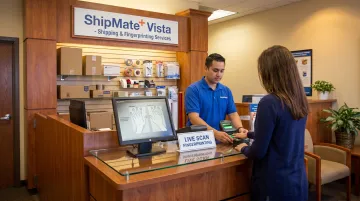
ShipMate+ (1929 W Vista Way Suite F, Vista, CA 92083) offers Live Scan digital fingerprinting services locally in Vista — no need to travel to Oceanside or San Marcos.
Why choose ShipMate+ for your Live Scan?
- Convenient hours: Monday–Friday 9AM–6PM, Saturday 9AM–1PM
- Walk-in and appointment options: Flexibility to fit your schedule
- First-timer friendly: Staff walk you through the required form and process so nothing gets missed
- Additional services on-site: Notary services, passport photos, and document handling available during the same visit
To schedule or confirm availability, call (760) 295-1074 or visit in person. The team can answer questions about accepted payment methods, current fees, and appointment availability.
If you need alternative options, you can locate additional authorized Live Scan sites through the CA DOJ's public site locator. Most Vista residents find that a local provider saves significant time compared to government office wait times.
Frequently Asked Questions
Do volunteers get background checks?
Yes, many volunteer roles in California now require background checks. For youth-serving organizations, California AB 506 specifically mandates fingerprint-based Live Scan background checks for routine volunteers who have direct contact with minors for more than 16 hours/month or 32 hours/year.
What shows up on a Live Scan background check in California?
Live Scan checks return criminal history records (arrests and convictions), sex offender registry status, and identity verification. Results are pulled from the California DOJ and, when the FBI component is included, from federal databases and other states as well.
How long does a Live Scan background check take?
The fingerprinting appointment itself takes under 15 minutes. Results are typically returned to the requesting organization within 2–3 business days for clear records, though federal processing or manual review cases may take longer.
What is the difference between a background check and a Live Scan?
A standard background check is name-based and searches commercial records databases. Live Scan is fingerprint-based and runs through official government repositories (CA DOJ/FBI), making it more accurate and harder to falsify. It's the method required under California law for youth-serving volunteers.
Do I need a new Live Scan for every organization I volunteer with?
Yes, Live Scan results are not transferable between organizations. Each organization must receive its own results directly from the CA DOJ due to confidentiality requirements under Penal Code 11105.3.