Introduction
Every year, an estimated 7.1 million Americans relocate to a different state, and many more move within their current region. While roughly 22% of interstate movers hire professional moving companies, the remaining 78% handle it themselves — often underestimating the planning, physical effort, and local rules involved.
For Encinitas residents, renting a moving truck comes with a specific set of challenges. The coastal community features narrow streets through historic Leucadia and near beach parking areas, strict residential parking restrictions, and demand spikes during the busy summer moving season.
First-time DIY movers often overlook details like weight distribution, insurance coverage, and local parking ordinances. Catching these gaps early is the difference between a smooth move and a costly, stressful one.
These six practical tips will help you avoid the most common rental pitfalls and navigate your Encinitas move safely and efficiently.
Key Takeaways
- Book 3–4 weeks ahead, especially May–August when North County demand peaks
- Match truck size to your square footage (15–17 ft for most 2-bedroom homes)
- Check the fine print — mileage caps, fuel policies, and damage waivers vary widely
- Load heavy items first over the axle; use tie-downs on coastal and hilly routes
- Overnight street parking for trucks over 10,000 lbs is prohibited in Encinitas residential zones
- Return clean, on time, with a full tank to avoid surprise fees
Before You Book: Planning Tips for Your Encinitas Move
Tip 1: Book Early and Choose the Right Truck Size
Reserve your truck early. Peak moving season runs late May through early August, when rental costs climb 20–30% due to demand. Encinitas and the broader San Diego North County area see heavy competition for available trucks on summer weekends and month-end dates. Book 3–4 weeks in advance to lock in better availability and pricing.
Match truck size to your actual needs. Choosing the wrong size wastes money or forces you into multiple trips:
- Cargo van or 10-ft truck: Studio or 1-bedroom apartments
- 15–17-ft truck: 2–3 bedroom homes (most common for Encinitas residents)
- 20–26-ft truck: 3+ bedroom homes or large furniture inventories
Encinitas streets near the coast—especially in Leucadia and Cardiff—are narrow with on-street parking on both sides. Avoid the largest trucks (26 ft) unless your inventory truly requires it. Maneuvering a 26-footer down Coast Highway 101 or into tight residential driveways increases difficulty and risk considerably.
Check rental location proximity. Major providers near Encinitas include:
- U-Haul Moving & Storage of Carlsbad (6175 Paseo Del Norte, Carlsbad)
- Penske at Home Depot #660 (1001 N El Camino Real, Encinitas)
- Budget Truck of Vista (1859 W Vista Way, Vista)
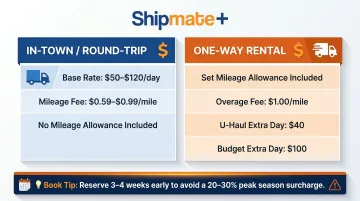
One-way vs. round-trip pricing matters. In-town rentals typically cost $50–120 plus per-mile fees (approximately $0.59–0.99 per mile). One-way rentals include a mileage allowance but charge overage fees—$1.00 per additional mile and $40 per extra day for U-Haul; $100 per day and $1.00 per mile for Budget. If you're moving within Encinitas or to nearby Carlsbad or Solana Beach, calculate your expected mileage upfront to avoid costly surprises.
Tip 2: Compare Rental Companies and Read the Rental Agreement Carefully
Don't just compare base rates. The advertised daily rate is only part of the total cost. Compare:
- Mileage fees vary by move type — U-Haul charges per mile for local moves; one-way rentals include a set allowance
- Fuel policies — most companies require a full tank on return. Budget charges in 1/8th tank increments if you don't refuel; Penske and U-Haul add service fees plus per-gallon costs
- Weekend surcharges apply Friday–Sunday; Tuesday–Thursday pickups typically cost less
Watch for hidden contract terms. The most commonly overlooked clauses include:
- Most credit cards do NOT cover moving trucks — Visa excludes trucks seating more than eight; American Express excludes cargo vans and box trucks entirely
- Overhead damage is often excluded — Budget's standard LDW does not cover hitting bridges or low-hanging objects; a separate Physical Damage Waiver (PDW) is required
- Accessories like dollies and furniture pads often cost extra ($7–12 per item at U-Haul) — confirm what's included before pickup
Verify your insurance coverage before declining supplemental protection. Personal auto policies usually exclude rental trucks because they exceed standard weight limits. According to Bankrate, contact your auto insurer and credit card issuer before deciding on the rental company's damage waiver.
If you decline coverage, you're financially responsible for all damage, vandalism, and repair-related costs.
On Moving Day: Loading and Driving the Truck Safely
Tip 3: Pack and Load the Truck Strategically
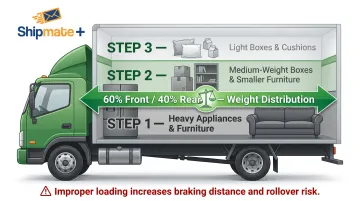
Proper weight distribution is critical for safe handling. U-Haul recommends a 60/40 split — 60% of weight toward the front of the axle, 40% toward the rear. Improper loading shifts the truck's center of gravity, increasing braking distance and rollover risk on coastal roads and hilly terrain.
Follow this loading sequence:
- Heavy appliances and furniture against the cab wall
- Medium-weight items (boxes, smaller furniture) in the middle
- Light boxes and cushions on top
Most rental companies offer furniture pads for $5–7 per half-dozen. For electronics, artwork, or anything breakable, professional packing materials are worth the extra step. ShipMate+ in nearby Vista (1929 W Vista Way Suite F) carries over 20 box sizes along with bubble wrap, packing peanuts, and heavy-duty tape at discounted prices — good to stock up before loading day.
Use tie-down straps or rope anchors along the truck's interior walls to prevent shifting on turns along Coast Highway 101 or the winding stretches of Olivenhain Road. Leave pathways clear for safe unloading at your destination.
Tip 4: Drive Safely in an Unfamiliar Large Vehicle
Once the truck is loaded, the next challenge is getting it there safely. Moving trucks handle nothing like a car — the FMCSA notes that large trucks can require up to two football fields to stop, and blind spots extend well beyond what you're used to. Before hitting the road, do a slow lap around an empty parking lot to get a feel for turning radius, braking, and mirror visibility.
Anticipate Encinitas-specific driving challenges:
- Coast Highway 101 through Leucadia: A two-lane road with narrow lanes, frequent on-street parking, and pedestrian crossings. Stay alert and drive slowly.
- I-5 merges near Birmingham Drive: These high-traffic interchanges require extra caution when merging in a heavy, slower-accelerating truck.
- Olivenhain Road: Winding and hilly with limited shoulders. Maintain lower speeds and avoid sudden lane changes.
Practice defensive driving:
- Scan ahead 15 seconds (about a quarter mile on highways)
- Check mirrors every 8–10 seconds to monitor blind spots
- Maintain greater following distance than you would in a car
- Avoid lane changes unless absolutely necessary
- Use a spotter outside the truck when parking or backing up
Navigating Encinitas Rules and Returning Your Truck Without Surprises
Tip 5: Know Local Parking and Road Restrictions in Encinitas
Encinitas has specific rules for large vehicles that can catch movers off guard. Before you hit the road, understand these restrictions:
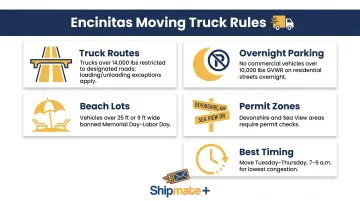
- Truck routes: The city prohibits trucks over 14,000 lbs on non-designated routes. Designated routes include El Camino Real, Encinitas Boulevard, Highway 101, La Costa Avenue, and Olivenhain Road. Municipal Code Section 14.33.030 allows an exception for local deliveries — you can use restricted streets while actively loading or unloading at your residence.
- Overnight parking: Encinitas Municipal Code Section 14.35.030 prohibits parking commercial vehicles with a GVWR of 10,000 lbs or more on residential streets. A fully loaded 20-ft or 26-ft truck typically exceeds this threshold. Park on the street only while actively loading; otherwise move the truck to private property overnight.
- Beach parking lots: From the Friday before Memorial Day through Labor Day, vehicles over 25 feet long or 9 feet wide are banned from beach parking lots at Moonlight Beach, Swami's, Beacon's, and Cardiff State Beach.
- Permit parking zones: Areas like Devonshire and Sea View have residential permit restrictions. Check the City of Encinitas website or call Public Works before moving day.
- Timing: Early weekday mornings (7–9 a.m., Tuesday–Thursday) reduce congestion and make maneuvering easier in tight neighborhoods.
Tip 6: Return the Truck on Time and in Good Condition
A clean, on-time return avoids surprise charges that can add hundreds of dollars to your total moving cost. Here's what to watch:
- Return on time: Budget charges 100% of the daily rate for each late day on local rentals, plus 100% of protection product costs. One-way rentals incur $100 per day plus $1.00 per mile. U-Haul charges $40 per additional day and $1.00 per mile. Even a few hours late can trigger a full-day charge.
- Refuel before drop-off: Most companies measure fuel in 1/8th tank increments and add service fees plus inflated per-gallon costs if you return short. Fill up at the station nearest the return location immediately before drop-off.
- Sweep the interior: Budget assesses a $25+ cleaning fee for dirty returns. Remove packing materials, sweep out debris, and wipe down surfaces.
- Document damage at pickup and return: Consumer Reports recommends photographing or video recording all pre-existing damage before you drive off the lot. Walk the truck, capture close-ups of dents, scratches, and tires, and have the rental agent note existing damage on your contract.
- Return all accessories: Unreturned dollies, furniture pads, or GPS units can cost $25–$499 in replacement fees.
Once the truck is back, update your mailing address right away. If mail is still arriving at your old Encinitas address during the transition, ShipMate+ in Vista offers mailbox rental with a real street address and mail forwarding — so nothing gets lost in the shuffle.
Common Moving Truck Rental Mistakes to Avoid
Three mistakes consistently trip up Encinitas renters before the first box even hits the truck:
1. Underestimating time. Loading and unloading almost always takes twice as long as people expect. Build in a 2-hour buffer beyond your estimates — especially for multi-story homes in the Encinitas hills. If you reserved the truck for 8 hours but the move takes 10, late fees add up fast.
2. Skipping the pre-rental inspection. Photograph every dent, scratch, and scuff before driving off the lot. Failing to document existing damage is the leading cause of disputed charges. Per U-Haul's damage policy, you're responsible for all damage — including vandalism — if you decline coverage. Do the same walkthrough at return.
3. Ignoring the full cost of mileage. Low daily rates often come with strict mileage caps and steep per-mile overages. If you're moving within Encinitas or to nearby Carlsbad or Solana Beach, calculate your expected mileage before booking. A 15-mile round trip with errands can easily hit 30–40 miles. Always compare total cost — base rate, mileage, and fuel — not just the headline price.
Frequently Asked Questions
Frequently Asked Questions
How far in advance should I book a moving truck in Encinitas?
Book at least 3–4 weeks ahead for summer moves (May–August). Last-minute bookings during peak season often result in limited size availability or higher prices from Carlsbad and Solana Beach locations.
What size moving truck do I need for a 2-bedroom home in Encinitas?
A 15–17-ft truck works for most 2-bedroom homes. The right size depends on furniture volume and whether a second trip is feasible given round-trip mileage costs.
What's the cheapest day to rent a moving truck?
Yes. U-Haul confirms that Tuesday–Thursday rentals are cheaper than weekends, and mid-month dates reduce competition and pricing pressure compared to month-end.
Do I need special insurance to rent a moving truck in California?
Personal auto insurance usually doesn't cover rental trucks due to weight limits. Verify with your insurer and credit card provider before accepting the rental company's damage waiver.
Can I park a rental moving truck on Encinitas streets overnight?
Encinitas restricts overnight parking of vehicles with GVWR over 10,000 lbs in residential zones. Check local ordinances or contact the City before leaving the truck on a public street after hours.
What should I do if my rental truck breaks down during a move in Encinitas?
Use the rental company's 24/7 roadside assistance number (found in your rental agreement) and stay safely off the road. Most major companies provide roadside support at no extra charge.