
Weight limits, dimensional weight, and carrier-specific fees mean the "right" way to ship something heavy depends heavily on what you're sending, where it's going, and which carrier you choose. This guide explains carrier weight limits, the exact steps to ship a heavy item, the key cost factors to understand, and the mistakes to avoid so your package arrives safely without surprise fees.
Key Takeaways
- USPS accepts packages up to 70 lbs; UPS and FedEx accept up to 150 lbs for parcel service
- Carriers charge based on actual weight OR dimensional (DIM) weight — whichever is greater
- Packages over 70 lbs need an "Over 70 lbs" label and a double-wall box to meet carrier requirements
- Shipping zones affect cost dramatically: cross-country shipments cost 3-4× more than local
- Freight shipping becomes the practical option once a package exceeds 150 lbs or standard parcel limits
Weight Limits by Carrier: What You Need to Know Before You Ship
Every major carrier has hard weight limits, and exceeding them can mean more than a higher bill: refusal, freight reclassification, or surcharges applied after pickup.
USPS Weight Limits
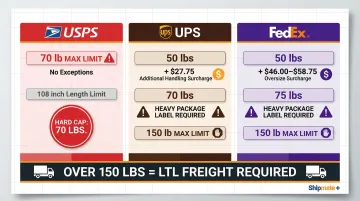
USPS has a hard cap of 70 lbs per package with no exceptions. Flat-rate boxes let you ship dense items at a fixed price up to that limit — one of the better value options for compact, heavy shipments on short to medium routes.
Size limits also apply: packages can't exceed 108 inches in length or 130 inches in combined length and girth. Go over either measurement and the package gets refused or returned.
UPS and FedEx Weight Limits
Both UPS and FedEx accept packages up to 150 lbs via their ground services. Packages over 70 lbs require a visible "Heavy Package" label showing the actual weight:
- UPS: Bright yellow sticker placed to the right of the address label
- FedEx: Yellow and black safety labels over diagonal corners (required above 75 lbs)
This label is a carrier requirement, not a suggestion. Packages over 150 lbs must move to freight services (UPS Freight/FedEx Freight), which involve different pricing structures, pallet requirements, and longer transit timelines.
Both carriers also apply additional handling fees for packages exceeding 50 lbs:
- UPS: $27.75 flat fee (all zones)
- FedEx: $46.00 (Zone 2) to $58.75 (Zone 7+)
When a Package Becomes "Freight"
The 150 lb threshold is the dividing line between parcel and freight shipping. Above it, items typically move via LTL (Less-Than-Truckload) freight — palletized, and often requiring liftgate service for residential delivery. Pricing shifts to per hundredweight (CWT) rather than per package, which reduces the per-pound cost for heavy shipments but adds handling complexity and longer transit times.
How to Ship a Heavy Item: Step-by-Step
Step 1: Weigh and Measure Your Package
You need both the actual weight and the dimensions (length × width × height) before choosing a carrier or calculating cost. Carriers bill based on whichever is greater — actual weight or dimensional weight.
- Use a reliable scale for weight
- Measure all three dimensions with a tape measure
- Round up to the nearest inch and pound to avoid billing discrepancies
As of August 2025, carriers round every fractional inch up to the next whole inch before calculating DIM weight, so a box measuring 23.1" × 15.2" × 10.3" is billed as 24" × 16" × 11".
Step 2: Pack the Item Correctly for Its Weight
Use a new, double-walled corrugated box rated for the item's weight. Check the Box Maker's Certificate on the bottom flap to verify the box can support your item's weight.
Packaging requirements for heavy shipments:
- Wrap contents securely in dense cushioning (foam or bubble wrap — not packing peanuts, which compress under heavy loads)
- Seal all seams with reinforced tape applied in three strips across both top and bottom (H-taping method)
- Ensure at least 2 inches of cushioning on all sides for fragile items
For irregularly shaped or especially fragile items, professional packing services help ensure the package meets carrier standards and reduces the risk of damage claims or refusal at drop-off.
Step 3: Choose Your Carrier and Compare Rates
Decision logic:
- Under 70 lbs, short distance: Check USPS flat rate first
- 70–150 lbs: UPS or FedEx Ground is typically the best option
- Over 150 lbs: Freight is required
Rates vary significantly by destination zone, so comparing quotes across carriers before committing is essential. ShipMate+ in Vista, CA compares UPS, FedEx, and USPS rates side-by-side — and as an authorized shipper for all three, handles drop-off in one stop.
Carrier pickup times at ShipMate+:
- UPS/FedEx: 4:30 PM Monday–Friday, 12:00 PM Saturday
- USPS: 11:00 AM Monday–Saturday
Step 4: Label, Declare, and Drop Off
Packages over 70 lbs require a "Heavy Package" sticker placed to the right of the address label. Include the package weight in the designated field on the sticker. These labels are available at carrier locations or authorized shipping outlets.
Confirm dimensions and weight are entered accurately when creating the shipping label. If the carrier finds a mismatch during processing, they can bill you after the fact — sometimes weeks after delivery.
Key Factors That Affect the Cost of Shipping Heavy Items
Two packages at the same weight can cost very different amounts to ship. These four variables determine where your final bill lands.
Dimensional (DIM) Weight
DIM weight is a calculated "theoretical" weight based on box volume. If the DIM weight exceeds actual weight, the carrier charges the higher number.
DIM weight formula:
- UPS/FedEx Ground: (Length × Width × Height) ÷ 139
- USPS: (Length × Width × Height) ÷ 166 (packages over 1 cubic foot)
Example: A 50 lb package measuring 24" × 20" × 16" has a DIM weight of:
- (24 × 20 × 16) ÷ 139 = 55 lbs
- You'll be billed for 55 lbs, not 50 lbs
Practical tip: Use the tightest box that safely fits the item to minimize DIM weight charges.
Shipping Zones
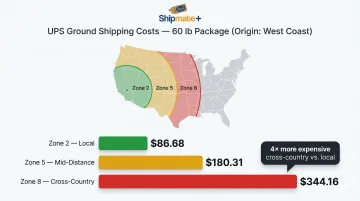
All major carriers use a zone-based pricing model (typically Zones 1–8 in the U.S.), where Zone 1 is closest to the origin and Zone 8 is the farthest.
60 lb UPS Ground retail rate example:
- Zone 2 (local): $86.68
- Zone 5 (mid-distance): $180.31
- Zone 8 (cross-country): $344.16
A 60 lb package shipped cross-country costs nearly 4× more than the same package shipped locally.
Carrier Surcharges
Common surcharges for heavy shipments:
| Surcharge Type | Trigger | UPS (2026) | FedEx (2026) |
|---|---|---|---|
| Additional Handling | Weight >50 lbs | $27.75 | $46.00–$58.75 |
| Large Package | Length >96", L+G >130", Weight >110 lbs | $105.50–$117.25 | $255.00–$330.00 |
| Residential Delivery | Home address | $3.55 | $6.45–$6.95 |
These fees stack. A 120 lb package with a 100" length going to a home address will trigger all three surcharges.
Ground vs. Express Services
Express and overnight air services can cost 3–5× more than ground for heavy shipments. Ground is the right call for the vast majority of heavy items — reserve air freight for time-sensitive shipments where the cost premium is justified.
Common Mistakes When Shipping Heavy Items
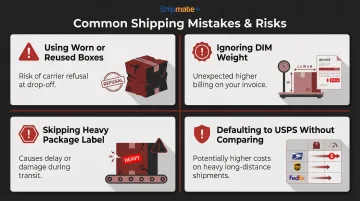
Even careful shippers run into avoidable problems when dealing with heavy packages. These four mistakes come up most often:
- Using worn or reused boxes — Used and flimsy boxes are a leading cause of carrier refusals and damage claims. Carriers can reject packages at drop-off if the packaging doesn't meet standards, meaning your item gets sent back before it ships.
- Calculating cost by actual weight only — Many shippers are surprised by a higher bill because the carrier billed dimensional (DIM) weight or applied a large package surcharge. Always calculate both actual and DIM weight before choosing your box size and carrier.
- Skipping the heavy package label — UPS and FedEx require a heavy package sticker on all packages over 70 lbs. Without it, the package risks delay, refusal, or rough handling that increases damage in transit.
- Defaulting to USPS without comparing rates — USPS flat rate works well for dense items under 70 lbs traveling moderate distances. For heavier packages or long hauls, UPS or FedEx Ground often comes out cheaper — especially when the item doesn't fit a flat-rate box.
When Your Item Needs Freight Instead of Parcel
Once a shipment exceeds 150 lbs — or when multiple heavy boxes are going to the same destination — LTL (Less-Than-Truckload) freight becomes more practical and cost-effective than parcel shipping. Freight pricing is calculated per hundredweight (CWT) rather than per package, which lowers the per-pound cost for large, heavy shipments.
Key practical differences:
- Freight typically requires the item to be palletized
- Transit times are longer (often 2–7 business days)
- Residential delivery often requires a liftgate service (an additional fee)
- The shipper usually needs to schedule a pickup rather than drop off at a retail counter
2026 freight pricing examples:
- FedEx Freight: Residential liftgate fee of $13.96 per CWT ($207 minimum, $681 maximum)
- UPS Freight (TForce): Residential liftgate fee of $13.00 per CWT ($200 minimum, $615 maximum)
For most individual shippers sending a one-off oversized item, FedEx Freight and UPS Freight are the most accessible entry points — and ShipMate+ in Vista, CA is an authorized shipper for both. Bring your heavy shipment in and the team can help you compare rates, arrange pickup, and make sure your item is packed and palletized correctly before it goes out the door.
Frequently Asked Questions
What is the cheapest way to ship a heavy item?
USPS flat rate is typically the best value for dense items under 70 lbs going moderate distances, while UPS or FedEx Ground typically wins for 70–150 lb packages. Comparing rates across all three at ShipMate+ gives you side-by-side pricing across all three carriers for your specific shipment.
How much does it cost to ship a 50 lb item?
Cost varies by carrier, destination zone, and box dimensions. A 50 lb package typically costs $85–$180 via UPS Ground depending on distance, with USPS flat rate offering fixed pricing if the item fits their boxes. Comparing rates at a multi-carrier location before you ship usually surfaces the best deal.
Can I ship a 50 pound package with USPS?
Yes, USPS accepts packages up to 70 lbs, so a 50 lb package is within their limit. USPS flat rate boxes are a cost-effective option if the item fits; otherwise standard USPS pricing is calculated by weight and zone.
What is a weight restriction?
A weight restriction is a carrier's maximum allowable weight per package — USPS caps at 70 lbs, UPS and FedEx at 150 lbs for parcel shipping. Packages exceeding these limits must be shipped via freight services instead.
What happens if my package exceeds the carrier's weight limit?
The carrier will refuse the package at drop-off or apply freight reclassification with additional fees. Packages over 150 lbs must move to freight services, so weigh your shipment before heading to the carrier.
Does UPS or FedEx accept packages over 70 lbs?
Both UPS and FedEx Ground accept packages up to 150 lbs, but packages over 70 lbs require a visible "Heavy Package" label and may incur additional handling surcharges. Above 150 lbs, the shipment must move to their respective freight services.