

Introduction
Same-day and two-day delivery have become the default expectation. Waiting a week for a package now feels unacceptable—for both individuals placing personal orders and businesses fulfilling time-sensitive client commitments.
Expedited shipping is often framed around its cost premium, but its real value shows up in specific situations: missed legal deadlines, lost customers, spoiled perishable goods. When timing determines the outcome, speed stops being optional.
This guide breaks down what expedited shipping delivers in practice and helps you decide when the premium is worth it—and when standard shipping is the smarter call.
Key Takeaways
- Expedited shipping delivers packages within 1–3 business days, significantly faster than standard 3–7 day windows
- Your shipment receives priority status throughout the carrier's network, reducing delay risks common during peak seasons
- Core benefits: guaranteed delivery speed, priority handling, real-time tracking, and keeping customers happy when timing matters
- Best suited for urgent documents, perishable goods, high-value items, emergency parts, and last-minute needs
- ShipMate+ in Vista, CA lets you compare and send FedEx, UPS, and USPS expedited options side by side — no guesswork
What Is Expedited Shipping?
Expedited shipping is a delivery method that moves packages faster than standard service by assigning shipments priority status within a carrier's network. While standard shipping typically takes 3–7 business days, expedited services deliver within 1–3 business days depending on the service tier and destination.
Where it's typically applied:
- Urgent legal or medical documents requiring guaranteed delivery
- Time-sensitive business supplies or emergency replacement parts
- Perishable goods with short shelf life (food, flowers, biologics)
- High-value items where extended transit risk isn't acceptable
- Last-minute gifts for birthdays, anniversaries, or special occasions
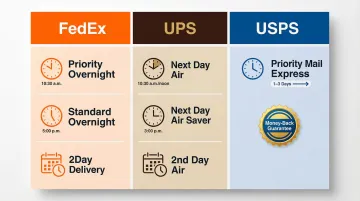
All three major carriers—FedEx, UPS, and USPS—offer specific expedited tiers with distinct delivery commitments:
FedEx expedited options:
- Priority Overnight (next-business-day by 10:30 a.m.)
- Standard Overnight (next-business-day by 5:00 p.m.)
- 2Day service (two business days)
UPS expedited options:
- Next Day Air (next-business-day by 10:30 a.m. or noon)
- Next Day Air Saver (next-business-day by 3:00 p.m.)
- 2nd Day Air (two business days)
USPS expedited option:
- Priority Mail Express (1–3 days by 6:00 p.m., with money-back guarantee)
Each carrier structures its tiers differently, so the right choice depends on your deadline and destination. The cost premium behind any of these services reflects something specific: priority placement at sorting facilities, fewer transit stops, air transport instead of ground, and end-to-end tracking from drop-off to delivery.
Key Benefits of Expedited Shipping
Each benefit below connects to a concrete situation where expedited shipping changes the outcome — not in theory, but in practice.
Speed and On-Time Delivery
Expedited shipping's core advantage is guaranteed speed. Packages are routed directly with fewer stops, often bypassing regional sorting hubs that add days to standard shipments. Carriers assign expedited packages higher processing priority at each facility, meaning they move to the front of the queue at every transit point.
How this works in practice:
When a standard ground package arrives at a sorting hub, it joins hundreds of thousands of other parcels waiting for available truck space. Expedited packages bypass this queue entirely: they load onto dedicated air transport or priority ground routes immediately. This priority routing eliminates the 1–2 day delays that routinely occur when standard shipments sit in warehouses during volume surges.
Why this advantage matters:
For time-sensitive scenarios such as legal filings with court deadlines, medical supplies needed for patient care, event merchandise that must arrive before the function starts, or a birthday gift for tomorrow, standard shipping's unpredictability simply isn't an option. Research shows that 21% of online shoppers abandon their carts specifically because delivery is too slow, demonstrating how delivery speed directly influences purchasing decisions.
Expedited shipping converts an unknown timeline into a reliable commitment. When a contract must be signed by Friday, a replacement part is needed to prevent downtime, or perishable goods have a 48-hour shelf life, "estimated 5–7 days" isn't good enough. "Guaranteed by 10:30 a.m. tomorrow" is.
KPIs impacted:
- On-time delivery rate
- Transit time
- Deadline adherence
When this advantage matters most:
Situations involving hard deadlines (court filings, product launches, event dates), perishable goods with short shelf life, or any shipment where a single day's delay creates cascading problems that cost more than the expedited premium.
Priority Handling and Reliable Tracking
Expedited shipments receive priority handling throughout the entire shipping process—from pickup through sorting and final delivery—reducing the likelihood of misrouting, warehouse holdups, or packages being set aside during volume surges.
Carriers assign dedicated tracking milestones to expedited packages, providing real-time visibility at each stage. Standard shipments often show sporadic updates ("in transit" for days without detail), while expedited services generate granular scan events at every facility, giving you precise location data throughout the journey.
Why this advantage matters:
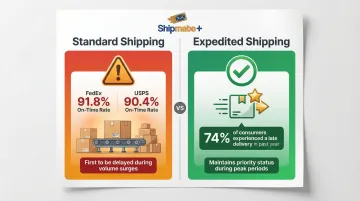
Priority handling directly reduces risk during peak volume periods. During the 2024 holiday season, FedEx and USPS on-time rates dropped to 91.8% and 90.4% respectively, with USPS missing five of six service targets. Standard shipments are most vulnerable during these peaks — they're the first to be delayed when networks become congested.
Expedited packages maintain priority status even during these surges. While standard ground shipments may sit for an extra day or two waiting for available truck space, expedited packages move forward immediately. Research indicates that 74% of consumers experienced a late delivery in the past year, making reliability a critical differentiator.
Enhanced tracking also provides peace of mind and enables proactive communication. For businesses, knowing exactly where a high-value or critical shipment is at any moment reduces reactive problem-solving. You can notify customers of precise delivery windows, intercept packages if delivery issues arise, and provide concrete answers when clients ask "where is my order?"
KPIs impacted:
- Delivery accuracy rate
- Tracking visibility
- Shipment exception rate
When this advantage matters most:
High-value items where loss or delay is costly, businesses managing customer expectations with specific delivery commitments, and time-sensitive shipments sent during holiday peaks or weather-prone seasons when standard shipping reliability drops significantly.
Customer Satisfaction and Business Continuity
For businesses, offering expedited shipping directly impacts customer retention. Customers who receive orders when they need them are far more likely to return and recommend your company. Research shows that 55% of shoppers are more likely to make a repeat purchase if their delivery arrives on time, making delivery reliability the strongest loyalty driver identified.
Late deliveries do the opposite — and the damage sticks. Sixty percent of customers aged 18–29 will abandon a brand entirely after a single late delivery, and 58% of all customers will not return after a poor delivery experience.
Business continuity benefits:
Expedited shipping enables critical business operations to continue without interruption. When you need to restock inventory before running out, fulfill a rush order from a key client, or get supplies to a job site on time, expedited delivery prevents revenue loss and operational disruption.
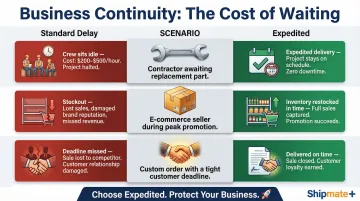
Consider these scenarios:
- A contractor needs a replacement part to keep a project on schedule—a two-day delay means the entire crew sits idle, costing hundreds of dollars per hour
- An e-commerce seller runs low on bestselling inventory during a promotional period—expedited restocking prevents lost sales
- A small business receives a custom order request with a tight deadline—expedited fulfillment closes the sale instead of losing it to a competitor
In markets where Amazon has normalized fast delivery, businesses that offer or use expedited shipping close the gap between customer expectation and actual experience. Providing expedited options positions you as responsive and reliable, while using expedited services internally ensures you can meet the commitments you make.
KPIs impacted:
- Customer retention rate
- Order fulfillment lead time
- Repeat purchase rate
When this advantage matters most:
E-commerce businesses during promotional periods, small businesses fulfilling custom or urgent orders, and any operation where a delayed shipment means a missed sale, broken client relationship, or operational shutdown that costs more than the expedited premium.
When Expedited Shipping Makes the Most Sense
Expedited shipping provides the highest return relative to its cost premium in specific situations. Understanding when to use it—and when standard shipping remains the better choice—helps you make smarter cost-benefit decisions.
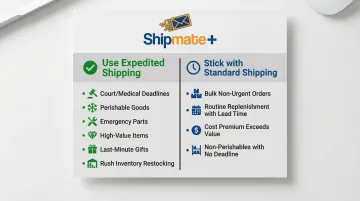
Situations where expedited shipping is justified:
- Court filings, patient records, and contracts with hard deadlines that can't slip
- Perishable goods — fresh food, flowers, biological samples — with shelf lives shorter than standard transit times
- Emergency replacement parts where equipment downtime costs more than the shipping premium
- High-value items like jewelry or electronics where longer transit increases theft or damage risk
- Last-minute gifts needed by a specific birthday, anniversary, or holiday date
- Rush inventory restocking to prevent stockouts during peak sales periods
Scenarios where standard shipping remains the better choice:
- Bulk, non-urgent orders where timing flexibility exists
- Routine inventory replenishment with adequate lead time
- Shipments where the cost premium exceeds the value of faster delivery
- Non-perishable goods with no specific deadline
ShipMate+ in Vista, CA is an authorized shipper for FedEx, UPS, and USPS, so you can compare all three carriers' expedited tiers and pricing side-by-side in one visit. That means no guesswork — just the option that fits your timeline and budget without being locked into a single carrier's rates.
What Happens When You Skip Expedited Shipping
Defaulting to standard shipping when the situation calls for speed creates real-world consequences that routinely exceed the cost of expedited service.
Missed Deadlines With No Recovery
Legal filings that arrive after court deadlines are rejected outright. Business proposals submitted late lose to competitors who delivered on time. Event merchandise arriving after the function ends is worthless. In each case, the entire shipment value is lost — not just delayed.
Perishable Goods That Don't Survive Transit
The USDA defines the temperature "Danger Zone" as 40°F–140°F, where bacteria multiply rapidly — and perishable foods can't stay in that range longer than 2 hours. Standard 3–7 day shipping can't meet that window. The result is full product loss, a replacement shipment cost, and potential liability if spoiled food reaches a customer.
Customer Trust Lost After One Late Delivery
Late arrivals generate negative reviews, refund requests, and permanent customer loss. When 60% of younger customers abandon brands after a single late delivery, the lifetime value lost from one delayed shipment far exceeds a $20–$40 expedited shipping premium.
Operational Shutdowns That Cost Far More Than Shipping
When critical supplies arrive late, the downstream costs add up fast:
- A manufacturing line stays down waiting on a part that's two days out
- A construction site stalls because materials missed the schedule
- A retail store loses a full weekend of sales when inventory misses the Friday cutoff
The operational cost of these delays — idle labor, missed revenue, penalty clauses — routinely runs into thousands of dollars.
In each of these scenarios, the expedited shipping fee would have been the cheaper option by a wide margin.
How to Get the Most Value from Expedited Shipping
Expedited shipping works best when used strategically, not reflexively. Identify in advance which shipment categories are genuinely time-sensitive versus which simply feel urgent.
Set Clear Internal Criteria
Create internal criteria for when expedited shipping is required. This prevents guesswork and ensures consistency. For example:
- "Any shipment with a hard deadline within 3 business days automatically uses expedited service"
- "Perishable goods always ship overnight regardless of cost"
Compare Carriers Before Committing
FedEx, UPS, and USPS each have distinct expedited service tiers with different price points and delivery windows. A FedEx 2Day shipment may cost $30 while USPS Priority Mail Express to the same destination costs $45—or vice versa depending on weight, dimensions, and zones. Choosing the right carrier for your specific destination and timeline prevents overspending by $10–$20 per shipment.
Use official carrier rate calculators to generate accurate quotes:
- FedEx Rate Tools
- UPS Calculate Time and Cost
- USPS Price Calculator
Drop Off Everything in One Stop (Vista, CA)
That comparison is easy to do in person at ShipMate+ in Vista. As an authorized FedEx Ship Center, UPS Authorized Shipping Outlet, and USPS Approved Shipper, ShipMate+ lets you compare options, get packages professionally packed, and drop off in one stop during extended hours (Monday–Friday 9:00 a.m.–6:00 p.m., Saturday 9:00 a.m.–1:00 p.m.).
Daily carrier pickups run on consistent schedules—FedEx and UPS at 4:30 p.m. weekdays, USPS at 11:00 a.m.—so your expedited packages enter carrier networks promptly. For businesses shipping regularly, this removes the hassle of managing accounts with three separate carriers.
Conclusion
Expedited shipping's value comes down to three outcomes: speed that protects deadlines, reduced risk through priority handling, and the kind of delivery reliability that keeps customers coming back.
Bulk, non-urgent shipments rarely justify the premium. Still, knowing when to use expedited service, which carrier to choose, and how to access those options efficiently turns expedited shipping from an occasional emergency expense into a reliable tool for both personal and business needs.
For situations where timing determines success—legal deadlines, perishable goods, customer commitments, or operational continuity—missing the window almost always costs more than the upgrade would have.
Frequently Asked Questions
Frequently Asked Questions
What is expedited shipping?
Expedited shipping is a faster-than-standard delivery method that prioritizes shipments in a carrier's network, typically delivering within 1–3 business days depending on the service tier and destination. It uses priority routing, air transport, and enhanced handling to guarantee speed.
How long does expedited shipping take?
Delivery times vary by carrier and service level. Overnight options deliver the next business day, 2-day services arrive within two business days, and standard expedited options deliver within 1–3 business days. Windows also depend on origin, destination, and the selected service tier.
Is expedited shipping worth the extra cost?
It depends on the shipment's urgency and stakes. For time-sensitive documents, perishables, or high-value items, the cost of a missed or late delivery typically exceeds the shipping premium. For non-urgent goods with flexible timelines, standard shipping is usually sufficient.
What types of items are best suited for expedited shipping?
Urgent legal or medical documents, perishable goods (food, flowers, biologics), last-minute gifts, emergency replacement parts, and high-value items where secure, on-time delivery is critical.
Does expedited shipping guarantee delivery by a specific date?
Most carriers guarantee delivery windows for expedited services and offer refunds or credits when those windows are missed. Exceptions apply for severe weather or operational disruptions, and guarantees are often suspended during peak holiday seasons.
What is the difference between expedited shipping and overnight shipping?
Overnight shipping is a specific type of expedited shipping that guarantees next-business-day delivery. Expedited shipping is a broader category that includes overnight, 2-day, and other faster-than-standard service tiers with varying delivery windows and price points.