Dropshipping offers a compelling solution by eliminating inventory risk entirely. A third-party supplier stores, packs, and ships products directly to your customers while you focus on marketing and sales. This article covers how dropshipping works, its pros and cons, how to choose reliable suppliers, and the practical steps to launch your business — including why even dropshippers need access to dependable shipping resources for returns and samples.
TLDR — Key Takeaways
- Dropshipping lets you sell online without holding inventory; suppliers ship orders directly to customers on your behalf
- Startup costs are low, you can run the business from anywhere, and product variety is nearly unlimited
- Slim 15-20% profit margins, limited quality control, and intense competition are the trade-offs to plan for
- Supplier reliability determines your brand reputation and customer satisfaction
- Dropshippers still need a local shipping partner — ShipMate+ in Vista, CA handles returns, samples, and urgent direct shipments across FedEx, UPS, and USPS
What Is Dropshipping and How Does It Work?
Dropshipping is a retail fulfillment method where you list products for sale but never physically handle inventory. Instead, when a customer places an order, you forward the details to a third-party supplier who packs and ships the product directly to the customer under your brand.
This model has deep roots. Early catalog retailers like Sears and J.C. Penney used the same approach long before e-commerce existed — taking orders by mail and fulfilling them from centralized warehouses without the customer ever setting foot in a store.
The global dropshipping market was valued at $365.67 billion in 2024 and is projected to reach $1.25 trillion by 2030, growing at 22.0% annually. Currently, 27% of e-commerce businesses worldwide use dropshipping as their primary fulfillment model.
Roles in the Dropshipping Model
Three key players make dropshipping work:
- Manufacturer — Creates the products but rarely sells directly to consumers
- Wholesaler/Supplier — Buys inventory in bulk from manufacturers, marks it up, and sells to retailers
- Dropshipping Retailer (You) — Markets and sells products to end customers, earning the margin between retail and wholesale price
Understanding the concept of "seller of record" is critical. As the dropshipper, you are legally the seller responsible for pricing, collecting sales tax, ensuring compliance with consumer protection laws, and managing all customer service — even though the supplier handles physical fulfillment.
The Dropshipping Process Step-by-Step
Here's how a typical dropshipping transaction flows:
- Customer places order on your online store
- You forward order details to your supplier (often automated via platform integrations)
- Supplier picks, packs, and ships the order directly to the customer
- You pay the wholesale price to the supplier and keep the difference as profit
- You manage customer communication and handle any returns or issues
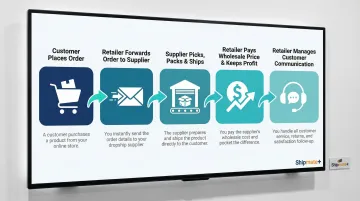
Because inventory never passes through your hands, your cost structure stays lean even as order volume grows — which is exactly what makes the model attractive to new and scaling sellers alike.
The Benefits and Challenges of Dropshipping
Benefits of Dropshipping
The core advantages that make dropshipping attractive include:
- Low startup costs — No need to purchase inventory upfront or invest in warehouse space
- Location flexibility — Run your business from anywhere with internet access
- Wide product catalog — Offer hundreds or thousands of products without physical storage constraints
- Scalability — Grow order volume without hiring fulfillment staff or expanding facilities
- Reduced risk — Test new products and niches without committing to bulk inventory purchases
These advantages explain why dropshipping attracts so many new sellers. The harder part is understanding what makes most of them struggle.
Challenges and Limitations
The benefits are real — but so are the trade-offs:
Slim profit margins: Most dropshippers operate with net profit margins between 15% and 20%. High-performing stores may reach 30%, while poorly optimized operations fall below 10%. Because you purchase products individually rather than in bulk, your markup ability is inherently limited.
Intense competition: Low barriers to entry mean thousands of sellers offer identical products. Currently, approximately 7.7 million e-commerce businesses worldwide use dropshipping, creating fierce price competition.
Limited quality control: You can't physically inspect products before they reach customers. If a supplier ships defective items, wrong products, or uses substandard packaging, your brand takes the hit.
Customer service burden: Even though you never touched the product, customers hold your brand responsible for late deliveries, damaged items, or fulfillment errors. According to PwC's 2025 Customer Experience Survey, 29% of consumers abandon brands entirely after a poor experience.
In a 2025 survey of over 3,100 dropshipping store owners, 64% cited shipping delays as their biggest pain point, and 48% cited unreliable suppliers. For dropshippers, the shipping experience IS the brand experience — and it's largely outside your control.
How to Choose the Right Dropshipping Supplier
Supplier selection is the most consequential decision in dropshipping. A reliable supplier determines product quality, shipping speed, and customer satisfaction. A bad supplier choice, on the other hand, creates fulfillment delays, return disputes, and chargebacks that compound quickly.
Key questions to ask potential suppliers before committing:
- What are your average fulfillment timelines from order to shipment?
- Which carriers do you use, and do you provide tracking numbers?
- What are your return, warranty, and defect replacement policies?
- Are there handling fees, per-order fees, or minimum order requirements?
- Can I order product samples to evaluate quality and shipping speed?
Requesting product samples is a critical first step — samples let you evaluate product quality, packaging standards, and actual shipping speed firsthand rather than relying on supplier promises.
Red Flags and Due Diligence
Watch for these warning signs when vetting suppliers:
- No verifiable reviews or customer references
- Unwillingness to share fulfillment timelines or carrier information
- Lack of clear return or warranty policies
- Excessive monthly "membership" fees with unclear value
- Sourcing from unverified overseas manufacturers with unknown quality standards
To find reputable suppliers:
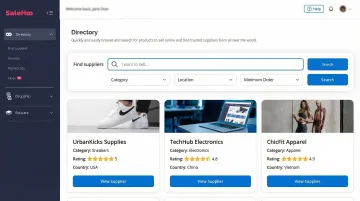
- Search established directories: Worldwide Brands (8,000+ certified wholesalers), Spocket (80% US and EU suppliers), or SaleHoo (2.5 million pre-vetted products)
- Check independent reviews and business references before committing
- Attend trade shows to meet suppliers face to face
- Start with small test orders before scaling volume
Supplier reliability also has legal implications. The FTC's Mail Order Rule requires sellers to have a reasonable basis to ship within advertised timeframes, or within 30 days if no timeframe is specified. If delays occur, you must obtain customer consent or issue prompt refunds — and you are fully liable for these violations, even when the delay originates with your supplier.
Steps to Launch Your Dropshipping Business
Step 1 — Choose a Niche and Validate Product Demand
Identify a profitable niche by researching market trends, competitor pricing, search demand, and product availability. Choose categories with consistent demand but not oversaturated competition. Use tools like Google Trends, keyword research platforms, and competitor analysis to validate demand before committing.
Step 2 — Build Your Online Store and Product Listings
Create a professional storefront with clear product pages, high-quality images, transparent pricing, and trust signals like return policies and contact information. Major platforms support dropshipping integrations:
- Shopify — Supports dropshipping via third-party apps in the Shopify App Store
- WooCommerce — Offers WooCommerce Dropshipping extension for automated order notifications
- BigCommerce — Features native channel integrations and dropshipping apps in the App Marketplace
Step 3 — Calculate Margins and Set Pricing
Work backward from the supplier's wholesale price. Add handling fees, marketing costs, and your desired profit margin to arrive at a retail price that is both competitive and profitable.
Standard pricing formula: Cost of Goods (Purchase Price + Shipping/Fees) + Markup = Retail Price
Remember that typical net profit margins hover between 15-20%, so price accordingly to cover advertising costs and platform fees.
Step 4 — Plan for the Physical Shipping Side of Your Operation
Even though suppliers handle most shipments, you'll still need to manage returns, ship product samples for quality checks, or occasionally fulfill urgent orders directly.
A local multi-carrier shipping center handles exactly these gaps. ShipMate+ in Vista, CA is an authorized FedEx, UPS, and USPS shipper with professional packing services, packaging supplies, and daily carrier pickups. For dropshipping entrepreneurs, ShipMate+ offers:
- Access to USPS, UPS, and FedEx under one roof — no separate carrier accounts needed
- Expert packing for samples and returns, with items guaranteed for insurability
- Extended hours (Mon–Fri 9 AM–6 PM, Sat 9 AM–1 PM) to skip the post office line
- A secure business address for receiving supplier samples and returns, with 24-hour mailbox access
- Over 40 freight carriers available for bulk orders or oversized shipments
Visit ShipMate+ at 1929 W Vista Way Suite F, Vista, CA 92083, or reach them at (760) 295-1074 / info@shipmateplus.com.
Step 5 — Market Your Store and Monitor Performance
Focus on marketing channels relevant to dropshipping:
- Email marketing — Delivers an average ROI of $36 for every dollar spent
- Paid search — Accounts for 28.3% of e-commerce revenue but requires careful budget management
- Social media — Organic and paid campaigns to build brand awareness
- SEO content — Long-term traffic generation through blog posts and product guides
Track sales data, supplier fulfillment rates, and customer feedback on an ongoing basis. Monitor metrics like delivery times, return rates, and customer satisfaction to identify supplier issues before they damage your reputation.
Dropshipping vs. Direct Shipping: What's the Difference?
The core difference comes down to who holds the inventory. With direct shipping (also called direct-to-consumer or DTC), the retailer owns the stock and fulfills orders from their own warehouse. With dropshipping, a third-party supplier stores, packs, and ships on your behalf — you never touch the product.
Each model carries real trade-offs across cost, control, and scalability:
| Feature | Dropshipping | Direct Shipping (DTC) |
|---|---|---|
| Upfront Costs | Very low — no inventory investment | High — requires inventory purchase and warehousing |
| Profit Margins | Lower (15-20%) — per-order purchasing limits markup | Higher — bulk purchasing allows better margins |
| Quality Control | Low — reliant on third-party suppliers | High — full control over product quality and packaging |
| Shipping Speed | Variable — depends on supplier location and processes | Faster — direct control over fulfillment timelines |
| Scalability | Easy — no operational complexity | Harder — requires infrastructure investment |
| Branding | Limited — supplier packaging may be generic | Full control — custom packaging and unboxing experience |
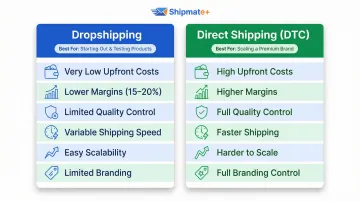
Dropshipping makes sense when you're testing a new product category with minimal upfront risk. Direct shipping becomes the better play once you're ready to invest in inventory, protect margins, and deliver a branded customer experience.
Frequently Asked Questions
What are dropshipping services?
Dropshipping services are platforms, suppliers, or tools that let retailers sell products without holding inventory. When a customer orders, the supplier handles warehousing, packing, and shipping directly.
What is the difference between direct shipping and dropshipping?
In direct shipping, the seller owns the inventory and ships it from their own warehouse. In dropshipping, the seller never handles the product; a third-party supplier ships directly to the customer after the sale.
Is drop shipping legal in the US?
Yes, dropshipping is fully legal in the United States. Sellers must comply with sales tax laws, follow platform-specific dropshipping policies, and ensure suppliers don't ship counterfeit or trademark-infringing goods.
Is Amazon a dropshipper?
Amazon used an early form of dropshipping in its book business and still allows third-party sellers to use dropshipping under specific policies. However, Amazon primarily operates as a retailer and marketplace rather than a dedicated dropshipping operation.
What is third party fulfillment?
Third-party fulfillment (3PL) is when an external company handles warehousing, packing, and shipping on behalf of a retailer. Unlike dropshipping, the retailer typically owns the inventory and stores it at the 3PL's warehouse before orders go out.