
Introduction
The United States Postal Service has rolled out significant service standard changes affecting First-Class Mail, with two phases launching in 2025 that are now fully in effect in 2026. Whether you're mailing birthday cards to family, sending invoices to clients, or shipping small packages to customers, these changes affect how you should think about drop-off timing and delivery expectations.
What most mailers need to know upfront:
- 75% of First-Class Mail is delivered at the same standard or faster under the new rules
- The overall delivery window remains 1–5 days — no piece will take longer than 5 days
- Specific routes and drop-off timing now matter more than before
Knowing the details for your ZIP code — and when to drop off your mail — can prevent missed deadlines and delivery surprises.
TLDR: Key USPS First-Class Mail Changes at a Glance
- Delivery estimates now use 5-digit ZIP code pairs instead of 3-digit pairs, making service standards more precise and localized
- Both rollout phases are fully active: Phase 1 launched April 1, 2025; Phase 2 launched July 1, 2025
- 75% of mail moves at the same speed, 14% arrives faster, and only 11% sees a slight slowdown
- Sundays and holidays no longer count as transit days for mail collected on Saturdays or the day before a holiday
- Mail must reach processing centers by 8:00 PM under new Critical Entry Times (CET), or it won't enter the network until the following day
What's Actually Changing with USPS First-Class Mail in 2025–2026
USPS is refining—not overhauling—its service standards as part of the "Delivering for America" 10-year strategic plan. The goal: improve reliability and save the Postal Service at least $36 billion over 10 years through reduced transportation, processing, and real estate costs.
The biggest operational shift involves moving to a 3-leg operational model that accurately reflects how mail actually moves through the network:
- Leg 1: Collection to origin processing facility
- Leg 2: Origin processing to destination processing facility
- Leg 3: Destination processing to final delivery
Previous service standards only accounted for Leg 2 (facility-to-facility transport), while the new standards establish clear expectations for all three legs. With all three legs defined, USPS can now measure and optimize the entire journey from collection point to final delivery.
For mailers in ZIP codes located more than 50 miles from a Regional Processing and Delivery Center (RPDC), one additional day may be added in Leg 1. However, Leg 2 speeds are being improved overall, with drive-time bands expanded by 4 hours, increasing the geographic reach of 2-, 3-, and 4-day delivery standards.
Distinguishing First-Class Mail vs. First-Class Package Service Changes
First-Class Mail (letters and flats up to 13 oz) and First-Class Package Service (FCPS) are separate products with different impacts:
| Product | Volume Unchanged | Getting Faster | Getting Slower |
|---|---|---|---|
| First-Class Mail (letters/flats) | 75% | 14% (same 1–5 day range) | 11% |
| First-Class Package Service | 64% | 4% upgraded to 2-day | 32% shift to 4–5 days |
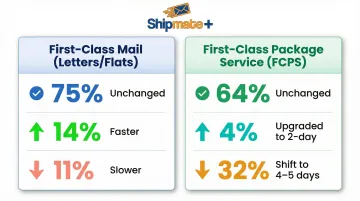
The package service changes are the more significant story. That 32% slowdown hits primarily long-distance shipments, so if you regularly send small packages across the country, build extra buffer into your timelines starting in 2026.
The Two-Phase Implementation Timeline
USPS implemented the final rule in two distinct phases to facilitate smooth operational execution:
| Phase | Date | What Changed | Who's Affected |
|---|---|---|---|
| Phase 1 | April 1, 2025 | Added 1 day to Leg 1 for origins >50 miles from RPDC; implemented Sunday/holiday transit exclusion; updated Critical Entry Times (CET) | Weekend mailers; rural/distant ZIP codes; commercial mailers |
| Phase 2 | July 1, 2025 | Expanded Leg 2 drive-time bands by +4 hours; expanded "turnaround" service within RPDC regions | Regional mailers; businesses sending volume within their processing area |
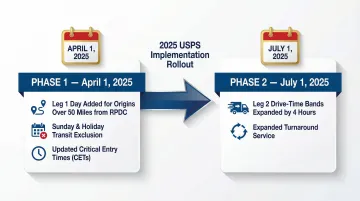
Current status in 2026: Both phases are complete and active. Plan your First-Class Mail timelines around these updated standards — the prior delivery windows no longer apply.
How the New Standards Actually Affect Your Mail Delivery Times
Let's break down the real-world impact using official USPS figures:
- 75% of First-Class Mail: Same delivery standard as before
- 14% of First-Class Mail: Faster delivery standard
- 11% of First-Class Mail: Slightly slower delivery standard
For most everyday correspondence—bills, greeting cards, local business mail—you'll see no change or improvement.
Who's most impacted? Mailers in ZIP codes farther from an RPDC facility (typically more than 50 miles) may see a one-day extension on Leg 1 transit time. Urban and suburban senders close to processing centers will largely see no change or improvement.
Critical Entry Time (CET) Changes and Why Drop-Off Timing Matters
The Critical Entry Time (CET) is the latest time on a particular day that mail can enter the postal network and still have its service standard calculated from that day. Miss the CET, and your mail won't "start the clock" until the following day, adding a full day to delivery.
USPS updated CETs so that all originating volume reaches an RPDC by 8:00 PM (20:00 hours). For time-sensitive mail, dropping off earlier in the day can push delivery a full day earlier.
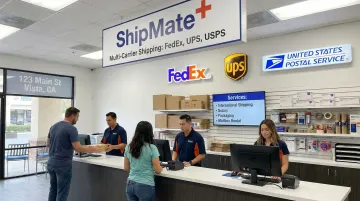
ShipMate+ in Vista, CA is a USPS Approved Shipper open until 6:00 PM weekdays and 1:00 PM Saturdays—later than most post office counter hours allow. USPS picks up from ShipMate+ at 11:00 AM Monday through Saturday, so items dropped off before that time enter the network the same day.
Sunday and Holiday Exclusion: What It Means Practically
Mail collected on Saturdays or the day before a holiday no longer counts Sundays or holidays as transit days. This doesn't alter the physical delivery process, but it changes the expected delivery date shown to customers.
Example: A letter with a 3-day service standard mailed on Friday shows a Monday delivery estimate. That same 3-day letter mailed on Saturday now shows a Wednesday delivery estimate, because Sunday isn't counted.
Practical advice: Avoid Saturday drop-offs for date-critical mail. Mail it Friday or wait until Monday.
What Vista, CA Residents and Small Businesses Should Know
Vista mailers should use the USPS Service Commitments lookup tool to find the new expected delivery time for any mail class on any given date. Enter your specific 5-digit ZIP code (92083 for ShipMate+ customers) to see how the new standards affect your mail.
**For small businesses and home-based businesses** sending invoices, marketing mailers, or client correspondence:
- If your mailings are presorted or entered at an RPDC-adjacent facility, the changes are minimal
- If you're sending individual pieces via Post Office counter or drop box, verify your new standard and plan ahead for deadlines
- For time-sensitive shipments where a guaranteed delivery window is non-negotiable, ShipMate+'s multi-carrier options—including FedEx and UPS alongside USPS—give you flexibility to choose a service with a firm delivery commitment
When First-Class Mail delivery windows don't work for your timeline, these guaranteed services available at ShipMate+ fill the gap:
Guaranteed delivery options at ShipMate+:
- FedEx Priority Overnight: Next-business-day delivery by 10:30 AM — ideal for urgent documents or last-minute deadlines
- FedEx 2Day: Arrives in two business days; good fit for non-urgent but time-bound shipments
- UPS Next Day Air: Next-business-day delivery with a money-back guarantee if the commitment isn't met
- UPS 2nd Day Air: Two-day delivery to most U.S. addresses, with tracking included
- USPS Priority Mail Express: The only USPS service with a guaranteed delivery date, including weekends
Important reminder: Forever Stamps remain valid regardless of rate changes, but verify current postage for heavier letters (over 1 oz) and non-standard sizes. Additional postage may be required, and under-stamped mail can be delayed or returned.
How to Check Your New Expected Delivery Time
With delivery windows now varying by ZIP code pair and adjusted for weekends and holidays, the safest approach is to look up your specific route rather than estimate. USPS offers two tools for this:
- USPS Service Commitments Tool — Enter your origin ZIP, destination ZIP, mail class, and mailing date to get a specific expected delivery date. Best for customer-facing delivery quotes and one-off shipments.
- USPS Service Standards Map — Enter your origin ZIP and mail class to see delivery time zones across the country. Useful for bulk mailings and campaign planning, though it shows stated standards only, not weekend-adjusted dates.
Frequently Asked Questions
What are the changes to first-class mail?
USPS refined its service standards in two phases (April and July 2025), preserving the 1–5 day range for First-Class Mail while improving precision using 5-digit ZIP pairs. 75% of mail is unaffected, 14% is faster, and 11% is slightly slower.
What is the current price of first class mail?
As of July 13, 2025, the Forever Stamp (1 oz First-Class letter) costs $0.78. Additional ounces cost $0.29 each. Service standard changes are separate from postage rate adjustments. Check usps.com for the most current pricing.
Is there a difference between first class mail and regular mail?
"Regular mail" typically refers to First-Class Mail for most consumers—it covers letters, postcards, and flats up to 13 oz. First-Class Mail receives priority handling over Marketing Mail (formerly Standard Mail), with a service standard of 1–5 days.
Can I use 3 forever stamps for a 3 oz letter?
Yes, 3 Forever Stamps ($2.34 total) will work — but you'd overpay by $0.98. A 3 oz letter only requires $1.36 ($0.78 first oz + $0.29 second oz + $0.29 third oz). Two stamps ($1.56) cover it with just $0.20 extra.
Will my mail take longer to arrive after these changes?
For the vast majority of mail, delivery times are the same or faster. Only 11% of First-Class Mail pieces have a slightly slower standard, primarily affecting long-distance routes from ZIP codes far from USPS processing facilities.
How do I check the new delivery time for my specific ZIP code?
Visit the USPS Service Commitments tool and enter your origin and destination ZIP codes along with the mail class and mailing date to see the updated expected delivery date under the new standards.
Need help navigating these changes? The team at ShipMate+ in Vista, CA can advise on mail timing, multi-carrier options, and guaranteed delivery services.
- Address: 1929 W Vista Way Suite F, Vista, CA 92083
- Phone: (760) 295-1074
- Email: info@shipmateplus.com
- Hours: Mon–Fri 9:00 AM–6:00 PM | Sat 9:00 AM–1:00 PM