Introduction
You've just landed a major wholesale order—26 pallets of inventory headed to a retailer across the country. You call your usual shipping contact and suddenly face two unfamiliar acronyms: LTL and FTL. Which one do you choose? Pick wrong, and you'll either overpay for empty trailer space or watch your shipment crawl through a maze of distribution hubs for a week.
LTL freight is handled 6 to 8 times per shipment, resulting in damage rates between 2% and 5%—up to five times higher than FTL's 0.5% to 2% rate. Meanwhile, choosing FTL for a three-pallet shipment means paying for 23 empty pallet spaces you didn't need. This guide breaks down exactly how each option works, what it costs, and which one fits your shipment.
Key Takeaways
- LTL shares truck space with other shippers—ideal for 1-12 pallets
- FTL reserves an entire truck—best for 24+ pallets or fragile goods
- LTL costs less upfront —though it adds 2-5 days transit time
- FTL delivers faster with minimal handling but requires volume to justify cost
- Shipments between 6-14 pallets are well-suited for Partial Truckload (PTL)
LTL vs FTL: Quick Comparison
Cost Structure
LTL and FTL operate on fundamentally different pricing models. LTL shippers pay only for the portion of trailer space their freight occupies, calculated by weight brackets using a cost-per-hundredweight (CWT) system. The July 2025 NMFC updates enforce a strict 13-tier density-based classification that heavily influences final pricing—loose packing or inefficient palletizing now carries significant cost penalties.
FTL shippers pay a flat rate for exclusive use of the entire truck, regardless of how much space the freight actually fills. Pricing is driven primarily by distance, current market capacity, and fuel costs rather than freight characteristics.
Key pricing differences:
- LTL accessorial fees stack up fast: liftgate service, residential delivery, inside delivery, and reweigh charges are all common additions
- FTL keeps extra fees minimal—usually just detention or lumper charges
- Accurate dimensions and weight are critical for LTL; miscalculation triggers reclassification and higher costs
- With FTL, you pay for the full trailer whether it's packed tight or half-empty
Transit Time
Transit time differences stem from how each mode physically moves freight through the transportation network.
LTL uses a hub-and-spoke model. A local driver picks up your freight, hauls it to an origin terminal, and it's sorted onto a linehaul trailer before routing through one or more intermediate hubs. Each terminal touch adds roughly half a day to a full day of transit time, so LTL shipments typically run 2 to 5 days longer on the same lanes.
FTL skips all of that. Freight loads at your dock and rides directly to the destination on the same truck—no sorting, no transfers, no surprises on delivery day.
Cargo Handling
More handling touches mean more chances for damage:
| Metric | LTL | FTL |
|---|---|---|
| Handling touches | 6-8 times per shipment | 2 times (load and unload) |
| Damage rate | 2-5% of shipments | 0.5-2% of shipments |
| Risk factor | 2.5x to 5x higher | Minimal; cargo stays sealed |
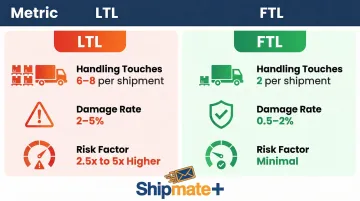
LTL freight moves through loading docks, consolidation hubs, and transfer points where it's repeatedly loaded and unloaded alongside other shippers' cargo. FTL cargo is loaded once at origin and stays on the same truck until final delivery.
Best Fit by Shipment Size
LTL suits shipments roughly between 150 lbs and 15,000 lbs, typically covering 1 to 12 pallets. FTL applies when freight fills or nearly fills a standard 53-foot trailer—generally 24+ pallets or 15,000+ lbs.
The crossover zone between 6 and 14 pallets creates pricing complexity where standard LTL becomes expensive and FTL wastes paid capacity. This is where Partial Truckload (PTL) or Volume LTL options often deliver better value.
What is LTL Shipping?
LTL (Less-than-Truckload) shipping consolidates freight from multiple shippers heading in the same direction onto a single truck. Each shipper pays only for the space their cargo occupies rather than reserving an entire trailer.
Weight and size parameters:
- Typical weight range: 150 to 15,000 lbs
- Pallet count: 1 to 12 pallets
- Individual piece limit: Often capped at 4,000 lbs per pallet
- Height restriction: Usually 84-90 inches when stacked
How LTL Works
Carriers use a hub-and-spoke terminal network. A local driver picks up your freight and brings it to a regional consolidation center, where dock workers sort pallets by destination and reload them onto long-haul trailers.
This process repeats at each hub along the route. Once your freight reaches the destination market, a local driver handles final delivery.
Key Benefits of LTL
- Costs less for smaller loads — you pay only for the trailer space your freight occupies, not the whole truck
- Daily or near-daily pickup schedules on major lanes suit businesses with irregular shipping volume
- Fewer trucks on the road, since multiple shippers share each trailer
Main Drawbacks
- Transit adds 2-5 days vs. direct FTL routing, with broader delivery windows on multi-stop final routes
- Each loading/unloading cycle at consolidation hubs raises the chance of freight shifting or sustaining damage
- Shipments passing through multiple terminals can be harder to track in real time than a single dedicated truck
Use Cases for LTL Shipping
LTL serves businesses that ship regularly but in moderate volumes:
- Small and mid-sized businesses shipping 1-10 pallets per order without needing a full truck
- E-commerce sellers fulfilling B2B orders to retailers or distributors
- Seasonal shippers whose volumes fluctuate and can't consistently fill trucks
- Regional distributors moving goods to nearby markets, typically under 500 miles
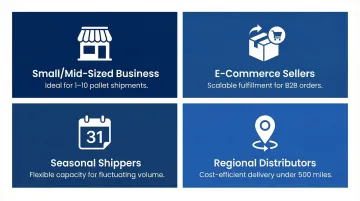
The Top 25 LTL carriers generated $48.1 billion in revenue in 2024, handling over 586,000 shipments daily—a scale that reflects how many small and mid-sized businesses rely on shared freight to move goods cost-effectively.
What is FTL Shipping?
FTL (Full Truckload) means the shipper books and pays for an entire truck, even if the freight doesn't physically fill every inch of trailer space. The truck travels directly from pickup to destination with no intermediate stops.
Standard FTL parameters:
- Trailer type: 53-foot dry van (most common)
- Maximum cargo weight: 42,000–45,000 lbs (after accounting for truck/trailer weight)
- Pallet capacity: Up to 26 standard 48"×40" pallets
- Federal weight limit: 80,000 lbs gross vehicle weight
Those specs determine when FTL actually pencils out. Here's what you gain — and where it falls short.
Key benefits:
- Point-to-point routing eliminates terminal delays, and carriers provide firm delivery appointments rather than broad day-range estimates
- Cargo loads once at origin and never transfers until final delivery, cutting handling touchpoints from 6–8 (LTL) down to just 2
- With enough volume to fill or nearly fill a trailer, per-pallet costs drop well below LTL rates
Main drawbacks:
- Paying for a full truck when you only have 4–6 pallets means subsidizing empty trailer space at a steep premium
- Businesses with unpredictable or low-volume shipping rarely generate enough consistent freight to make FTL pricing work
Use Cases for FTL Shipping
FTL fits businesses with large, time-sensitive, or fragile freight:
- Manufacturers shipping full production runs — automotive parts, building materials, industrial equipment
- Retailers restocking distribution centers with 20+ pallets of inventory
- High-value or fragile shipments that can't survive multiple handling touchpoints
- Time-critical deliveries with firm deadlines, such as trade shows or promotional launches
Example scenario: A Southern California home goods retailer ships 22 pallets of glassware to a regional distribution center ahead of a seasonal promotion. The items are fragile and the delivery window is fixed. FTL gives them a dedicated truck, no shared handling, and a confirmed arrival date — worth the higher upfront cost when the alternative is broken inventory and a missed launch.
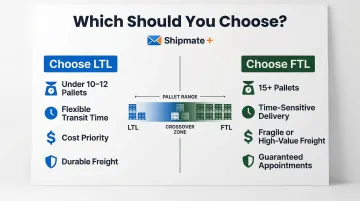
LTL vs FTL: Which is Right for You?
The right choice comes down to your shipment size, timeline, budget, and how much handling your freight can tolerate.
Decision Framework
Choose LTL if:
- Your load is under 10-12 pallets or 10,000 lbs
- Transit time flexibility of 2-5 extra days is acceptable
- Minimizing cost-per-shipment is the priority
- Your freight can tolerate multiple handling touchpoints
Choose FTL if:
- You're shipping 15+ pallets or 15,000+ lbs consistently
- Time-sensitive delivery requirements exist
- Freight is fragile, high-value, or cannot risk damage from multiple transfers
- You need guaranteed delivery appointments
The In-Between Scenario
Shipments between 6 and 14 pallets fall into a crossover zone where standard LTL pricing climbs steeply and FTL may actually become more economical. According to Red Stag Fulfillment, once freight exceeds 6-12 pallets or 10,000 lbs, the cost-per-unit often shifts to favor FTL or Partial Truckload (PTL) over shared LTL space.
PTL (also called Volume LTL) offers a middle ground. You share trailer space with one or two other shippers rather than a full consolidation load, which reduces handling touchpoints while keeping costs below dedicated FTL rates. Availability varies by region and lane, so request quotes for both LTL and PTL when your shipment approaches 8-10 pallets.
Packaging: The Critical LTL Factor
Every extra handling touchpoint in the LTL network is an opportunity for damage. According to TT Club, up to 65% of cargo damage is caused or made worse by poor packaging — and carriers can deny claims when your packaging doesn't meet their standards.
Essential LTL packaging requirements:
- Eliminate pallet overhang — freight extending beyond edges reduces compression strength by 32% and invites puncture damage
- Stretch wrap with 70-gauge film, starting at the base, overlapping by 50%, with 3 inches anchored directly to the pallet
- Stack cartons in columns, not pyramid or interlocking patterns, to maintain structural integrity
- Keep total stacked height under 84 inches to prevent toppling in transit
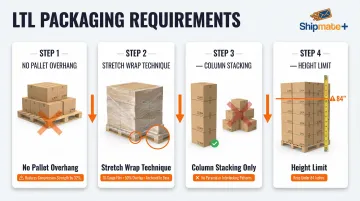
For businesses in Vista, CA shipping LTL freight, ShipMate+ offers professional palletizing and stretch wrapping services before handoff to carriers. Properly preparing freight before it enters the LTL network dramatically reduces damage risk and claim denials.
Real-World Comparison
Scenario 1: 5 pallets of retail goods
A Vista-based e-commerce seller ships 5 pallets of packaged consumer products (3,200 lbs total) to a distributor in Phoenix. Transit time isn't urgent, and the products are moderately durable. LTL offers the most cost-effective solution—the seller pays only for the space occupied, and the 3-day transit window fits the delivery schedule.
Scenario 2: 26 pallets of time-sensitive electronics
A manufacturer ships 26 pallets of assembled electronics (18,500 lbs) from San Diego to a trade show in Chicago. The freight is fragile, high-value, and must arrive by a firm date. FTL provides dedicated capacity, eliminates handling risk, and guarantees on-time delivery—justifying the higher cost through damage prevention and schedule certainty.
Conclusion
The right choice between LTL and FTL comes down to your shipment's size, timeline, and how much handling it can tolerate. LTL delivers cost-effective transport for smaller, flexible loads where budget matters more than speed. FTL earns its premium when volume, timing, and cargo fragility demand dedicated capacity and minimal handling.
Start your decision with shipment size and timeline, then work outward to cost and handling requirements. When your freight falls into the 6-14 pallet crossover zone, request quotes for both LTL and Partial Truckload to identify the best value.
For individuals and small business owners in Vista, CA who need help determining whether their freight qualifies as LTL or FTL—or want expert packing services to prepare shipments for safe LTL transit—ShipMate+ offers professional freight consultation and multi-carrier shipping options to fit your needs. Stop by 1929 W Vista Way Suite F or call (760) 295-1074 to discuss your shipping needs.
Frequently Asked Questions
What is the difference between LTL and FTL?
LTL (Less-than-Truckload) means your shipment shares truck space with other shippers' cargo and moves through consolidation hubs. FTL (Full Truckload) means you book the entire truck for your freight, which travels directly to its destination without intermediate stops.
Which is cheaper, LTL or FTL?
LTL is usually cheaper for small shipments since you only pay for the space you use. FTL becomes more cost-effective when you have enough volume to fill or nearly fill a truck—typically 15+ pallets or 15,000+ lbs.
What weight or size qualifies a shipment for LTL vs FTL?
LTL typically covers shipments between 150 and 15,000 lbs (up to about 12 pallets). FTL is used when freight exceeds that threshold or when volume justifies a dedicated truck—generally 15,000+ lbs or 24+ pallets.
Can LTL be floor loaded?
While most LTL freight is palletized to simplify handling at consolidation hubs, some carriers accept floor-loaded shipments. Palletizing is strongly recommended, since LTL freight passes through multiple transfer points where unpalletized cargo is more prone to damage.
What is the difference between FCL and FTL?
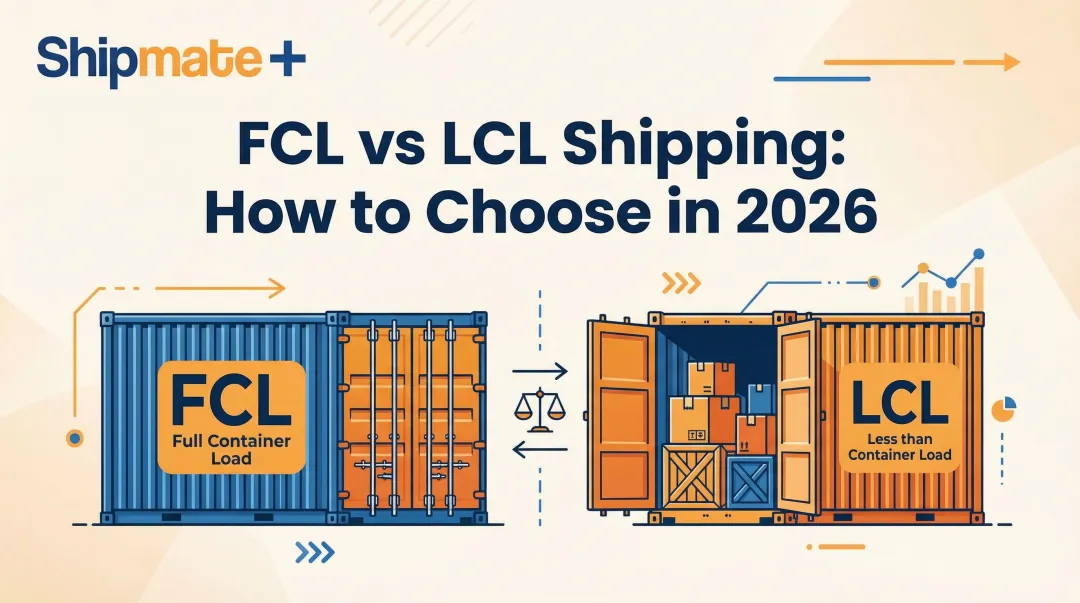
FCL (Full Container Load) is an ocean freight term for booking an entire shipping container. FTL (Full Truckload) applies to ground/road transport. Both mean dedicated capacity, but they operate in different modes: FCL for sea freight, FTL for trucking.
What is FTL and LCL?
FTL is a road freight term for a full dedicated truck. LCL (Less than Container Load) is the ocean freight equivalent of LTL—both involve sharing space with other shippers to cut costs. LCL applies to sea containers; LTL applies to trucks.