This guide covers the main types of freight shipping, the five factors that should drive your decision, and how to match your specific shipment profile to the right carrier or service — before you book, not after.
Key Takeaways
- Freight shipping includes parcel, LTL, FTL, air, and ocean — each suited to different shipment sizes, distances, and urgency levels
- Five factors drive the decision: shipment weight and size, destination, speed requirements, budget, and special handling needs
- Comparing FedEx, UPS, and USPS side-by-side beats defaulting to one carrier — especially for domestic small business shipments
- Accessorial fees (fuel surcharges, residential delivery, oversized charges) can represent 20–35% of total parcel shipping spend — always request itemized quotes
- LTL freight makes sense when shipments exceed 150 lbs but don't fill a full truck — a freight broker or multi-carrier shipping center can find the best rate fast
What Is Freight Shipping?
Freight shipping is the commercial transportation of goods in bulk or volume. The line between "parcel" and "freight" is more specific than most people assume: both FedEx and UPS define freight as any shipment over 150 lbs. USPS draws the line earlier — Ground Advantage caps at 70 lbs.
The main categories businesses encounter:
| Mode | Best For | Typical Size Range |
|---|---|---|
| Parcel/Courier | Individual packages, orders, documents | Under 150 lbs |
| LTL (Less-than-Truckload) | Palletized goods, bulk inventory | 150–15,000 lbs |
| FTL (Full Truckload) | Large volume, direct routing | 15,000+ lbs |
| Air Freight | Time-sensitive, high-value international | Any size |
| Ocean Freight | High-volume international shipments | Container loads |
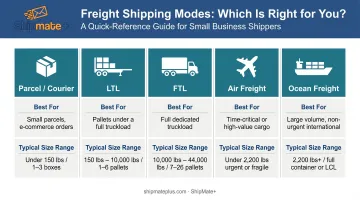
APQC benchmarks put the median cost of the "deliver products and services" supply chain function at $90 per $1,000 in revenue. At that scale, choosing the wrong mode or carrier consistently erodes profit — which is exactly why getting this decision right matters.
Types of Freight Shipping Options for Businesses
Every freight mode has a specific sweet spot. Ship outside it, and you're either paying for capacity you don't need or accepting slower transit times on shipments that needed to move faster.
Parcel and Courier Shipping (FedEx, UPS, USPS)
Parcel covers packages under 150 lbs and is the most common method for small businesses shipping individual orders, samples, or documents. Three carriers dominate domestic parcel volume — and they're not interchangeable.
Key differences worth knowing:
- USPS reaches every U.S. address, including PO Boxes and rural routes — nearly 167 million delivery points. Best value for packages under 2 lbs. Note: UPS and FedEx cannot deliver to PO Boxes
- UPS leads on revenue share (35% of the U.S. parcel market) and posted the best peak-season on-time performance in December 2024 at 96.5%, compared to FedEx at 91.8% and USPS at 90.4%
- FedEx is strongest for time-sensitive express and overnight delivery, and handles international particularly well
No single carrier wins across all scenarios. Comparing rates for each shipment rather than defaulting to one carrier is where real cost savings happen.
Less-Than-Truckload (LTL) Freight
LTL ships freight that doesn't fill an entire truck. Your goods share trailer space with other shippers' cargo, and you pay only for the portion of capacity you use. Typical range: 150 to 15,000 lbs, or roughly 1–6 pallets.
LTL makes sense when:
- Your shipment exceeds parcel size limits but doesn't justify a full truck
- You're moving palletized goods, manufacturing parts, or bulk retail inventory
- Cost matters more than transit speed (LTL involves multiple stops and longer windows)
Freight class (NMFC class 50–500) determines your LTL rate. It's assigned based on four characteristics: density, stowability, ease of handling, and liability. Higher-density shipments that are easy to handle earn lower freight classes — and lower rates per pound.
FTL, Air, and Ocean Freight
Full Truckload (FTL): One trailer, one shipper. The truck goes directly from origin to destination, which reduces handling and transit time. A standard trailer holds 24–26 pallets. FTL is the right call at 15,000+ lbs, or when you need direct routing for fragile or time-critical freight.
Air freight: Fastest option, highest cost. According to IATA, air cargo represents over 33% of global trade by value despite accounting for less than 1% of volume. That ratio reflects the reality: air moves high-value, time-sensitive shipments where speed justifies the premium.
Ocean freight: Slowest, cheapest for high-volume international. A comparable shipment can cost five times more by air than by ocean — a gap that makes ocean the clear choice for bulk imports or exports where a few weeks' transit time is acceptable. For bulk imports or exports where a few weeks' transit time is acceptable, ocean is the obvious choice.
Key Factors to Consider When Choosing a Freight Shipping Option
The lowest rate on a quote sheet isn't always the lowest total cost. Choosing a freight option means matching your shipment's specific profile — size, destination, urgency, and contents — to the mode and carrier that delivers the best result on every front.
Shipment Size and Weight
Weight and dimensions are your first filter:
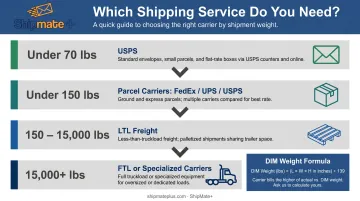
- Under 70 lbs → USPS is in play
- Under 150 lbs → Parcel carriers (FedEx, UPS, USPS) apply
- 150–15,000 lbs → LTL freight territory
- 15,000+ lbs → FTL or specialized carriers
Watch out for dimensional weight (DIM weight). Both FedEx and UPS calculate it by dividing length × width × height (in inches) by a divisor — 139 for most FedEx shipments, and 139 or 166 for UPS depending on rate type. If your DIM weight exceeds actual weight, you're billed on DIM weight. A lightweight but bulky package can cost significantly more than its scale weight suggests.
Destination and Coverage
Where the shipment is going narrows carrier options quickly:
- PO Boxes or rural addresses → USPS is often your only reliable option. UPS explicitly doesn't deliver to PO Boxes, and FedEx's domestic PO Box delivery is limited to Ground Economy (a contract-only service)
- Commercial urban deliveries → FedEx and UPS have strong networks and better reliability data
- International → Carrier customs capabilities and partnerships vary significantly; documentation requirements add complexity
Delivery Speed and Urgency
Ground shipping costs the least but takes 1–7 business days domestically. Express services (FedEx Overnight, UPS Next Day Air) guarantee faster delivery at a higher price.
A practical approach is to segment shipments by urgency:
- Routine replenishment orders → ground shipping keeps costs down
- Time-critical or high-value items → express rates are justified
- Mixed shipment batches → default to ground unless a deadline requires otherwise
Treating every shipment the same way — always rushing or always going cheapest — costs more over time.
Budget and Total Shipping Cost
The base rate on a quote rarely reflects what you'll actually pay. Accessorial fees — fuel surcharges, residential delivery, signature required, oversized fees, address corrections — can represent 20–35% of your total shipping bill and climb toward 40% during peak season.
Before booking, always:
- Request a fully itemized quote
- Compare total landed cost across carriers, not just base rates
- Account for residential vs. commercial delivery charges if applicable
Special Handling Requirements
Fragile, hazardous, temperature-sensitive, or high-value goods require verification before booking.
Key restrictions to know:
- USPS has specific lithium battery limits (cells under 1.0g lithium content domestically; international lithium batteries are largely prohibited unless installed in the device)
- FedEx and UPS both have hazardous materials programs with their own packaging and documentation requirements
- Damage claims typically require proof of professional packaging — UPS specifically requires photos of the item, interior packing, the shipping label, and exterior damage for a claim to be honored
How ShipMate+ Makes Freight Shipping Easier for Your Business
For small businesses in Vista and the North San Diego County area, ShipMate+ removes most of the friction described above.
As a FedEx Authorized ShipCenter, UPS Authorized Shipping Outlet, and USPS Approved Shipper, ShipMate+ gives you access to all three major carriers under one roof — domestic, express, and international services from each. That means you can compare rates across FedEx, UPS, and USPS for a single shipment and pick the option that fits your timeline and budget.
When your shipment outgrows a standard parcel, ShipMate+ also handles LTL, FTL, air cargo, and ocean freight through a network of 40+ freight and cargo carriers — covering palletized inventory, industrial equipment, vehicles, and full household moves.
Key services for business shippers:
- Multi-carrier rate comparison and drop-off (FedEx, UPS, USPS — daily pickups from all three)
- Professional packing with an insurability guarantee on items packed in-store
- Custom box-making for oversized or irregular items
- International shipping to 200+ countries with full customs documentation support (Commercial Invoices, Pro Forma Invoices, EEI forms)
- Free package receiving and signing — staff accepts packages from all major carriers
- Email and text notifications when packages arrive
- Discounted pricing on packaging supplies (20+ corrugated box sizes, bubble wrap, packing peanuts, heavy-duty tape)
- Private mailbox rental with a real street address — not a PO Box — suitable for business registration
- Extended hours: Monday–Friday 9AM–6PM, Saturday 9AM–1PM
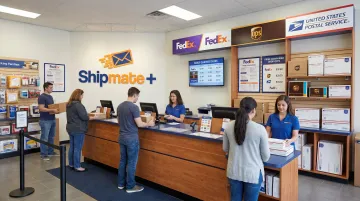
Those hours matter if you're running a business. Most carrier retail locations close by 5PM and run longer lines. ShipMate+ stays open later, moves faster, and handles everything in a single stop — so you're back to work, not waiting.
Conclusion
Start with weight and dimensions — that single filter eliminates most of the wrong options immediately. From there, work through the remaining filters in order:
- Destination (domestic, regional, or international)
- Urgency (standard transit vs. time-definite delivery)
- Total cost, including accessorial charges
- Special handling requirements
That sequence prevents most of the common mistakes.
One habit worth keeping: revisit your carrier choices periodically. As your shipment volumes, destinations, or product types shift, the carrier and service level that made sense six months ago may not be the right call today. Freight decisions aren't permanent — and a quick comparison at the point of booking consistently outperforms locked-in routines.
If you're shipping out of Vista or anywhere in North San Diego County, ShipMate+ compares rates across FedEx, UPS, and USPS at the counter — so you can see your options side by side before committing to a service level.
Frequently Asked Questions
What factors should I consider when choosing the right freight shipping option for my business?
The five core factors are shipment size and weight, destination, delivery speed, total budget (including accessorial fees like fuel surcharges, residential delivery, and liftgate charges), and any special handling requirements. Matching all five to the right carrier and service type, rather than optimizing for just one, produces the best outcome.
What are the four types of freight?
The four commonly recognized freight types are:
- Ground/road (LTL and FTL) — handles most domestic shipments
- Air freight — best for speed-critical international cargo
- Ocean/sea freight — moves high-volume international goods at the lowest cost
- Courier/parcel — covers packages under 150 lbs
How do I determine freight class for shipping?
Carriers assign freight class (NMFC class 50–500) based on four characteristics: density, stowability, ease of handling, and liability. Higher-density shipments that are easy to handle earn lower freight classes, which means lower rates per pound.
What is the difference between parcel shipping and freight shipping?
Parcel shipping handles individual packages generally under 150 lbs via carriers like FedEx, UPS, or USPS. Freight shipping handles larger, heavier, or palletized shipments — typically moved via LTL, FTL, or specialized carriers — where size or weight exceeds standard parcel limits.
Is it cheaper to ship with FedEx, UPS, or USPS?
It depends on the package's weight, dimensions, destination, and service level. USPS generally offers better rates for packages under 2 lbs, while UPS and FedEx are more competitive for heavier parcels and commercial deliveries. Comparing all three for each shipment is the only reliable way to find the lowest total cost.
What happens if my shipment is lost or damaged during freight shipping?
Most carriers include limited declared-value liability in the base rate, with additional coverage available for high-value shipments. Filing a claim requires proof of proper packaging, so document your materials before shipping and retain all receipts.