Introduction
Picture this: you're a small business owner staring at two wildly different freight quotes for the same shipment. One carrier wants to charge you $1,800 for an entire truck. Another offers to move your six pallets for $650 by sharing space with other shippers. Which one saves you money? Which one gets your products there faster? And which one won't leave your cargo damaged at the loading dock?
That choice matters more than most shippers realize. The wrong call can cost you hundreds — or thousands — in wasted truck space, add days to your delivery timeline, or leave your cargo damaged at the dock. According to industry data, LTL shipments experience an average damage rate of 1.24% due to multiple handling touchpoints, while FTL shipments see significantly less handling risk.
This guide covers clear definitions of FTL and LTL, side-by-side cost and speed comparisons, and a practical framework for choosing the right option based on your shipment size, budget, and timeline.
Key Takeaways
- FTL reserves an entire truck for your shipment alone — fastest option for large or time-sensitive loads
- LTL splits truck space with other shippers, making it the most economical choice for shipments under 10,000 lbs
- FTL delivers direct with minimal handling; LTL routes through terminals, adding 2-3 days in transit
- Key decision factors: weight, pallet count, urgency, cargo fragility, and budget
- For very small shipments under 150 lbs, parcel carriers offer better rates than either FTL or LTL
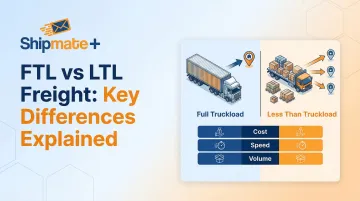
FTL vs. LTL: Quick Comparison
| Factor | FTL | LTL |
|---|---|---|
| Cost | Flat rate for full truck (~$2.50–$3.50/mile) | Pay only for space used; priced by class, weight, distance |
| Transit Time | 1–2 days (direct, no stops) | 3–7 days (multiple terminal stops) |
| Cargo Handling | Loaded/unloaded once | Handled 5+ times between pickup and delivery |
| Shipment Size | 10,000+ lbs or 10+ pallets | 150–10,000 lbs, typically 1–6 pallets |
| Flexibility | Full truck cost regardless of fill level | Scale shipment size without committing to full truck |
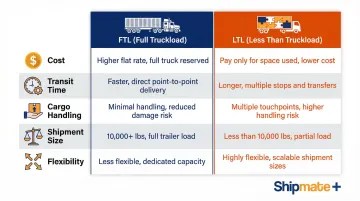
Cost
FTL: You pay a flat rate for the entire truck, typically $2.50–$3.50 per mile including fuel. The absolute cost is higher, but the per-unit cost drops significantly at high volumes. Shipping 20 pallets across 500 miles might cost around $1,500 total.
LTL: You pay only for the space you use, priced by freight class, weight, and distance. A six-pallet shipment might cost $650 for the same 500-mile route.
Transit Time
FTL: Direct, point-to-point delivery with no intermediate stops. A cross-country FTL shipment typically takes 1–2 days.
LTL: Multiple terminal stops and freight transfers. The same route can take 3–7 days depending on the carrier's hub-and-spoke network design.
Cargo Handling
FTL: Loaded once at origin, unloaded once at destination. Minimal handling means lower damage risk and better security since the trailer isn't opened mid-route.
LTL: Freight moves between multiple trucks and terminals. Industry estimates suggest each pallet is handled at least five times between pickup and delivery, increasing the chance of damage or loss.
Shipment Size
FTL: Best for loads that fill or nearly fill a 48–53 ft trailer. Typical threshold: 10,000+ lbs or 10+ pallets.
LTL: Designed for smaller shipments between 150 lbs and 10,000 lbs, typically 1–6 pallets.
Flexibility
FTL: Less flexible — you pay for the full truck whether you use 50% or 100% of the space.
LTL: Highly scalable. You can adjust shipment size without committing to an entire truck, making it practical for businesses with variable shipping volumes.
What is FTL (Full Truckload) Freight?
FTL means you reserve the entire capacity of a truck or trailer for your shipment alone. No other shipper's freight is loaded, and the truck travels directly from origin to destination — no intermediate stops, no shared space.
Here's how a typical FTL shipment moves from pickup to delivery:
How the FTL Process Works:
- Booking: You provide origin, destination, shipment size, weight, and any special requirements (temperature control, lift gate, etc.)
- Carrier Pickup: The carrier arrives with an empty trailer dedicated to your freight
- Direct Transit: The truck travels straight to your destination with no intermediate stops
- Delivery & Inspection: Your freight is unloaded and inspected at the destination
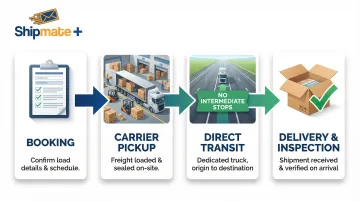
Those steps translate into a few concrete advantages — but also some real tradeoffs worth knowing before you commit.
Core Advantages:
- Arrives faster since the truck drives straight through without stops
- Reduces damage risk — freight is loaded once, unloaded once
- Limits theft and tampering exposure because the trailer isn't shared or reopened mid-route
- Costs less per pallet than LTL when shipping 15+ pallets at scale
Key Drawbacks:
- You pay for the full trailer even if your load only fills 60% of it
- Typically requires 10+ pallets or 15,000–20,000 lbs to be cost-effective
- Once loaded, changes to the shipment are difficult to make
Use Cases of FTL
FTL is the right choice when:
- Shipping large volumes regularly (10+ pallets or 15,000+ lbs)
- Transporting fragile or high-value goods that can't tolerate extra handling
- Meeting strict delivery windows for retail restocking or manufacturing production schedules
- Shipping perishables like food and beverage that require uninterrupted cold-chain continuity
Industries that rely heavily on FTL:
- Manufacturing: Raw materials and finished goods moving between facilities
- Retail: Distribution center to store shipments for seasonal inventory
- Food & Beverage: Perishables requiring temperature-controlled trailers
- Construction: Heavy materials like lumber, steel, and concrete
- E-commerce: Large or bulky items like furniture and appliances
What is LTL (Less Than Truckload) Freight?
LTL means multiple shippers share space in the same trailer, each paying only for the portion they use. The carrier picks up and delivers freight for several customers along one route, stopping at terminals to sort and consolidate shipments.
How LTL Pricing Works:
LTL rates are calculated using a complex formula based on:
- Weight and dimensions of your shipment
- Distance between origin and destination
- Freight class: A standardized classification system managed by the National Motor Freight Traffic Association (NMFTA)
Freight class ranges from 50 to 500, determined by four factors: density (lbs per cubic foot), ease of handling, stowability, and liability (damage or theft risk).
Dense, compact items like bricks land in low classes (cheaper rates). Light, bulky items like lampshades land in high classes (more expensive).
Core Advantages:
- Pay only for the trailer space you actually use
- Ship 1–6 pallets without committing to a full truck
- Scale shipment sizes up or down as demand shifts
- Access extensive carrier networks covering most domestic routes
Key Drawbacks:
- Transit times run 2–3 days longer than FTL due to terminal transfers
- Freight is unloaded and reloaded multiple times, raising damage risk
- Delivery windows are less predictable — terminal delays and route changes happen
- Damage claims are harder to resolve when multiple handlers are involved
Use Cases of LTL
LTL works best when:
- Shipping smaller loads (1–6 pallets or under 5,000–10,000 lbs)
- Managing fluctuating shipment volumes where full truckloads aren't always available
- Testing a new trade lane before committing to regular FTL volumes
- Balancing cost over speed — you can wait a few extra days for significant savings
Important Threshold:
For very small or lightweight shipments under 150 lbs, standard parcel carriers like FedEx, UPS, or USPS are often faster and more cost-effective than LTL freight. Major carriers enforce a strict 150 lb weight limit for parcel networks — anything heavier must move via freight.
If your shipment falls under that 150 lb threshold, ShipMate+ in Vista, CA handles FedEx, UPS, and USPS shipping under one roof — so you can compare rates and pick the right service without making multiple stops.
FTL vs. LTL: Which One Should You Choose?
The right choice depends on five key factors:
1. Shipment Weight and Pallet Count
This is your most reliable starting point.
- 10+ pallets or 10,000+ lbs: FTL is usually more economical
- 1–6 pallets or under 5,000 lbs: LTL is typically cheaper
- Under 150 lbs: Use parcel carriers (FedEx, UPS, USPS)
2. Time Sensitivity
- FTL: Direct delivery, faster transit times
- LTL: Saves money if you can wait 3–7 days
3. Cargo Fragility and Value
- Fragile or high-value goods: FTL minimizes handling and damage risk
- Durable goods that can tolerate handling: LTL is acceptable
4. Budget Constraints
- LTL: Lower upfront cost for budget-conscious shipments
- FTL: Worth the premium when speed and cargo security matter
5. Shipping Frequency
- High-volume, regular shipments: FTL becomes more cost-effective over time
- Occasional or variable shipments: LTL gives you flexibility without commitment
Decision Framework
Choose FTL if:
- Your shipment is 10,000+ lbs or 10+ pallets
- You need guaranteed delivery within 1–2 days
- You're shipping fragile, high-value, or perishable goods
- You require a dedicated truck with no other freight
Choose LTL if:
- Your shipment is under 10,000 lbs or fewer than 6 pallets
- Cost savings outweigh speed
- Your cargo can tolerate extra handling
- You have flexible delivery windows
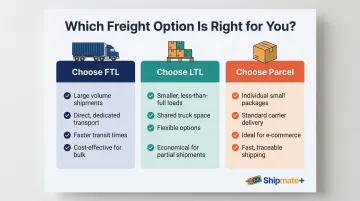
Consider parcel shipping if:
- Your shipment is under 150 lbs
- You need fast delivery without freight complexity
The Gray Zone: 5,000–10,000 lbs
The framework above covers most situations, but shipments between 5,000 and 10,000 lbs (roughly 6–10 pallets) sit in murkier territory. The cost difference between LTL and FTL can be marginal here. In this range, Volume LTL and Partial Truckload (PTL) options offer flat-rate spot pricing that may beat standard LTL tariffs.
Practical tip: Request quotes for both LTL and FTL before committing — the difference can surprise you.
ShipMate+ in Vista, CA works with multiple carriers across FTL, LTL, air cargo, and sea container shipping. If you're not sure which option fits your shipment, call (760) 295-1074 or email info@shipmateplus.com for a free freight quote.
Conclusion
Neither FTL nor LTL is universally superior — the right choice depends entirely on your shipment size, urgency, cargo type, and budget. Understanding these differences helps you avoid overpaying for unused truck space or sacrificing speed when you need it most.
Quick recap:
- FTL is faster and safer for large, time-sensitive, or fragile shipments
- LTL is more economical for smaller loads that don't fill a trailer
- For shipments under 150 lbs, parcel carriers offer the best combination of speed and cost
Evaluate your next shipment against the criteria covered in this guide: weight, pallet count, delivery timeline, cargo fragility, and budget. If you're still unsure which option fits your needs, a freight specialist can compare rates and find the right carrier for you.
ShipMate+ in Vista, CA handles FTL, LTL, air cargo, sea container shipping, and multi-carrier parcel services — along with professional packing, palletizing, and crating. Stop by at 1929 W Vista Way Suite F, Vista, CA 92083, or call (760) 295-1074 to talk through your next shipment.
Frequently Asked Questions
What does FTL mean in freight?
FTL stands for Full Truckload, meaning a shipper reserves an entire truck for their shipment alone. No other cargo shares the space — the truck travels directly from origin to destination.
Is FTL cheaper than LTL?
It depends on shipment size. FTL becomes more cost-effective per unit at high volumes (10+ pallets or 15,000+ lbs), while LTL is cheaper for smaller loads since you only pay for the space you use.
What is the minimum shipment size for LTL freight?
LTL typically handles shipments between 150 lbs and 10,000 lbs (roughly 1–6 pallets). Anything under 150 lbs usually ships at lower cost via parcel carriers like FedEx, UPS, or USPS.
How long does LTL freight take compared to FTL?
FTL is generally faster because it travels direct with no intermediate stops, taking 1–2 days for most routes. LTL involves terminal transfers and multiple stops that can add 2–3 days, resulting in 3–7 day transit times.
What is the difference between freight shipping and parcel shipping?
Parcel shipping (via FedEx, UPS, USPS) handles individual packages under ~150 lbs with fast delivery networks. Freight shipping (LTL or FTL) is designed for larger, heavier, or palletized shipments that exceed parcel carrier limits.
Can small businesses use LTL shipping?
Yes, LTL is a practical option for small businesses — you only pay for the truck space your shipment occupies, not the whole trailer. If you're unsure which freight option fits your load, a local pack-and-ship center like ShipMate+ can help you compare carriers and arrange the right service.