Introduction
Every international shipper faces the same core question when booking ocean freight: do you book an entire container, or share one? FCL (Full Container Load) and LCL (Less than Container Load) are the two dominant ocean freight methods, each suited to very different cargo volumes and timelines.
This choice carries real weight in 2026. Tariff volatility, shifting supply chains, and rising freight costs mean the wrong call can cost you on both price and delivery time. This guide walks through how each method works, where each one wins, and the decision criteria that actually matter.
Key Takeaways
- FCL means one shipper books an entire container; LCL means your cargo shares space with other shippers and is priced by volume (CBM)
- FCL is faster, more secure, and cost-effective — typically once cargo exceeds 25–30 CBM
- LCL suits small or irregular shipments, startups, and businesses that need flexibility
- Tariff volatility is shifting costs — always check current freight rates before committing
FCL vs. LCL at a Glance
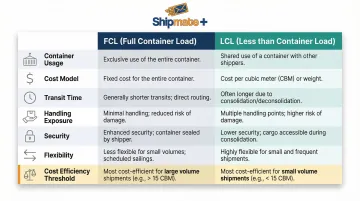
Understanding the core differences between FCL and LCL helps you make informed shipping decisions. Here's how they compare across critical factors:
| Factor | FCL (Full Container Load) | LCL (Less than Container Load) |
|---|---|---|
| Container Usage | Exclusive — one shipper books entire container | Shared — multiple shippers share one container |
| Cost Model | Flat rate per container (regardless of space used) | Priced per CBM or weight, whichever is greater |
| Typical Transit Time | Faster — direct routing without consolidation stops | 5-10 days longer due to CFS handling |
| Handling Exposure | Minimal — sealed at origin, opened at destination | Higher — multiple touchpoints at consolidation facilities |
| Security | High — container remains sealed throughout journey | Moderate — cargo handled at CFS locations |
| Flexibility | Lower — requires full container volume commitment | Higher — ship smaller quantities more frequently |
| Cost Efficiency Threshold | Economical above 25-30 CBM (2026 rates) | More cost-effective below 25 CBM |
The Break-Even Point Has Shifted
The old 15 CBM rule no longer holds in 2026. With Asia-US West Coast LCL rates running $110-$150 per CBM and 20-foot FCL rates between $1,900-$3,200, the break-even point now sits at 25-30 CBM.
2026 Break-Even Analysis:
- Shanghai to Los Angeles: Break-even at approximately 27 CBM
- Hong Kong to New York: Break-even at approximately 28 CBM
- Singapore to London: Break-even at approximately 29 CBM
This means shippers upgrading to FCL at 15 CBM are overpaying by 40-70% compared to LCL. Calculate your specific break-even point based on current market rates before committing.
When to Use Both FCL and LCL
Many mid-sized importers run both methods within the same supply chain. Each serves a distinct purpose:
- FCL for large, scheduled bulk replenishment where volume justifies a full container
- LCL for urgent restocks, test shipments, or orders splitting across multiple destinations
- LCL when cash flow makes smaller, more frequent orders preferable to large single loads
Matching the method to the shipment type — rather than defaulting to one — typically produces the best cost outcome.
What is FCL Shipping?
FCL (Full Container Load) means one shipper exclusively books an entire shipping container — either a 20-foot or 40-foot unit. The container is sealed at origin and remains untouched until it reaches its destination. Even if your cargo doesn't fill the container completely, it still travels as FCL.
Core Operational Benefits
- Reduced handling: The container is sealed at your facility and opened only at the destination, avoiding the multiple touchpoints that increase damage and theft risk.
- Faster transit: FCL containers bypass consolidation stops, typically arriving 5-10 days faster than LCL on comparable routes.
- Predictable pricing: You pay one flat container rate regardless of fill level, making cost forecasting straightforward.
Container Size Options
Understanding container capacity helps you choose the right option:
| Container Type | Capacity (CBM) | Standard Pallets (48"x40") | EUR Pallets (1200x800mm) |
|---|---|---|---|
| 20-Foot Standard | 33.2 CBM | 10 pallets | 11-12 pallets |
| 40-Foot Standard | 67.7 CBM | 20-22 pallets | 24-30 pallets |
| 40-Foot High Cube | 76.3 CBM | 20-21 pallets | 25 pallets |
What does "40 FCL" mean? A 40-foot FCL refers to booking a full 40-foot shipping container exclusively for your cargo. High cube variants provide an extra foot of vertical space, maximizing volume for lighter goods without altering the floor-level pallet footprint.
FCL Drawbacks
- Higher upfront cost: You pay the full container rate regardless of fill level, making FCL impractical for smaller or infrequent shipments.
- Inflexible scheduling: Waiting to consolidate enough cargo to justify a full container can delay shipments when volume is inconsistent.
- Facility requirements: You need space at both origin and destination to load and unload a full container within the allowed free time window.
When to Use FCL
Choose FCL when:
- Cargo volume approaches or exceeds 25-30 CBM — the break-even point where FCL becomes more cost-effective than LCL
- High-value, fragile, or temperature-sensitive goods require minimal handling to reduce damage risk
- Time-critical shipments where delays from consolidation are unacceptable (product launches, seasonal inventory)
- Predictable, regular shipping cycles allow you to benefit from consistent container bookings
Free Time Windows and Demurrage Fees
With FCL, shippers typically have a limited "free time" window to pick up and return the container before fees accrue. At major US West Coast terminals like LA/LB, this window is often just 4 days. After free time expires, demurrage and per diem fees escalate rapidly — often $150-$250 per day. A container left at the port for one week beyond free time can easily accrue over $1,000 in penalties.
What is LCL Shipping?
LCL (Less than Container Load) means cargo from multiple shippers is consolidated into one shared container at a Container Freight Station (CFS). It's then transported together and deconsolidated at the destination before delivery to each recipient. Pricing is based on volume (CBM) or weight, whichever is greater.
Core Benefits
Pay only for space used. You're charged only for the cubic meters your cargo occupies — not the full container.
Ship on your schedule. No need to wait until you've accumulated full-container volumes, which supports lean inventory strategies.
Well-suited for growth and testing. Growing businesses, seasonal shippers, and companies exploring new trade lanes can use LCL without committing to FCL volumes.
Key Drawbacks
More handling points increase risk. Cargo moves through consolidation, deconsolidation, and customs at multiple stops — each one a potential source of damage or delay.
Longer transit times. Expect LCL shipments to run 5-10 days longer than FCL on the same route due to CFS processing.
Packaging becomes critical. Because LCL goods are handled multiple times, sturdy, freight-ready packaging is essential to ensure they arrive intact.
If you're shipping freight from the Vista, CA area, ShipMate+ offers professional freight-ready packing services to protect your goods at every stage of transit.
When to Use LCL
These drawbacks are manageable when the shipment profile is right. Choose LCL when:
- Cargo is under roughly 25 CBM and doesn't justify a full container
- Irregular or seasonal shipment volumes make FCL commitments impractical
- Shipping to multiple destination points within a region
- E-commerce sellers managing lean inventory need steady, smaller-batch replenishment
- Testing a new trade lane or supplier before committing to FCL volumes
FCL vs. LCL: How to Choose the Right Option in 2026
Factor 1: Cargo Volume and the Break-Even Calculation
The first step is calculating whether LCL or FCL is more cost-effective for your shipment. In 2026, Asia-US West Coast LCL rates average $110-$150 per CBM, while a 20-foot FCL costs $1,900-$3,200.
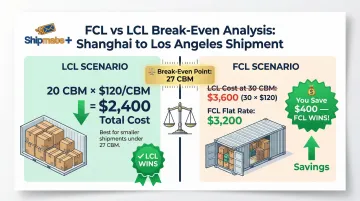
Example calculation (Shanghai to LA):
- LCL rate: $120/CBM
- 20' FCL rate: $3,200
- Break-even point: $3,200 ÷ $120 = 27 CBM
If your shipment is 20 CBM, LCL costs $2,400 versus $3,200 for FCL — a 25% savings. At 30 CBM, FCL costs $3,200 versus $3,600 for LCL — FCL saves 11%.
Factor 2: Urgency and Transit Time
FCL avoids consolidation delays and typically delivers 5-10 days faster on comparable routes. For time-sensitive shipments — product launches, replenishment deadlines, seasonal inventory — this speed advantage often justifies the higher cost of FCL even at moderate volumes.
Transit time comparison: An FCL container might transit Shanghai to LA in 31 days. LCL on the same route takes 43 days — the container must be discharged at a transshipment hub, broken down, sorted, and reconsolidated before final delivery.
Factor 3: Cargo Type and Handling Sensitivity
Fragile goods, electronics, high-value items, or anything requiring temperature control should default to FCL where possible. Industry data shows two-thirds of cargo damage claims are caused or worsened by poor packing, and LCL's multi-touch nature raises that risk considerably.
For durable, non-sensitive cargo, LCL is a reasonable choice — additional handling rarely causes problems when goods are properly packaged.
Factor 4: Budget, Cash Flow, and Inventory Strategy
Your choice here comes down to upfront cost versus long-term unit economics:
LCL advantages:
- Lower upfront cost reduces capital commitment
- Enables lean inventory by shipping smaller, more frequent batches
- Reduces warehousing costs by avoiding large stock accumulation
FCL advantages:
- Lower cost-per-unit at high volumes
- Predictable pricing simplifies financial forecasting
- Economies of scale for established supply chains
Factor 5: 2026-Specific Considerations
Several factors unique to 2026 affect your FCL/LCL decision:
Tariff volatility: The US Supreme Court struck down IEEPA-based tariffs in February 2026, triggering a replacement 10% global import duty. LCL's flexibility helps importers match order volumes to fluctuating demand without overcommitting to full containers.
Warehousing crunch: The 2025 front-loading rush spiked US warehousing demand by 25%, pushing vacancy rates to 4.5%. Shipping smaller, more frequent LCL loads lets importers avoid paying for storage they don't have.
Port congestion: LA/LB moved record volumes in 2025, worsening chassis shortages. Extended street dwell times have made demurrage planning critical for FCL shippers — budget for it.
Global schedule reliability fell to 62.8% in late 2025, and carriers deployed 136 blank sailings in February 2026 alone (a 122% month-over-month jump) to manage excess capacity. Build buffer time into any FCL plan.
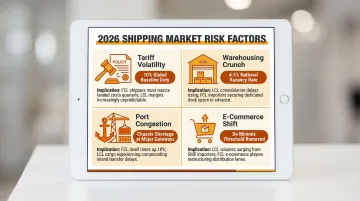
E-commerce shift: Removal of the $800 de minimis threshold pushed DTC brands off individual parcel shipping from China. Many are now consolidating millions of units via ocean freight to US warehouses, driving a surge in LCL demand — and tighter LCL space on peak lanes.
Decision Summary
Choose FCL if:
- Your cargo exceeds 25-30 CBM
- You're shipping high-value, fragile, or time-sensitive goods
- You have predictable, regular shipping volumes
- You can accommodate demurrage windows and have warehouse capacity
Choose LCL if:
- Your cargo is under 25 CBM
- You need flexibility for irregular or seasonal volumes
- You're managing lean inventory or testing new markets
- Lower upfront cost and cash flow preservation are priorities
Real-World Examples: FCL and LCL in Action
Electronics Industry: FCL for Speed and Security
Companies shipping large quantities of high-value electronics — smartphones, laptops, components — typically default to FCL. The reduced handling minimizes damage risk, and direct routing meets tight product launch timelines. Fairphone, a sustainable electronics manufacturer, shifted high-value smartphone shipments to surface freight using optimized routing decisions, reportedly cutting logistics costs by 28% while offsetting 100% of shipping-related carbon emissions.
The predictable FCL pricing model also simplifies supply chain cost forecasting for this sector, where margins are tight and product lifecycles are short.
Fashion and E-Commerce: LCL for Agility
Fashion and DTC e-commerce brands use LCL to ship seasonal product lines or small test orders. LCL allows these companies to respond to demand signals quickly, ship frequently in small batches, and avoid the inventory overstock risk that comes with committing to full-container volumes.
French fashion brand Sézane partnered with Kuehne+Nagel to establish a dedicated fashion logistics campus using flexible supply chain solutions to handle order surges during peak sales periods and new product launches — maintaining premium unboxing experiences without compromising delivery speed.
Mixed Strategy: Optimizing Cost and Flexibility
Mid-sized importers — automotive parts distributors, consumer goods brands — often use both methods:
- FCL handles large, scheduled bulk replenishment orders
- LCL covers urgent smaller shipments or multi-destination distributions
- Hybrid approaches shift the balance seasonally as volume demands change
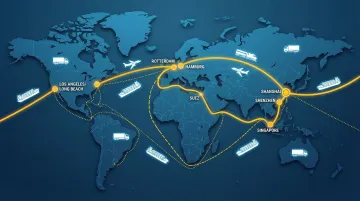
Retailer Currys PLC took a similar approach when Trans-Pacific capacity crunches hit. By diversifying sourcing — shifting from Asia to closer markets like Türkiye — and combining that near-shoring strategy with flexible LCL and FCL options through Maersk's network, the company maintained product flow through sustained supply chain disruptions.
Getting Cargo Freight-Ready: The Packing Factor
The examples above share one common thread: proper packaging protects margins. Whether your cargo is heading into LCL consolidation — where handling risk is higher — or being loaded directly into an FCL container, how your goods are packed before they reach a freight forwarder matters.
For businesses in Vista, CA and the surrounding area, ShipMate+ offers expert packing services to get your goods freight-ready. Reach us at (760) 295-1074 or info@shipmateplus.com.
Frequently Asked Questions
Is FCL or LCL cheaper?
LCL is cheaper for small shipments because you only pay for the space used. FCL becomes more cost-effective as volume increases, typically beyond 25-30 CBM in 2026 market conditions, because the flat container rate is spread across a larger cargo volume.
Which is better, FCL or LCL?
Neither is universally better. FCL suits high-volume, time-sensitive, or sensitive cargo, while LCL is better for smaller, flexible, or infrequent shipments. The right choice depends on your specific cargo volume, urgency, and budget.
How to know if the shipment is LCL or FCL?
Cargo volume is the primary indicator — under ~25-30 CBM typically means LCL. Check the bill of lading: LCL shipments reference a CFS (Container Freight Station), while FCL documents reference a single container assigned to one shipper.
Is LCL a good shipping option?
LCL works well for businesses with small or irregular volumes — it cuts upfront cost and supports flexible inventory planning. The trade-off is slightly longer transit times and more handling, so proper packaging matters more than with FCL.
What does 40 FCL mean?
A 40' FCL means booking a full 40-foot container exclusively for one shipper's cargo. It holds approximately 67.7 CBM (up to 76.3 CBM for a high-cube variant), making it ideal for larger shipments that exceed a 20-foot container's capacity.
How is FCL different from LCL?
FCL means one shipper has exclusive use of a container sealed from origin to destination, while LCL means cargo from multiple shippers shares one container and is consolidated and deconsolidated at freight stations. This difference affects cost, transit time, handling risk, and scheduling flexibility.