
Introduction
Imagine this: You're in Vista, CA, and you need to send a birthday gift to family in Germany. Or you're a small business owner fulfilling your first order to France. You're staring at a box on your kitchen table, wondering where to even start with international shipping to Europe.
Shipping to Europe from the US does require the right approach — choosing a reliable carrier, understanding customs rules, and packing your shipment correctly. This guide walks through each step, so you can ship with confidence whether you're sending a one-time gift or shipping regularly for work.
Key Takeaways
- Shipping to Europe typically takes 1–3 business days via express services or 6–16 business days via economy options
- FedEx, UPS, and USPS offer multiple service tiers at different price and speed points for US-to-Europe shipping
- Every package requires a completed customs declaration form listing contents, value, and purpose
- Prohibited items vary by country—verify what's allowed before shipping to avoid delays or seizure
- ShipMate+ lets you compare FedEx, UPS, and USPS rates in one stop—no guesswork required
Which Carrier Should You Use for Shipping to Europe?
The three main carriers for US-to-Europe shipping are FedEx, UPS, and USPS. The best choice depends on your budget, delivery speed, and destination country. ShipMate+ is an authorized shipper for all three, so you can compare rates and services in one stop at the Vista, CA location.
FedEx International Services to Europe
FedEx offers two primary services for European shipments:
- FedEx International Priority: Delivers in 1–3 business days to most European destinations, by end of business day — ideal for time-sensitive shipments like urgent documents or perishables
- FedEx International Economy: 2–5 business day delivery at a lower cost, suited for less urgent packages where speed matters less than price
Both services cover EU and non-EU countries, including the UK, Switzerland, and Norway.
UPS International Services to Europe
UPS provides three main international service tiers:
- UPS Worldwide Express: Next business day delivery to major EU cities, with time-specific delivery (often by 8:30-10:30 a.m. or noon)
- UPS Worldwide Saver: End-of-day delivery within 1–3 business days
- UPS Worldwide Expedited: 2–5 business day delivery at a lower cost
UPS is particularly strong for heavier packages and businesses needing reliable tracking and proof of delivery.
USPS International Services to Europe
USPS offers the most economical options for lighter packages:
- Priority Mail International: 6–10 business day delivery, accepts packages up to 70 lbs; computer-generated customs forms required
- Priority Mail Express International: 3–5 business day delivery with money-back guarantees to select destinations
- First-Class Package International Service: For packages under 4 lbs valued under $400 — the lowest-cost option for small, lightweight items
How Much Does Shipping to Europe from the US Cost?
Three key factors determine your shipping cost to Europe:
- Package weight and dimensions: All carriers use dimensional (DIM) weight pricing, billing for whichever is greater (actual weight or package volume). The formula is (Length × Width × Height) / DIM Divisor — FedEx and UPS use 139 for international shipments; USPS uses 166.
- Destination country: Shipping to major EU hubs like Germany or France typically costs less than remote areas or non-EU countries with separate customs processes.
- Delivery speed: Express services cost significantly more than economy options but deliver in a fraction of the time.
Sample Shipping Costs
For a 5 lb package (10" × 10" × 10") from Southern California to London, UK:
| Carrier | Service | Transit Time | Approximate Cost |
|---|---|---|---|
| USPS | Priority Mail International | 6-10 business days | $75-$95 |
| USPS | Priority Mail Express International | 3-5 business days | $95-$115 |
| FedEx | International Economy | 2-5 business days | $110-$140 |
| FedEx | International Priority | 1-3 business days | $145-$180 |
| UPS | Worldwide Expedited | 2-5 business days | $115-$145 |
| UPS | Worldwide Express | 1-3 business days | $150-$190 |
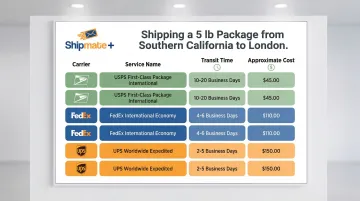
Rates are estimates and vary based on exact dimensions, destination postal code, and current fuel surcharges.
Hidden Cost Factors
Several additional charges can increase your final cost beyond the base rate:
- Fuel surcharges: FedEx and UPS apply variable fuel surcharges (adjusted weekly) as a percentage of transportation charges
- Residential delivery fees: FedEx and UPS charge extra for deliveries to home addresses versus commercial locations
- Remote area surcharges: Destinations outside major cities may add extra charges
- Insurance add-ons: Optional coverage for high-value items
Shipping Costs vs. Import Duties
Shipping costs are what you pay the carrier. Import duties and VAT are separate — the destination country's customs authority assesses them and typically charges them to the recipient.
You can choose Delivered Duty Paid (DDP) to prepay duties and taxes for your recipient, or Delivered Duty Unpaid (DDU) where the recipient pays upon delivery. DDP removes surprise charges for international buyers, which matters if you're shipping for business.
EU Customs, Duties, and Delivery Times Explained
Shipping to Europe means navigating customs — and getting the details right upfront saves your customers from delays, unexpected fees, or returned packages. The EU's 27 member countries share common trade rules, but non-EU countries like the UK (post-Brexit), Norway, and Switzerland each run their own separate customs processes.
Required Customs Documentation
Every package shipped to Europe requires a completed customs declaration form:
| Form | Also Known As | When Required | Key Details Needed |
|---|---|---|---|
| CN22 | PS Form 2976 (USPS) | Smaller, lower-value packages | Item descriptions, quantities, declared value, country of origin |
| CN23 | PS Form 2976-A (USPS) | Larger parcels and shipments | All CN22 fields plus HS codes and item-level breakdown |
Critical: Vague descriptions like "gift" or "merchandise" cause delays. Be specific—"cotton t-shirt" instead of "clothing," "ceramic coffee mug" instead of "household item."
All USPS customs forms must be computer-generated, not handwritten. At ShipMate+, we handle customs form preparation for every international shipment we process — so nothing gets held up over a paperwork error.
How Import Duties and VAT Work
Import duties are calculated based on:
- Product type (identified by HS code)
- Declared value
- Country of origin
VAT (Value-Added Tax) rates vary by EU country, typically ranging from 17% (Luxembourg) to 27% (Hungary). VAT is charged on top of duties.
Two regulatory changes affect every shipment to the EU:
- VAT on all imports: Since July 1, 2021, the EU eliminated the €22 VAT exemption — VAT now applies to all commercial imports regardless of value.
- New flat duty coming: Starting July 1, 2026, a €3 flat duty per item category applies to packages under €150, replacing the existing €150 customs duty exemption.
Realistic Delivery Times
Once customs clears — which adds its own time — carrier delivery windows look like this:
| Service | Carrier | Estimated Delivery |
|---|---|---|
| Express | FedEx, UPS | 1–5 business days |
| Express | USPS | 3–5 business days |
| Economy | FedEx, UPS | 2–7 business days |
| Standard | USPS | 6–16 business days |
Customs clearance at the destination can add 1–5 days on top of these estimates. The exact delay depends on the country, shipment value, and how accurately the documentation was completed.
How to Pack and Label Your Package for International Shipping
Packing Best Practices
Proper packing is essential for long-haul international transit:
- Use a sturdy, double-walled box appropriate for the item's weight
- Wrap fragile items in bubble wrap or foam with at least 2 inches of cushioning on all sides
- Fill empty space with packing material (peanuts, air pillows, crumpled paper) to prevent shifting
- Reinforce all seams with 2-inch packing tape using the "H" method (sealing top and bottom flaps)
- For extremely fragile items, use the two-box method: place a cushioned inner box inside a larger outer box
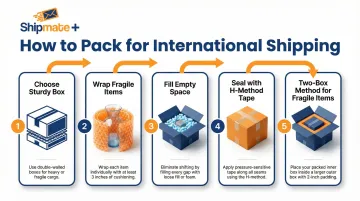
Note that improper packaging can void carrier insurance coverage. ShipMate+ offers professional packing services with trained experts who guarantee items for insurability — so your shipment stays protected from the moment it leaves Vista, CA.
Address Formatting for Europe
Correct address format prevents delivery delays:
RECIPIENT'S FULL NAME
STREET ADDRESS
POSTAL CODE CITY
COUNTRY NAME
Key points:
- Write the address in English
- In most European countries, the postal code appears before the city name
- Include the country name in capital letters on the last line
- Use the recipient's full name, not nicknames
Example (Germany):
HANS MUELLER
HAUPTSTRASSE 45
10115 BERLIN
GERMANY
Labeling Requirements
Before dropping off your package, confirm:
- Label placement: Attach the shipping label and customs form securely to the outside of the package
- USPS customs forms: Must be computer-generated — handwritten forms are not accepted
- Form accuracy: Incorrect or incomplete customs declarations are a leading cause of delivery delays
ShipMate+ generates all required customs forms as part of the shipping process, reducing the chance of rejections or hold-ups at customs.
What You Can and Can't Ship to Europe
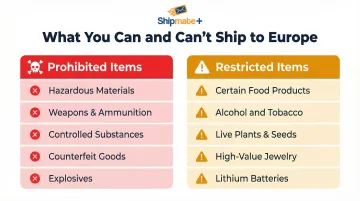
Broadly Prohibited Items
Europe has a common list of prohibited items regardless of country:
- Hazardous materials (flammable liquids, compressed gases, certain lithium battery configurations)
- Weapons and ammunition
- Controlled substances (including marijuana, hemp products, and CBD)
- Counterfeit goods
- Explosives and fireworks
Each EU country may add country-specific restrictions on top of these.
Commonly Restricted Items
These items may require special documentation or face refusal:
- Certain food products (meat, dairy, fresh produce)
- Alcohol and tobacco
- Live plants and seeds
- High-value items like jewelry or luxury goods
- Lithium batteries (strict rules apply—USPS only allows batteries installed in equipment; FedEx and UPS have specific packing requirements)
Not Sure If Your Item Is Allowed?
Carrier rules vary — especially for lithium batteries, where USPS, FedEx, and UPS each have different requirements. The ShipMate+ team can walk you through what's allowed, which carrier fits your shipment, and what documentation you may need.
The USPS maintains individual country listings detailing specific prohibitions and restrictions for each destination.
Frequently Asked Questions
What is the cheapest way to ship to Europe?
USPS Priority Mail International and First-Class Package International Service are typically the most affordable options for lighter packages (under 10 lbs). For heavier shipments, economy services from FedEx and UPS may be competitive. ShipMate+ can pull quotes from all three carriers side-by-side so you can choose the best rate for your shipment.
How much does US to UK shipping cost?
Costs vary by weight, dimensions, and service level. For a small package (under 10 lbs), expect $75-$95 via USPS Priority Mail International (6-10 days) or $145-$190 via FedEx/UPS express services (1-3 days). Remember: the UK is no longer in the EU, so customs documentation and duties apply to all shipments.
How much would it cost to ship a 20 lb package internationally?
Expect approximately $150-$220 via USPS Priority Mail International or $200-$300+ via UPS/FedEx Economy services to common EU destinations like Germany or France.
How to get US items shipped to the UK?
You can ship items from the US to the UK via USPS, FedEx, or UPS. All shipments require a customs declaration form and may be subject to UK import duties and VAT since Brexit.
Can I ship from the USA to Europe?
Yes, you can ship to all European countries from the US using major carriers like USPS, FedEx, and UPS. All packages require customs documentation and must comply with the destination country's import rules.
What does EU mean in shipping?
"EU" stands for European Union, a 27-country customs union that shares import regulations. Non-EU European countries like the UK, Norway, and Switzerland have separate customs requirements. Knowing whether your destination is in or out of the EU matters for documentation, duties, and processing times.
Ready to ship to Europe? Visit ShipMate+ at 1929 W Vista Way Suite F, Vista, CA 92083, or call (760) 295-1074 to compare rates across FedEx, UPS, and USPS and get expert help with your international shipment. Open Monday-Friday 9 AM-6 PM and Saturday 9 AM-1 PM.