

Introduction
You're at the counter with a package to send, staring at two familiar logos — UPS and FedEx — wondering which one will save you money, deliver faster, or get your shipment there in one piece. Both are household names, but they're built around very different strengths. UPS dominates domestic ground shipping with a unified network that reaches every corner of the US, while FedEx specializes in air express and international routes through multiple business units.
Choosing the right carrier directly affects your cost, delivery speed, and whether your package arrives on time. That matters most for individuals and small businesses paying retail rates without negotiated discounts. Hidden charges — residential delivery fees, fuel adjustments, and dimensional weight pricing — can quietly inflate your bill by 20% or more.
This guide compares UPS and FedEx head-to-head across pricing, speed, services, and real-world use cases, so you can make a confident choice every time you ship.
Key Takeaways
- UPS specializes in domestic ground delivery and handles heavy packages up to 150 lbs with better rates and fewer surcharges than FedEx
- FedEx excels at air express and international shipping, offering competitive overnight rates and service to 220+ countries
- Surcharges add up fast for both carriers: residential delivery fees ($6.95 at FedEx), fuel charges, and dimensional weight pricing all push costs well above base rates
- For international shipments, FedEx often wins on retail rates. For domestic ground, UPS typically offers better value, especially with volume discounts
- Neither carrier is universally better. The right choice comes down to your package weight, destination, delivery speed, and whether you have access to negotiated rates
UPS vs FedEx: Quick Comparison
Here's how UPS and FedEx compare across the metrics that matter most for everyday shipping decisions.
| Feature | UPS | FedEx |
|---|---|---|
| Core Specialty | Domestic ground shipping, heavy packages | Air express, international shipping |
| Delivery Speed Range | 1–6 business days (Ground to Next Day Air) | 1–5 business days (Ground to Priority Overnight) |
| Domestic Ground Service | UPS Ground (1–5 days, all 50 states) | FedEx Ground (1–5 days), FedEx Home Delivery (7 days/week) |
| International Shipping | 220+ countries via UPS Worldwide services | 220+ countries via FedEx International Priority/Economy |
| Weight Limits | 150 lbs standard parcel | 150 lbs standard parcel; 70 lbs for Ground Economy |
| Typical Surcharges | Residential, fuel, extended area, additional handling | Residential ($6.95), fuel, delivery area, dimensional weight |
| Declared Value/Insurance | $100 included; up to $50,000 maximum | $100 included; up to $50,000 maximum |
| PO Box Delivery | No | Only via FedEx Ground Economy (contract only) |
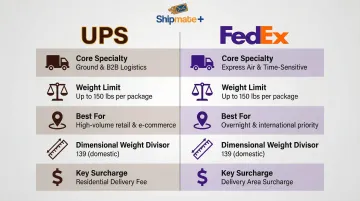
Both carriers offer tracking, delivery guarantees on express services, and comparable base liability coverage. Where they diverge is pricing structure, surcharge mechanics, and how well each fits your specific shipping volume and destination mix — which the sections below break down in detail.
UPS Shipping: Strengths, Services, and Best Use Cases
UPS operates as a domestic ground shipping powerhouse, managing air, ground, domestic, and international shipments through a single unified pickup and delivery network. This integration gives UPS strong efficiency advantages for US-based deliveries, particularly when shipping to rural or remote areas where other carriers may struggle.
Main UPS Service Tiers:
- UPS Ground – 1–5 business days to all 50 states; economical option for non-urgent shipments
- UPS 3 Day Select – Guaranteed 3-day delivery across the continental US
- UPS 2nd Day Air – Two-day delivery with morning and standard options
- UPS Next Day Air – Overnight delivery with Early A.M., Standard, and Saver variants
- UPS Worldwide Express/Saver – International shipping to 220+ countries with express and economy options
Standout Strengths:
UPS accepts packages up to 150 lbs on its standard parcel network, the highest weight limit among major carriers before freight services kick in. That makes it the practical choice for heavy or oversized shipments that would exceed typical parcel thresholds.
UPS also offers declared value coverage up to $50,000 per package — well above the standard $100 liability limit — making it a strong fit for electronics, jewelry, or business equipment.
Rural and remote delivery is another area where UPS stands out. UPS Ground reaches addresses across all 50 states, including locations other carriers may flag as extended delivery areas, though surcharges still apply to the most remote ZIP codes.
Key Surcharges to Watch:
- Residential delivery fee – Applied to all home and home-based business addresses
- Additional handling fee – Triggered for oversized boxes or irregular shapes
- Extended area surcharge – Applies to specific remote ZIP codes
- Fuel surcharge – Adjusted weekly based on the EIA diesel fuel price index
Beyond those fees, dimensional weight pricing (which factors package size, not just actual weight) uses a 139 divisor for UPS Daily Rates and a 166 divisor for Retail Rates. That higher divisor means retail shippers typically pay less in dimensional weight charges compared to FedEx.
Use Cases Where UPS Wins
- Heavy packages – Shipping items over 6 lbs domestically, especially 30+ lbs where UPS rates are significantly better than USPS or FedEx
- High-value items – Sending electronics, jewelry, or business equipment requiring declared value coverage above $100 and up to $50,000
- Rural/remote addresses – Ground delivery to all 50 states, including Alaska and Hawaii, with strong coverage in areas other carriers may not serve efficiently
- Domestic 2-day and 3-day express – Competitive rates for mid-range express services within the US

FedEx Shipping: Strengths, Services, and Best Use Cases
FedEx operates as an air express and international shipping specialist, structured around multiple independent business units—FedEx Express, FedEx Ground, and FedEx Freight—that serve over 220 countries and territories. This multi-unit structure provides flexibility for time-sensitive and long-haul shipments, allowing FedEx to optimize routes and pricing across different service types.
Main FedEx Service Tiers:
- FedEx Ground – 1–5 business days domestically; economical option for non-urgent parcels
- FedEx Home Delivery – Residential ground service with 7-day-per-week delivery, including Sundays in many areas
- FedEx Express Saver – 3-day express delivery
- FedEx 2Day – Two-day delivery with morning and standard options
- FedEx Priority Overnight – Next-business-day delivery by 10:30 AM or noon
- FedEx Standard Overnight – Next-business-day delivery by 3 PM or 4:30 PM
- FedEx International Priority/Economy – Express and economy options to 220+ countries
Standout Strengths:
- Overnight pricing – FedEx Priority Overnight and Standard Overnight are typically cheaper than UPS Next Day Air at retail rates, making FedEx the go-to for time-sensitive B2B deliveries
- Temperature-controlled shipping – Proprietary cold packaging and refrigerated transport serve pharmaceuticals, biologics, and perishables
- Drop-off access – A wide network of corporate-owned retail locations provides convenient access in most metro areas
- USPS last-mile partnership – FedEx Ground Economy (formerly SmartPost) hands off final-mile residential delivery to USPS, reducing costs on certain domestic routes
Key Surcharges and Dimensional Weight:
- Dimensional weight divisor – FedEx uses 139 for both domestic and international shipments, which can increase costs vs. UPS's 166 retail divisor for domestic packages
- Residential surcharge – $6.95 per package in 2026
- Fuel surcharges – Adjusted weekly based on the EIA diesel fuel index
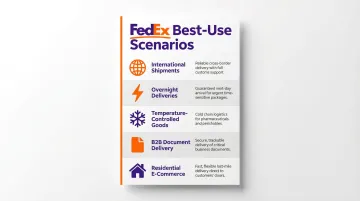
Use Cases Where FedEx Wins
- International shipments – Competitive retail rates and extensive global network to 220+ countries
- Overnight and time-sensitive deliveries – Priority Overnight and Standard Overnight often cost less than UPS Next Day Air
- Temperature-controlled goods – Specialty cold packaging and refrigerated transport for pharmaceuticals and perishables
- B2B document delivery – Fast, reliable service for contracts, legal documents, and business correspondence
- Residential e-commerce – FedEx Home Delivery offers 7-day-per-week service, including Sundays
UPS vs FedEx: Which Carrier Should You Choose?
There is no universal winner—the best carrier depends on four key factors: destination (domestic vs. international), package weight and dimensions, required delivery speed, and whether you're paying retail or have access to negotiated rates.
Choose UPS if:
- You're shipping heavy packages domestically (especially 30+ lbs)
- You need strong rural or remote area coverage
- You're sending high-value items requiring declared value coverage above $100 and up to $50,000
- You have access to UPS volume discounts or negotiated rates for domestic ground
Choose FedEx if:
- You need overnight delivery at competitive retail rates
- You're shipping internationally and want extensive global reach
- You have temperature-sensitive goods requiring specialty packaging
- You're sending time-sensitive B2B documents or contracts
Cost Reality
At standard retail rates, FedEx is often slightly cheaper for cross-country domestic shipments and international routes. However, UPS typically wins for domestic ground when volume pricing or negotiated rates apply. For example, a 3 lb package shipped from San Francisco to New York via ground may cost $15–$18 at FedEx retail rates versus $16–$20 at UPS retail rates. Those figures flip once commercial discounts apply.
That said, base rates only tell part of the story. Dimensional weight pricing and surcharges can shift the cheaper carrier even when quoted prices look close—a lightweight but bulky package can cost noticeably more due to FedEx's 139 divisor versus UPS's 166 retail divisor.
For individuals and small businesses in Vista, CA, ShipMate+ is an authorized shipping outlet for both UPS and FedEx—meaning you can bring your package in, compare rates on the spot, and have staff help select the best carrier and service level based on your specific shipment. No need to choose before you walk in. ShipMate+ is located at 1929 W Vista Way Suite F, Vista, CA 92083, and operates Monday–Friday 9 AM–6 PM and Saturday 9 AM–1 PM.
Conclusion
UPS and FedEx are both reliable, full-service carriers with overlapping capabilities, but their strengths point in different directions—UPS for domestic ground and heavy shipments, FedEx for express and international. The right answer depends on the specific shipment, not brand loyalty.
Small details like surcharges, dimensional weight, and destination type can shift which carrier offers better value. When in doubt, comparing rates before you ship pays off. If you're in Vista, CA, ShipMate+ is an authorized FedEx and UPS shipper, so you can compare options and drop off with either carrier in one stop.
Frequently Asked Questions
What is the least expensive way to ship packages?
USPS tends to be cheapest for small, lightweight packages under 1 lb. For heavier domestic shipments (6+ lbs), UPS Ground is often most cost-effective.
Is UPS or FedEx better for heavy packages?
UPS is generally the better choice for heavy packages, supporting weights up to 150 lbs with better rates and fewer surcharges on large items. UPS dimensional weight pricing for retail shippers uses a 166 divisor, which is more favorable than FedEx's 139 divisor for bulky, heavy parcels.
Which carrier is faster for overnight delivery — UPS or FedEx?
Both offer next-business-day delivery, but FedEx overnight services (Standard Overnight, Priority Overnight) are often marginally cheaper than comparable UPS Next Day Air options at retail rates. Delivery windows and guarantees are similar for both carriers' express services.
Can UPS or FedEx deliver to a PO box?
No, neither UPS nor FedEx can deliver to standard PO boxes—only USPS has access to PO box addresses. FedEx offers limited PO box delivery via FedEx Ground Economy (contract-only service), but retail customers cannot access this option.
Which carrier is more reliable for domestic shipping?
Both carriers offer delivery guarantees and tracking. UPS has a slight edge in domestic ground reliability and package handling reputation, while FedEx excels in on-time performance for overnight and express services.
Do UPS and FedEx charge extra fees beyond the base rate?
Yes, both carriers add surcharges including residential delivery fees ($6.95 at FedEx in 2026), fuel surcharges (adjusted weekly), and extended area fees for remote locations. These surcharges can add 15–30% on top of the advertised base rate, depending on destination and package characteristics.