Shipping large and oversized packages is fundamentally different from mailing standard parcels. Carrier size limits, dimensional weight formulas, special labeling requirements, and a cascade of surcharges all come into play. Making the wrong call—choosing the wrong box, underestimating weight, or selecting the wrong carrier—can cost you significantly more than expected and, in some cases, result in your shipment being rejected entirely.
Key Takeaways
- Each carrier defines "large" differently — UPS, FedEx, and USPS all have separate weight and size thresholds
- Dimensional (DIM) weight pricing bills big, light boxes as if they weigh much more—right-sized packaging saves money
- Always measure length, girth, and weight before selecting a carrier
- UPS and FedEx Ground handle 50–150 lb shipments well; USPS flat-rate works for heavy, compact items under 70 lbs; freight takes over above 150 lbs
- ShipMate+ compares rates across all major carriers and professionally packs oversized items in one stop
What Counts as a Large or Oversized Package?
Carriers don't all use the same definitions — and that matters when you're figuring out what you can ship, how much it'll cost, and whether a carrier will even accept your package. The three terms you'll run into are large (dimensional size), heavy (actual weight), and oversized (exceeding a carrier's maximum length, width, or height limits, sometimes called "out-of-gauge").
Major Carrier Thresholds
UPS and FedEx:
- Additional Handling fees apply at 50 lbs (weight-based) and 70 lbs (size-based)
- Exceeding 108 inches in length or 165 inches in length plus girth triggers large package surcharges
- Over 110 lbs or more than 17,280 cubic inches of volume incurs a Large Package Surcharge
- Above 150 lbs, the shipment must move as freight
USPS:
- 70 lb weight cap — no exceptions
- 108-inch length plus girth limit (130 inches for USPS Ground Advantage)
- Anything beyond these limits will be refused at the counter
Why These Distinctions Matter
Going over a threshold by even one inch or one pound can mean a steep surcharge — or a flat-out rejection. A package weighing 71 lbs cannot ship via USPS at all. A UPS package hitting 111 lbs incurs a Large Package Surcharge ranging from $105.50 to over $219, depending on your rate tier.
Checking your package dimensions and weight before heading to the counter is the simplest way to avoid unexpected costs at checkout.
How to Ship Large and Oversized Packages: Step by Step
Step 1: Measure and Weigh Your Package Accurately
Start with accurate measurements — carriers use these to calculate both actual and dimensional weight, and billing is based on whichever is higher.
To measure correctly:
- Identify the longest side as "length"
- Measure width and height for the remaining two dimensions
- Calculate girth using the formula: Girth = (2 × Width) + (2 × Height)
- Carriers measure girth around the widest point of the package
Dimensional Weight (DIM Weight):
Carriers bill you based on the greater of actual weight or DIM weight. The formula is:
DIM Weight = (Length × Width × Height) ÷ DIM Divisor
Current DIM divisors by carrier:
| Carrier | Rate Type | DIM Divisor |
|---|---|---|
| UPS | Daily Rates | 139 |
| UPS | Retail Rates | 166 |
| FedEx | Standard | 139 |
| USPS | Parcels over 1 cu ft | 166 |
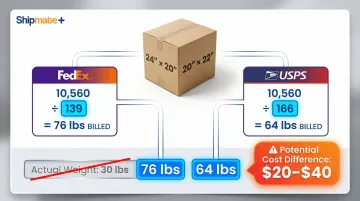
Example: A box measuring 24″ × 20″ × 22″ has a volume of 10,560 cubic inches.
- FedEx DIM Weight: 10,560 ÷ 139 = 76 lbs
- USPS DIM Weight: 10,560 ÷ 166 = 64 lbs
If the actual weight is only 30 lbs, FedEx bills you at 76 lbs and USPS bills at 64 lbs. That gap can add $20–$40 or more to your shipping cost depending on the destination zone.
Step 2: Pack the Item Securely for Heavy-Duty Shipping
For the box itself:
- Use double-walled corrugated boxes rated for your item's weight
- Never reuse old boxes for heavy shipments
- Aim for 2–3 inches of cushioning space around the item — too much inflates DIM weight, too little risks damage
- Reinforce all seams with heavy-duty packing tape in an H-tape pattern on top and bottom
For internal cushioning:
- Wrap individual items in bubble wrap or foam
- Use dense cushioning material — packing peanuts and crumpled paper crush under heavy weight
- Fill all empty space to prevent shifting during transit
- For fragile or high-value items, double-boxing adds meaningful protection
If you're unsure how to secure an awkward or fragile item, ShipMate+'s professional packing team in Vista, CA can handle it for you. Proper professional packing also helps ensure your shipment meets carrier insurability requirements.
Step 3: Select the Right Carrier and Service Level
Compare carriers based on actual weight, DIM weight, destination zone, and how quickly it needs to arrive.
Ground shipping is almost always more cost-effective than air for large or heavy items. The weight penalty on air services makes the price difference dramatic. Reserve express or air options only when delivery timing is non-negotiable.
As an authorized shipper for FedEx, UPS, and USPS, ShipMate+ can help Vista, CA customers compare rates across all three carriers in a single visit, rather than visiting each carrier separately.
Step 4: Label Correctly and Drop Off or Schedule Pickup
Heavy packages require specific carrier labels — skipping this step can cause handling delays or rejected shipments.
Required heavy package labels by carrier:
- UPS: Bright yellow "UPS Heavy Package" sticker placed visibly to the right of the address label (required for items over 70 lbs)
- FedEx: Yellow and black heavyweight label placed over diagonal corners (required for packages over 75 lbs)
- USPS: No mandatory shipper label required, though staff may apply internal handling labels
Write the package weight in the designated area on the label. Carriers use this information to alert handlers and ensure proper lifting equipment is used — missing it can delay processing.
At drop-off:
- Bring your measurement and weight data
- Have your carrier label printed or generate it at the counter
- Include any required documentation, particularly for international shipments
- Check carrier requirements in advance — some oversized packages need a scheduled pickup rather than a standard counter drop-off
Choosing the Right Carrier for Large and Oversized Packages
No single carrier is the best choice in every situation. The right option depends on the package's weight, dimensions, destination, and how quickly it needs to arrive.
UPS and FedEx Ground
Best for: Packages between 50–150 lbs
Both carriers offer reliable ground service with tracking and can handle packages up to 150 lbs. Beyond that, freight is required.
Surcharges to expect:
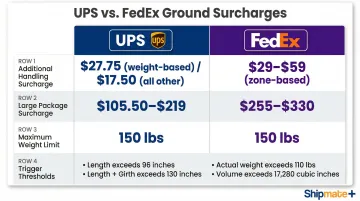
- Additional Handling Surcharge: Triggered at 50+ lbs or when cubic volume exceeds 10,368 cubic inches
- UPS: $27.75 (weight trigger) or $17.50 (other triggers)
- FedEx: $29–$59 (zone-based, 2026 rates)
- Large Package Surcharge: Triggered when length exceeds 96 inches, length plus girth exceeds 130 inches, weight exceeds 110 lbs, or cubic volume exceeds 17,280 cubic inches
- UPS: $105.50–$219 depending on rate tier
- FedEx: $255–$330 (zone-based, 2026 rates)
Advantage: Widest coverage, strong tracking, and generally the most competitive pricing for heavy parcels in the 50–150 lb range when shipping across multiple zones.
USPS
Best for: Packages under 70 lbs, especially dense, compact items
Priority Mail Flat Rate boxes allow shipping up to 70 lbs at a fixed cost of $31.50 (retail) regardless of destination—an excellent value for items like tools, books, or dense equipment parts.
Hard limits:
- 70 lb weight cap
- 108-inch length plus girth limit (130 inches for USPS Ground Advantage)
If your package approaches either threshold, USPS may not be the right fit. Zone-based pricing on non-flat-rate large packages can become expensive on long-distance routes.
Freight (LTL) Services
Required for: Packages over 150 lbs or items that need to be palletized
Less-than-Truckload (LTL) freight carriers typically charge by pallet or per hundredweight (CWT), and the per-pound cost is usually lower than parcel carriers for heavy shipments.
Trade-offs:
- Slower transit times
- Possible need for liftgate delivery service at residential addresses
- Minimum charges that make single small shipments less economical
If you're in Vista, CA and unsure which freight option fits your shipment, ShipMate+ can help you compare carriers and find the right service for heavy or oversized items — whether it's furniture, industrial equipment, or palletized goods.
Key Costs to Know: Dimensional Weight, Surcharges, and Size Limits
The price on a shipping label is rarely the only cost involved. Here are the main fees associated with large package shipping:
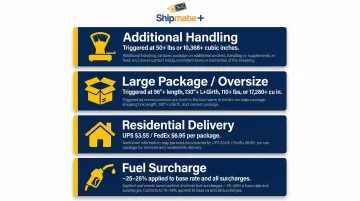
Common Surcharges:
- Additional Handling: Triggered at 50+ lbs or 10,368+ cubic inches
- Large Package/Oversize: Triggered by dimension or weight thresholds (96"+ length, 130"+ length plus girth, 110+ lbs, or 17,280+ cubic inches)
- Residential Delivery: UPS charges $3.55; FedEx charges $6.95 per package
- Fuel Surcharge: Approximately 25–26% as of March 2026, applied to base rate and many surcharges
Beyond the surcharges above, two more factors quietly push costs higher: how you measure weight, and how far your package travels.
Dimensional Weight
If you pack a lightweight item in an oversized box, you'll pay as if it's much heavier. Use the smallest box that safely fits the item with adequate cushioning. Even trimming a few inches on each side can shift the billed weight meaningfully.
How Shipping Zones Amplify Costs
The farther a package travels, the more zones it crosses, and each zone adds to the base rate. For heavy items, this multiplier effect is more pronounced than for lighter packages. Local or regional shipping is significantly cheaper than cross-country delivery.
Common Mistakes When Shipping Large and Oversized Packages
Wrong box size — and it goes both ways. A box that's too large inflates your DIM weight and drives up cost. One that's too small risks damage or outright carrier rejection. Aim for 2–3 inches of cushioning space around the item, no more.
Skipping measurements at home. Showing up at the shipping counter without confirmed dimensions and weight leads to the wrong service being selected, unexpected surcharges, or learning on the spot that your package has to ship as freight. Measure and weigh before you go.
Reaching for packing peanuts on heavy shipments. Packing peanuts and crumpled paper compress under weight and lose their protective value fast. For anything heavy, use dense foam, bubble wrap, or molded foam inserts — materials that hold up throughout transit.
Leaving off the "Heavy" label. Items over 70 lbs require a heavy package sticker. Skip it and you risk improper handling, damage, and a carrier that won't honor your claim.
Frequently Asked Questions
What is oversized shipping?
Oversized shipping refers to packages that exceed standard carrier size limits—defined by a package's length, combined length plus girth, or total dimensions. Each carrier sets its own thresholds, and surcharges apply once those thresholds are crossed.
How do carriers calculate dimensional weight for large packages?
Dimensional (DIM) weight is calculated by multiplying the package's length × width × height and dividing by a carrier-specific DIM divisor (139 for UPS and FedEx, 166 for USPS). If the resulting DIM weight is higher than actual weight, carriers charge the higher amount.
What is the maximum size UPS or FedEx will accept without going to freight?
Both UPS and FedEx accept packages up to 150 lbs and up to 108 inches in length (or 165 inches in combined length plus girth) for standard parcel service. Anything exceeding those limits must be shipped as freight.
Do I need special packaging for oversized items?
Yes. Large, heavy items need double-walled corrugated boxes, dense cushioning, heavy-duty tape, and a "Heavy Package" label for anything over 70 lbs. Professional packing is worth it for fragile or awkwardly shaped items.
Can USPS ship oversized packages?
USPS can ship packages up to 70 lbs and up to 108 inches in length plus girth (130 inches for USPS Ground Advantage), making it suitable for many large items—particularly with flat-rate box options. However, it cannot handle packages above those thresholds, and costs rise steeply for large packages traveling long distances.
How much does it cost to ship an oversized package?
Cost varies based on actual weight, dimensional weight, destination zone, carrier, and applicable surcharges (additional handling, large package, residential delivery). Use each carrier's online rate calculator to compare quotes—or stop by ShipMate+ and we'll compare rates across carriers for you.
Need help shipping a large or oversized package in Vista, CA? ShipMate+ offers professional packing services, multi-carrier rate comparison, and freight shipping expertise. Visit us at 1929 W Vista Way Suite F, Vista, CA 92083, call (760) 295-1074, or email info@shipmateplus.com for a free quote.