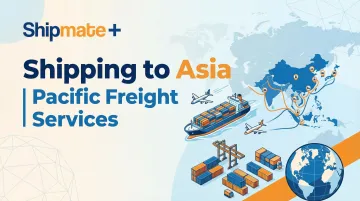
This guide covers everything you need to ship successfully to Asia: freight options (air vs. sea), packaging and labeling requirements, customs and duties, destination-specific tips, and how to streamline the process. Asia encompasses dozens of countries—from Japan and China to the Philippines, India, South Korea, Vietnam, and Thailand—each with its own customs rules, duty thresholds, and prohibited goods lists. Understanding the basics before you ship saves time, money, and headaches.
TLDR:
- Air freight (FedEx, UPS, USPS) delivers in 2–5 days (express) or 7–21+ days (economy); sea freight is slower but cost-effective for heavy cargo
- Proper packaging (corrugated boxes, bubble wrap, H-taping) prevents damage during long-distance transit
- Every package goes through customs; recipients may owe duties/taxes depending on declared value and destination country thresholds
- Many Asian countries recently eliminated or reduced duty-free thresholds—Thailand now taxes imports over 1 THB, Vietnam over 0 VND
- ShipMate+ in Vista, CA offers rate comparisons across FedEx, UPS, and USPS in one visit, plus professional packing and customs documentation support
Freight Options for Shipping to Asia from the US
Air Freight vs. Sea Freight
The two primary freight modes for US-to-Asia shipping are air freight (faster, more expensive, suited for smaller parcels and time-sensitive shipments) and sea freight (slower, cost-effective, ideal for large or heavy cargo). Most individual and small business shippers use air freight via major carriers.
Main Carrier Options
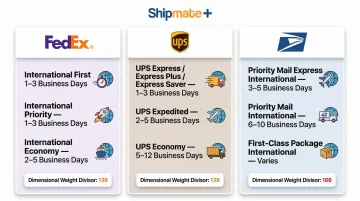
FedEx International:
- International First: 1–3 business days (early morning delivery)
- International Priority/Express: 1–3 business days
- International Economy: 2–5 business days
UPS Worldwide:
- Express/Plus/Saver: 1–3 business days
- Worldwide Expedited: 2–5 business days
- Worldwide Economy: 5–12 business days
USPS International:
- Priority Mail Express International: 3–5 business days
- Priority Mail International: 6–10 business days
- First-Class Package International: Varies by destination
Express vs. Economy Services
Express options typically deliver to major Asian cities within 2–5 business days, while economy options may take 7–21+ days. Transit times vary significantly by destination country. Remote areas consistently take longer than major urban centers.
Understanding Dimensional Weight Pricing
Carriers calculate shipping rates based on package weight and dimensions — **actual weight vs. dimensional weight**, whichever is greater. Carriers calculate dimensional weight differently:
- FedEx: (Length × Width × Height in inches) ÷ 139
- UPS: Uses a 139 divisor for international Daily Rates
- USPS: Applies dimensional weight to parcels exceeding 1 cubic foot (1,728 cubic inches), using a 166 divisor
ShipMate+ in Vista, CA, as an authorized FedEx, UPS, and USPS shipper, lets customers compare rates across all three carriers in a single visit — with side-by-side rate totals in hand before you commit. The team provides expert guidance on selecting appropriate box sizes to minimize both shipping costs and dimensional weight charges.
Freight Forwarding for Large Shipments
For parcels, the carrier options above cover most needs. For large freight or commercial shipments (pallets, bulk goods), work with a licensed freight forwarder instead. ShipMate+ offers freight forwarding services with access to over 40 different freight, LTL (less-than-truck-load), air cargo, and sea container carriers for shipments to Asia.
How to Prepare Your Package for International Shipping to Asia
Why Proper Packaging Matters
Packages traveling to Asia change hands multiple times, cross long distances, and may be subject to rough handling during air transport. Under-packed items are much more likely to arrive damaged. Carriers reference the International Safe Transit Association (ISTA) Test Procedure 3A to ensure appropriate product protection.
Essential Packaging Steps
- Choose the right box — Use sturdy corrugated cardboard with room for cushioning. Double-walled boxes are recommended for heavier items.
- Protect individual items — Wrap each item separately in bubble wrap or packing paper, using multiple layers for fragile pieces.
- Fill empty space — Add packing peanuts or air pillows to prevent shifting. Allow at least two inches of cushioning around all sides.
- Seal properly — Use 2-inch-wide pressure-sensitive plastic tape. Apply the H-taping method: three strips across the top seam and three across the bottom. Never use string or paper over-wrap.
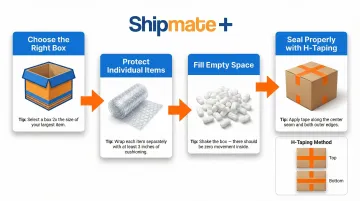
ShipMate+'s team of professional packers can handle this process for customers who want their items properly secured for international travel. Items packed by ShipMate+ meet international carrier insurability standards, which means claims won't be denied due to inadequate packaging.
International Shipping Label Requirements
The label must clearly show:
- Sender's full name and address
- Recipient's full name and address
- Item description
- Item weight
- Tracking/barcode number
Illegible or incomplete labels can cause delivery failures. Beyond the label, every international shipment also requires documentation that satisfies customs authorities at both ends.
Commercial Invoice: What It Is and Why It Matters
A commercial invoice documents what's in the package, the declared value of the contents, country of manufacture, and Harmonized System (HS) code. Carriers require this for every international parcel. The HS code is a standardized product classification system used by over 200 countries to determine customs duties — covering more than 5,000 commodity categories.
Critical: US CBP and China GACC reject shipments with vague descriptions like "gifts" or "accessories." Use precise descriptions such as "children's plastic dolls" or "cotton t-shirts."
Packing List Accuracy
The declared contents and their values on the commercial invoice must match what's actually inside the package. Customs agents may inspect shipments, and inaccurate declarations can result in customs delays, fines, or return shipment.
ShipMate+ provides international documentation services including Commercial Invoices, Pro Forma invoices, and E.E.I. forms, along with automated Airway bill generation to ensure proper documentation for Asian destinations.
Navigating Customs: Duties, Taxes, and Restricted Items
Understanding Customs Clearance
Every package entering an Asian country goes through customs clearance. The recipient may be required to pay import duties and/or local taxes (such as VAT or GST) before their package is released. The amount owed depends on:
- Declared value of the goods
- Type of goods (based on HS code)
- Destination country's specific duty rates
De Minimis Value Thresholds
De minimis value is the threshold below which imports are not taxed. Many Asian countries recently eliminated or drastically reduced these thresholds:
| Country | Current Threshold | Recent Changes |
|---|---|---|
| Thailand | 1 THB (~$0.03) | 1,500 THB exemption abolished Jan 2026 |
| Vietnam | None (0 VND) | 1,000,000 VND exemption repealed Feb 2025 |
| Japan | 10,000 JPY (~$67) | Applies to total customs value |
| China | 1,000 RMB (~$137) | 800 RMB for HK/Macao/Taiwan |
| Philippines | 10,000 PHP (~$170) | FOB or FCA value per shipment |
| South Korea | $150 USD | $200 USD for US goods under specific agreements |
| Singapore | $400 SGD (~$295) | GST applies to low-value goods from registered vendors |
| India | None for gifts | Gifts prohibited except life-saving drugs/Rakhi |
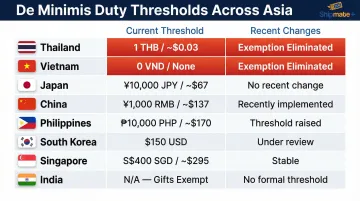
Any shipment above these thresholds is subject to full duties — check the table carefully before choosing a declared value.
Commonly Restricted or Prohibited Items
Most Asian countries prohibit:
- Narcotics and controlled substances
- Firearms and ammunition
- Pornographic materials
- Politically sensitive content
- Certain tobacco and alcohol products
- Pharmaceuticals (without proper permits)
- Certain food items
Customs will seize prohibited goods, and shippers may face legal consequences. Always verify the destination country's restricted goods list before shipping.
Severe Penalties for Misdeclarations
Accurate declarations are critical. Two countries with particularly steep penalties:
- Philippines: A discrepancy exceeding 10% triggers a 250% surcharge on duties owed. Fraudulent misdeclaration jumps to a 500% surcharge plus seizure of goods.
- China: Customs may confiscate smuggled goods and fine shippers up to three times the evaded duties — or up to 1,000,000 RMB for prohibited items.
Research Destination-Specific Requirements
Rules differ significantly by country:
- China: Strict import inspections require precise, detailed cargo descriptions — vague entries like "gift" or "merchandise" are routinely flagged
- Japan: Food and cosmetics face additional scrutiny, often requiring ingredient lists or import permits
- Philippines: High-value items need supporting documentation (invoices, receipts) to clear without delays
Check the destination country's official customs website before shipping — or stop by ShipMate+ in Vista and we'll walk you through the requirements for your specific destination.
Shipping to Popular Asian Destinations: Country Highlights
Japan
Generally efficient customs process. Certain food, plants, and medications require special permits. Two requirements to know before shipping:
- Prescription drugs: An Import Confirmation is required for supplies exceeding one month; issued by Japan's Ministry of Health, Labour and Welfare
- Plants: A Phytosanitary Certificate is mandatory — missing it means disposal, and penalties can reach 3 million JPY or 3 years imprisonment
FedEx, UPS, and USPS all serve Japan reliably.
China
Packages can be shipped to China, but stricter inspections and customs scrutiny apply. US CBP actively rejects shipments with vague cargo descriptions such as "gifts" or "accessories." Accurate documentation and correct declared values are essential to avoid delays or returns.
Philippines
Customs can be slow; ensure declared values and documentation are thorough. Goods valued under 50,000 PHP are processed as Informal Entry. Goods valued at 50,000 PHP and above require Formal Entry documentation. Express carriers like FedEx and UPS offer more predictable delivery times.
South Korea
Requires a Personal Customs Clearance Code (PCCC) for all B2C e-commerce shipments. The consignee name, phone number, and postal code must exactly match the PCCC record; mismatches result in customs holds.
India, Vietnam, Thailand
The USA can ship to all these destinations via major carriers. Each has unique customs rules and specific lists of restricted items:
- India: Animal products, firearms, ivory, milk products, and seeds are restricted/prohibited
- Vietnam: All imports now subject to duties following elimination of de minimis threshold
- Thailand: Narcotics, pornographic materials, counterfeit goods, and reserved animals are prohibited; all imports over 1 THB now taxable
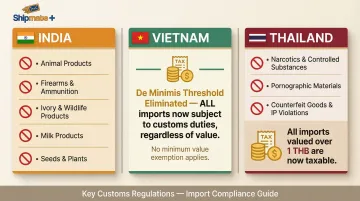
Regulations change — confirm country-specific rules before your shipment leaves the counter. The ShipMate+ team in Vista can help flag documentation requirements for your destination.
Delivery Times by Location
Major cities like Tokyo, Seoul, and Manila typically see delivery in 3–5 business days via FedEx or UPS. Rural or remote destinations can add 2–5 days for last-mile transit after arrival in-country.
Tips for a Faster, Smoother Delivery to Asia
Use Trackable Shipping Services
FedEx, UPS, and USPS Priority Mail International all include end-to-end tracking, so both sender and recipient can monitor the shipment through customs and last-mile delivery — reducing uncertainty at every stage.
Consider Delivery Duties Paid (DDP) Shipping
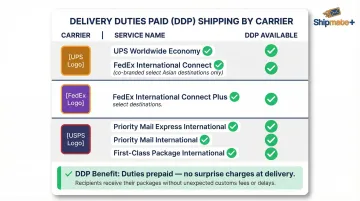
With DDP shipping, duties and taxes are prepaid before delivery — no surprise charges at the door, and far less risk of package refusal or customs abandonment. Several carriers offer DDP to select Asian destinations:
- UPS Worldwide Economy and FedEx International Connect — available to select destinations
- USPS — DDP available for Priority Mail Express International, Priority Mail International, and First-Class Package International Service
Plan for Transit Time Buffers
Even express services can experience delays at customs during peak periods such as Chinese New Year (Feb 16–23, 2026), National Day Holiday/Golden Week (Oct 1–7, 2026), and high-volume shopping seasons. Shipping a few extra days early prevents disappointment.
Frequently Asked Questions
How much does it cost to ship to Asia?
Costs vary widely based on package weight, dimensions, carrier choice, and destination country. Economy USPS options are more affordable for lighter packages (starting at $19.40 for First-Class Package International under 4 lbs), while express FedEx/UPS services cost more but offer faster delivery. Get a rate comparison at ShipMate+ in Vista, CA to find the best option.
What's the cheapest way to ship to Asia?
USPS First-Class Package International or Priority Mail International (starting at $32.65 for Flat Rate Envelopes) are typically the most budget-friendly options for lighter packages, though delivery times are longer. For heavier shipments, comparing rates across FedEx, UPS, and USPS is the best way to find the lowest rate.
Can I still ship items to China?
Yes, shipping to China is still possible through FedEx, UPS, and USPS, but packages are subject to stricter customs inspection. Accurate documentation, precise cargo descriptions (not vague terms like "gifts"), and correct declared values are especially important to avoid delays or returns.
Can the USA ship to Thailand?
Yes, the USA can ship to Thailand via all major international carriers. Thailand has specific prohibited goods (including some medications and food items) and recently abolished its 1,500 THB duty-free threshold—all imports over 1 THB are now taxable. Verify Thailand's restricted goods list before sending.
What are the main types of freight?
The three main freight types are air freight (fast, used for most parcel and express shipments), sea freight (slower but cost-effective for large/heavy shipments), and land/road freight (used for cross-border trucking where geography permits—less applicable for US-to-Asia shipping).
What services do Asian shipping companies offer?
Logistics carriers operating in Asia typically offer express parcel delivery, customs clearance assistance, last-mile delivery, freight forwarding, and in some cases cash-on-delivery options. US-based carriers like FedEx, UPS, and USPS partner with these local carriers to handle last-mile delivery at the destination.
Ready to ship to Asia? Visit ShipMate+ at 1929 W Vista Way Suite F, Vista, CA 92083 for expert guidance, rate comparisons across all three major carriers, professional packing services, and complete customs documentation support. Call (760) 295-1074 or email info@shipmateplus.com to discuss your international shipping needs. Open Monday–Friday 9 AM–6 PM, Saturday 9 AM–1 PM.