Introduction
Every product we use daily — from smartphones to clothing to food — traveled across an ocean before reaching our hands. The type of ship it traveled on was not chosen at random. The vessel was selected based on precise cargo requirements: the cargo's physical form, sensitivity to temperature, and how quickly it needed to arrive.
Freight ships are not a single category. They form a diverse fleet of specialized vessels, each engineered for a specific type of cargo and trade route. Match the wrong vessel to the wrong cargo, and the result is spoilage, damage, or costs that dwarf the original shipping budget.
This guide breaks down the main types of freight ships — how they work, what they carry, and what makes each one the right (or wrong) choice for a given shipment.
Key Takeaways
- A freight ship is a commercial vessel designed to transport goods across oceans and waterways
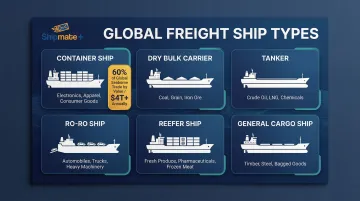
- Six main types exist: container ships, bulk carriers, tankers, Ro-Ro vessels, reefer ships, and general cargo ships
- Each type is purpose-built for specific cargo: containers, raw materials, liquids, vehicles, perishables, or break-bulk freight
- Choosing the wrong ship type causes damage, spoilage, inefficiency, or excessive cost
- Matching cargo to the right ship type is the first step toward reliable, cost-efficient international logistics
What Is a Freight Ship?
A freight ship (also called a cargo ship or freighter) is a merchant vessel commercially operated to transport goods, commodities, and raw materials across seas and oceans. These ships form the physical backbone of international trade, moving over 80% of goods traded worldwide by volume.
The terms "freight ship" and "cargo ship" are used interchangeably in practice. Technically, "freight" refers to the act of transporting goods while "cargo" refers to the goods themselves — a distinction that rarely matters outside academic contexts.
Freight ships vary widely in size and function. The global merchant fleet includes around 112,500 commercial vessels of at least 100 gross tons — ranging from small coastal vessels to ocean-going carriers exceeding 400 meters in length.
Each vessel is typically built around the specific cargo it carries, with hull design and loading systems optimized for that purpose.
Why the Type of Freight Ship Matters in Global Trade
Shipping the wrong type of cargo on the wrong type of vessel leads to real operational failures:
- Perishables spoiling without temperature control
- Bulk commodities damaged by moisture in enclosed holds
- Vehicles unable to load onto ships without drive-on ramps
- Liquid cargo spilling due to incompatible tank materials
Vessel type is not a bureaucratic detail. It is a logistical necessity that directly impacts cargo safety, cost, and delivery reliability.
For businesses working with freight forwarders or shipping partners, knowing the relevant ship type helps coordinate timelines, port compatibility, and cargo packaging requirements — all of which affect cost and on-time delivery.
Types of Freight Ships
The six types covered below represent the main commercial categories in use today. Each is distinguished by its hull design, loading mechanism, cargo hold structure, and the type of goods it is optimized to carry.
Container Ships
Description:
A container ship is a vessel designed to carry standardized intermodal containers — typically 20-foot and 40-foot steel boxes. Capacity is measured in Twenty-Foot Equivalent Units (TEUs). A standard 20-foot container measures approximately 6 meters long, 2.4 meters wide, and 2.6 meters high externally.
The largest modern container ships can carry over 24,000 TEUs. As of early 2024, MSC's Irina-class holds the record at 24,346 TEU capacity, measuring 399.9 meters in length and 61.3 meters in width. The global container ship fleet stood at 6,033 vessels with a total capacity of 30.3 million TEU as of April 2025.
How it differs and best use:
Containers allow cargo to transfer seamlessly between ships, trucks, and trains without unpacking — a process called intermodal transport. This makes container ships the dominant choice for manufactured goods on major global trade routes.
Typical cargo includes:
- Clothing and textiles
- Electronics and appliances
- Furniture and home goods
- Machinery and industrial equipment
- Consumer products
Container ships transport about 60% of the value of global seaborne trade, amounting to more than $4 trillion worth of goods annually.
Strengths and limitations:
Strengths:
- Fast loading and unloading via gantry cranes
- High port efficiency and throughput
- Seamless intermodal transfers
- Secure, standardized cargo protection
- Fixed liner schedules for predictable transit
Limitations:
- Require purpose-built port infrastructure with gantry cranes
- Not suited for loose bulk commodities or liquid cargo
- Ultra-large vessels face severe port compatibility restrictions
- Vulnerable to cascading delays (the Ever Given Suez Canal blockage in 2021 held up an estimated $9.6 billion of goods each day)
Dry Bulk Carriers
Description:
Dry bulk carriers (also called bulk carriers or bulkers) are vessels with large, open cargo holds specifically designed to transport unpackaged, dry commodities poured directly into the ship. Typical cargo includes grain, coal, iron ore, cement, and fertilizer.
Bulk carriers are the largest segment of the global fleet by capacity, accounting for 42.5% of total deadweight tonnage in 2025. By 2023, dry bulk commodities represented 36% of global maritime freight.
How it differs and best use:
No packaging or containerization is involved — cargo fills the hold directly. Size categories determine which routes and ports the ship can access:
| Size Class | Approximate DWT Range | Primary Characteristics & Cargoes |
|---|---|---|
| Handysize | 10,000 – 39,999 DWT | Geared with 25-35 ton cranes; flexible for smaller ports; carries grains, steel, fertilizers |
| Handymax / Supramax | 40,000 – 64,999 DWT | Often geared with own grabs; highly versatile; carries coal, grains, minor bulks |
| Panamax | 65,000 – 99,999 DWT | Historically limited by Panama Canal locks; usually gearless; carries coal, iron ore, grains |
| Capesize / VLOC | 100,000+ DWT | Too large for canals, must transit via Cape Horn or Cape of Good Hope; serves deepwater terminals for iron ore and coal |
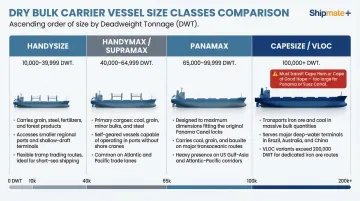
Bulk carriers are the primary vessel for raw materials powering industrial manufacturing worldwide.
Strengths and limitations:
Strengths:
- High-volume, low-cost transport for commodities at scale
- Efficient loading/unloading for uniform cargo
- Massive economies of scale with Capesize vessels
- Optimized for single-commodity shipments
Limitations:
- Not suited for mixed cargo or packaged goods
- No temperature control or special handling
- Capesize vessels face severe port infrastructure limitations
- Vulnerable to moisture damage for certain commodities
- Slower loading/unloading than container ships
Tankers
Description:
Tankers are vessels engineered to transport liquid cargo in bulk. They are divided into subtypes including oil tankers (crude and petroleum), chemical tankers, LNG (Liquefied Natural Gas) carriers, and LPG (Liquefied Petroleum Gas) carriers.
Tankers use internal tank compartments built from materials selected to prevent contamination. Oil tankers delivered from 1996 onwards must be fitted with a double hull to prevent pollution under MARPOL Annex I regulations. Dangerous chemicals are governed by the IBC Code, while liquefied gases like LNG and LPG fall under the IGC Code.
How it differs and best use:
Tankers are the only viable vessel type for liquid or gas cargo at commercial scale. They serve the oil and gas, petrochemical, and food-grade liquid industries. Their tanks can carry different liquids simultaneously in separate compartments.
Crude oil accounted for 18% of global maritime freight in 2023. Despite the massive volumes transported, the environmental safety record of tankers has improved drastically — spills exceeding 7 tonnes have reduced by over 90% since the 1970s.
Size classifications:
| Size Class | Approximate DWT Range | Typical Route / Function |
|---|---|---|
| Coastal / MR | Under 50,000 DWT | Transportation of refined products (gasoline, gasoil) |
| Aframax | 80,000 – 120,000 DWT | Short- and medium-haul routes to/from ports without infrastructure for larger vessels |
| Suezmax | 120,000 – 160,000 DWT | Originally the maximum capacity of the Suez Canal; used for long-haul crude oil |
| VLCC | 200,000 – 319,999 DWT | Very Large Crude Carriers; used for long-haul global routes; common length of 300 to 330 meters |
| ULCC | 320,000+ DWT | Ultra Large Crude Carriers; highly restricted port access; loaded/unloaded offshore |
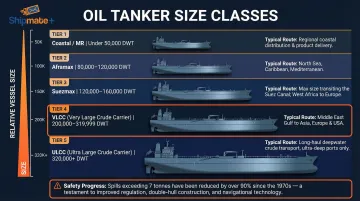
Strengths and limitations:
Strengths:
- Indispensable for energy supply chains
- Efficient bulk transport of liquids and gases
- Compartmentalized tanks allow multiple cargo types
- Specialized coatings prevent contamination
Limitations:
- Significant environmental risk (spill potential)
- Require specialized loading/offloading terminals
- Not adaptable for dry or solid cargo
- Strict regulatory compliance requirements
- Chemical compatibility requirements demand precise matching
Roll-on/Roll-off (Ro-Ro) Ships
Description:
Ro-Ro ships are purpose-built to carry wheeled cargo — cars, trucks, buses, construction equipment, and trailers. Vehicles are driven directly onto and off the ship via built-in ramps, without cranes or lifting equipment.
Pure Car and Truck Carriers (PCTCs) are a specialized evolution of this design, configured with 10-13 decks where height can be adjusted depending on the types of vehicles being transported to optimize cargo space.
How it differs and best use:
The drive-on/drive-off loading system sets Ro-Ro vessels apart from every other ship type. They are ideal for vehicle manufacturers, military transport, and heavy machinery exporters.
Global seaborne car trade is expanding fast. Volumes are projected to reach 32.1 million units in 2025, heavily driven by Chinese vehicle exports.
To meet this demand, operators are deploying increasingly large vessels. In January 2025, Höegh Autoliners took delivery of the Höegh Australis, a multi-fuel Aurora-class PCTC rated at 9,100 Car-Equivalent Units (CEU). Lloyd's Register has already awarded Approval in Principle for a dual-fuel PCTC design capable of carrying 12,800 CEU.
Strengths and limitations:
Strengths:
- Fast loading/unloading without cranes
- Minimal handling damage to vehicles
- Multi-level ramp systems maximize capacity
- Adjustable deck heights accommodate various vehicle types
- Ideal for high-volume automotive manufacturers
Limitations:
- Highly specialized and not adaptable for non-wheeled cargo
- Open-deck design creates ventilation management challenges
- Capacity constraints due to limited fleet size
- Automotive shippers must secure capacity well in advance
Reefer Ships
Description:
Reefer ships (refrigerated cargo ships) are vessels with temperature-controlled cargo holds that maintain a precise, adjustable climate — including temperature and humidity — throughout the entire voyage to preserve perishable goods.
How perishable goods move by sea has changed significantly. In 2022, of the 139 million tonnes of perishable food transported by sea, 88% was carried in refrigerated containers rather than dedicated reefer ships.
How it differs and best use:
The active, monitored climate control system distinguishes reefer ships from all other vessel types. Modern reefer containers can maintain internal temperatures within a range of -35°C to +30°C, with specialized super freezer units reaching as low as -60°C for ultra-cold storage requirements.
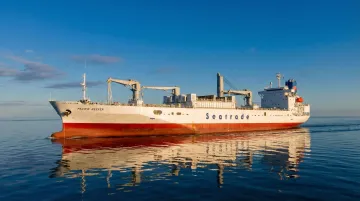
Reefer ships are essential for transporting:
- Fruits and vegetables
- Meat and seafood
- Dairy products
- Pharmaceuticals and vaccines
- Flowers and plants
- Temperature-sensitive chemicals
Strengths and limitations:
Strengths:
- Make the global fresh food supply chain possible
- Critical for pharmaceutical cold chain logistics
- Precise temperature and humidity control
- Real-time monitoring and alerts
- Long-distance transport without spoilage
Limitations:
- Expensive to operate due to continuous refrigeration energy demands
- Not cost-effective for non-perishable cargo
- When the cold chain fails, financial impacts are severe (Britannia P&I Club reported over $6 million in claims for damaged refrigerated cargo over a two-year period)
- Specific quantified losses include: $550,000 for cargo damage due to mechanical repair delays, $500,000 for unintentional thawing of 12 containers of tuna, and $335,000 for temperature abuse of 27 containers of fruit
General Cargo Ships
Description:
General cargo ships (also called general cargo vessels or break-bulk ships) are versatile vessels with multiple cargo holds, varied stowage configurations, and onboard handling equipment designed to carry mixed, non-standardized goods in smaller quantities.
Break-bulk is defined as general cargo loaded into a ship as individual or bundled pieces, not stowed into a container, and not transported in ship-sized liquid or dry bulk loads.
How it differs and best use:
General cargo ships serve routes and ports where cargo volumes are too small or mixed to justify specialized vessels, and where port infrastructure does not support large container ships or bulk carriers. They are the flexible option for smaller shipments of packaged goods, machinery, and industrial equipment.
The general cargo fleet has been in long-term decline due to containerization. It is now the oldest segment of the global merchant fleet, averaging 28 years of age in 2024.
Despite this decline, the multipurpose and break-bulk segment endures in highly specialized niches. Project cargo, heavy lifts, and oversized industrial items — knocked-down plants, power generation equipment, industrial boilers — physically cannot fit inside standard ISO containers, keeping demand alive.
Strengths and limitations:
Strengths:
- Flexibility for mixed, non-standardized cargo
- Port accessibility for smaller or less developed ports
- Onboard handling equipment (cranes, derricks)
- Ideal for project cargo and heavy-lift infrastructure
- No containerization requirements
Limitations:
- Loading and unloading is slower and more labor-intensive than containerized shipping
- Per-unit costs tend to be higher at scale
- Aging fleet with limited newbuild activity
- Shrinking fleet size limits spot-market availability
- Not suited for high-volume, standardized cargo
How to Choose the Right Freight Ship for Your Cargo
The correct vessel type is determined by cargo characteristics first, not by route preference or cost alone.
Primary considerations:
- Physical state — solid, liquid, gas, or perishable — determines which vessel class applies
- Form of the cargo (packaged, loose, wheeled, or containerizable) affects loading and stowage
- Volume per shipment and shipping frequency influence whether to charter or book liner space
- Special requirements like temperature control, chemical compatibility, or oversized dimensions narrow options further
Secondary considerations:
| Factor | What to Consider |
|---|---|
| Port infrastructure | Not all ports handle Capesize bulk carriers or ultra-large container ships — confirm compatibility before routing to avoid re-routing costs |
| Timeline | Container liners run fixed schedules with predictable transit times; tramp bulk carriers offer flexibility but less certainty |
| Budget | Reefer ships and LNG tankers cost more to charter than general cargo vessels, but skipping the right vessel type can result in total cargo loss |
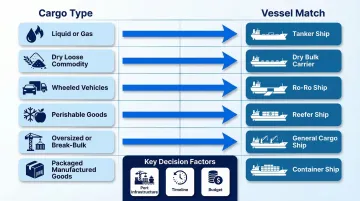
When in doubt, consult a freight forwarder early. Matching cargo requirements to the right vessel type upfront is far cheaper than correcting a mismatch mid-shipment.
Common Mistakes When Selecting a Freight Ship Type
Choosing vessel type based on cost alone:
Selecting a bulk carrier or general cargo ship for temperature-sensitive goods to save money often results in the entire shipment being lost to spoilage. The savings evaporate when the cargo arrives worthless.
Overlooking port infrastructure compatibility:
Selecting a large container ship or Capesize bulk carrier for a route that includes smaller regional ports that cannot physically accommodate the vessel causes costly re-routing or transshipment fees. Verify port capabilities before finalizing vessel selection.
Defaulting to container ships for all cargo:
Not all cargo is better suited to containerization. Bulk commodities, vehicles, and oversized equipment are often more efficiently transported via bulk carriers, Ro-Ro vessels, or break-bulk ships.
Defaulting to containers without evaluating fit can lead to inefficient packing, unnecessary handling, and higher costs per unit.
Misdeclaring cargo or ignoring stowage requirements:
The MSC Flaminia disaster in 2012 resulted in a massive explosion and fire caused by the auto-polymerization of divinylbenzene (DVB). The cargo was stowed under deck near heat sources, causing the chemical stabilization to fail.
Shippers must strictly adhere to the IMDG and IMSBC codes, using standardized checklists to ensure chemical compatibility and proper stowage away from heat sources.
Conclusion
Freight ships are the physical engine of global trade. The six main types — container ships, dry bulk carriers, tankers, Ro-Ro ships, reefer ships, and general cargo ships — each exist because no single vessel design can efficiently handle every type of cargo.
Understanding these differences is not just maritime trivia. It directly affects cargo safety, shipping cost, route planning, and delivery reliability for any business moving goods across international waters.
Ocean freight operates at a scale most businesses never touch directly — but the same logic applies at every level of shipping: the right carrier for the right cargo makes all the difference. For everyday packing and shipping needs closer to home, ShipMate+ in Vista, CA offers multi-carrier options through FedEx, UPS, and USPS under one roof, so you always have the right option for whatever you're sending.
Frequently Asked Questions
What is a freight ship?
A freight ship (also called a cargo ship or freighter) is a commercial vessel designed to transport goods and commodities across oceans and waterways. These vessels move over 80% of all goods traded worldwide by volume, making them the backbone of global commerce.
What is the difference between shipping and freight?
"Freight" typically refers to the commercial transportation of goods in bulk or large volumes (often by sea, air, or rail), while "shipping" is a broader term that includes all methods of transporting goods from one place to another, including smaller parcel delivery.
What is the difference between a freight ship and a cargo ship?
The terms are used interchangeably in practice — both refer to commercial vessels that carry goods across water. Technically "cargo" describes the goods themselves while "freight" describes the act of transporting them, but this distinction is rarely observed in everyday usage.
How many types of cargo ships are there?
While classifications vary, there are six widely recognized main types: container ships, dry bulk carriers, tankers, Ro-Ro ships, reefer ships, and general cargo ships — with additional specialized subtypes within each category.
What is the most common type of freight ship used in global trade?
Container ships are the most prevalent for manufactured and packaged goods, carrying approximately 60% of global seaborne trade by value. However, dry bulk carriers dominate by total volume, hauling the raw materials — iron ore, coal, grain — that keep global industry running.
What type of ship carries shipping containers?
Container ships (also called "boxships") are specifically designed to carry standardized intermodal shipping containers. As of April 2025, the global fleet numbered 6,033 vessels with a combined capacity of 30.3 million TEU — carrying the vast majority of the world's non-bulk seaborne cargo.