Introduction
Air cargo moves the world's most time-sensitive and high-value goods—from life-saving pharmaceuticals to the latest consumer electronics—across continents in hours or days.
Airlines transport over 62 million tonnes of goods annually, representing less than 1% of global trade by volume but approximately 33% by value ($8.3 trillion), or $22.7 billion per day. That small slice of shipments drives a strikingly large share of global trade value.
Yet despite its impact on nearly every supply chain, most individuals and small businesses don't fully understand how a shipment actually moves from a shipper's hands to its destination. That gap leads to poor carrier choices, missed deadlines, and avoidable costs. This guide covers the full picture in plain terms, walking you through the booking process, cargo handling stages, cost factors, and when to choose air over ground or ocean freight.
Key Takeaways
- Air cargo ships goods via aircraft belly holds or dedicated freighters, making it the fastest international shipping option
- Shipments move through booking/documentation, acceptance/inspection, in-flight handling, and customs clearance
- Two main categories: general cargo for everyday goods, and special cargo for perishables, dangerous goods, live animals, and high-value freight
- Cost is based on actual or volumetric weight (whichever is greater), factoring in route, urgency, and cargo type
- Best suited for time-sensitive, high-value, or lightweight shipments where speed outweighs cost
What Is Air Cargo Shipping?
Air cargo is the commercial transportation of goods and freight via aircraft, processed under strict documentation, handling, and regulatory standards designed for speed, safety, and accountability. It's distinct from passenger baggage and operates through dedicated cargo channels with specialized ground handling, customs protocols, and tracking systems.
Most international e-commerce and express shipments actually travel in the belly hold of the same passenger planes flying overhead — not just dedicated freighters. In 2025, dedicated freighters accounted for nearly 58% of international air cargo demand, while the remaining 42% moved in passenger aircraft lower holds. As passenger networks rebuild post-pandemic, belly cargo is growing faster, adding more than four times the cargo tonne-kilometers of freighters in 2025.
Why Choose Air Despite Higher Costs?
Air cargo remains the dominant choice for certain shipments despite being the most expensive freight mode:
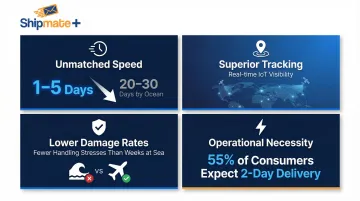
- Unmatched speed: Cross-continental delivery in 1–5 days vs. 20–30 days by ocean
- Superior tracking: Real-time visibility through carrier portals and IoT sensors
- Lower damage rates: Fragile goods face fewer long-term stresses than weeks at sea
- Operational necessity: Time-critical industries like pharmaceuticals, automotive manufacturing, and e-commerce depend on air freight to meet customer expectations, and 55% of global consumers expect online orders within two days
How Air Cargo Shipping Works
Air cargo moves through a defined, sequential process—from booking to final delivery. Each stage has specific compliance and handling requirements that determine whether your shipment arrives on time or faces costly delays.
Booking and Documentation
The process begins when the shipper (or their freight forwarder) reserves cargo space with an airline, directly or through a carrier platform. The core document generated is the Air Waybill (AWB)—a legally binding contract that serves as the shipment receipt, transport instruction, and customs declaration. The AWB is governed by the Montreal Convention and standardized by IATA Resolution 600b, providing an 11-digit tracking number for real-time monitoring.
Supporting documents required:
- Commercial invoice: Itemized list of goods, values, and buyer/seller information
- Packing list: Detailed contents, weights, and dimensions
- Supplementary permits: CITES permits for endangered species, health certificates for live animals, dangerous goods declarations for hazmat
Incorrect AWB data causes 23% of air freight delays, averaging 2.7 days per incident. Errors in weight, declared value, or cargo classification trigger customs holds or carrier rejection. The industry is rapidly adopting electronic Air Waybills (e-AWB), which now represent 78% of global air cargo shipments and reduce processing time by 40%.
Those errors are easy to avoid with the right support. ShipMate+ in Vista, CA is an authorized FedEx, UPS, and USPS shipper where staff help individuals and small businesses select the right carrier, verify documentation, and ensure compliance before drop-off—all under one roof.
Cargo Acceptance and Inspection
When cargo arrives at the airport or carrier facility, ground handlers physically inspect every shipment:
- Correct labeling and packaging integrity
- Declared weight accuracy (actual vs. documented)
- Compliance with carrier acceptance criteria
- Proper documentation completeness
Only cargo meeting all requirements is accepted for transport. At this stage, cargo is consolidated into Unit Load Devices (ULDs)—standardized containers and pallets that maximize space efficiency in the aircraft hold.
ULDs are regulated, removable aircraft parts that interface directly with the aircraft's Cargo Loading System, securing loads and maintaining weight and balance for flight safety.
Common ULD types:
| ULD Code | Description | Primary Use Case |
|---|---|---|
| LD-3 (AKE) | Half-width lower hold contoured container | Standard baggage and general cargo |
| PMC (P6P) | 10-ft flat pallet with net | Universal general-purpose consolidation |
| RKN | Contoured cool container | Temperature-controlled pharmaceuticals |
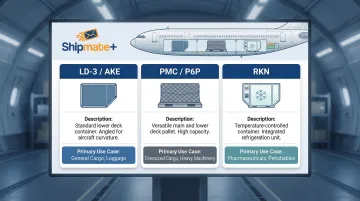
Special cargo (live animals, hazardous materials, temperature-sensitive goods) is segregated and handled under additional protocols at this stage, often requiring specialized ULDs with active temperature control or enhanced ventilation.
Loading, In-Flight Handling, and Monitoring
Ground crews use specialized equipment—high loaders, conveyor belts, roller systems—to move ULDs into the aircraft, following a carefully calculated weight-and-balance plan to maintain flight safety. Once aboard, cargo is secured with nets and locks to prevent shifting during takeoff, turbulence, and landing.
During the flight, temperature, pressure, and humidity are monitored within the hold for sensitive cargo. Modern tracking technologies (RFID, GPS, IoT sensors) provide real-time shipment visibility to shippers. For most commercial shipments via carriers like FedEx, UPS, or USPS Air, this tracking is automated and accessible through carrier portals.
The data layer behind all this tracking is also changing fast. IATA's ONE Record standard became the preferred method for cargo data exchange starting January 2026, replacing fragmented legacy EDI systems with a single digital language and API protocols. By late 2025, over 70% of surveyed industry participants showed awareness of ONE Record, and airlines representing over 70% of global AWB volumes were on track for implementation.
Cathay Cargo became the first carrier to adopt ONE Record in day-to-day operations, successfully exchanging eAWB and shipment status data with forwarders via API.
Delivery and Customs Clearance
Upon landing, cargo is unloaded, transferred to a bonded warehouse or cargo terminal, and subjected to customs clearance—the review and approval of all documentation by border authorities before goods are released for delivery. For international shipments, this stage often determines whether a shipment arrives on schedule or faces delays.
Customs officers verify:
- Proper documentation (AWB, commercial invoice, packing list)
- Declared value accuracy and tariff classification
- Compliance with import regulations and licensing requirements
- Payment of duties, taxes, and fees
Domestic air shipments (e.g., via FedEx Priority Overnight, UPS Next Day Air, or USPS Priority Mail Express) bypass international customs but still follow carrier delivery routing from the destination facility to the final address.
Types of Air Cargo
Air cargo falls into two broad categories: General Cargo (standard goods with no special handling needs) and Special Cargo (goods with unique requirements based on their nature, size, or value). Costs and processes differ considerably between them.
General Cargo
Everyday goods that travel under standard handling protocols:
- Clothing, textiles, and apparel
- Electronics and consumer goods
- Hardware, machinery parts, and dry goods
- Documents and printed materials
General cargo via express carriers (FedEx, UPS, USPS) is straightforward to book and ship, with minimal documentation beyond the standard AWB and commercial invoice for international shipments.
Perishable Cargo
Fresh produce, flowers, seafood—requires cold-chain management and strict transit time limits. In 2024, fruit and vegetables accounted for 29% of perishable air cargo, followed by fish (21%), general perishables (18%), flowers (13%), and meat (10%).
Temperature-Controlled Cargo
Pharmaceuticals, vaccines, biological specimens—requires constant climate monitoring. Pharmaceuticals make up just 4% of global air cargo by weight, but they hold 11% of the value share and command a 39% yield premium.
Temperature excursions cost the pharmaceutical industry an estimated $35 billion annually, with over 50% occurring while products are in the hands of airlines and airports. Tarmac exposure during loading and unloading is the highest-risk segment.
To reduce exposure risk, shippers should:
- Use active Temperature-Controlled Containers (such as RKN ULDs)
- Deploy real-time IoT data loggers throughout transit
- Avoid relying solely on aircraft belly temperatures for monitoring
Dangerous Goods
Batteries, chemicals, flammables—must comply with IATA Dangerous Goods Regulations and may be restricted to cargo-only aircraft. The 67th Edition of the IATA DGR came into force on January 1, 2026, introducing stricter charge limits for lithium-ion batteries packed with equipment and formalized shipping names for hybrid-powered vehicles. Lithium batteries saw a 25% year-on-year surge in air transport volume.
High-Value or Fragile Cargo
Fine art, luxury goods, precision instruments—requires enhanced security, specialized packaging, and in some cases escort services. ShipMate+ offers professional packing for fragile and high-value items using carrier-compliant materials, which helps ensure items qualify for declared-value coverage during transit.
Live Animals
Pets, livestock, research animals—handled under IATA's Live Animals Regulations with strict container, labeling, and welfare requirements. The 52nd Edition of the IATA LAR (effective 2026) includes updated ventilation and construction standards for containers and new species classifications.
Impact on Shipper Experience
Special cargo typically requires advance coordination with the carrier, additional documentation, and may incur surcharges that general cargo avoids. Even minor data discrepancies — like unchecked boxes on live animal health certificates — can trigger customs holds, quarantines, or outright rejections.
What Affects Air Cargo Shipping Costs
The Volumetric Weight Trap
Carriers charge by whichever is greater: actual (gross) weight or volumetric (dimensional) weight. Volumetric weight is calculated by multiplying the shipment's volume by a standard factor.
Standard IATA formula (metric): Volumetric Weight (kg) = (Length × Width × Height in cm) ÷ 6000
Example calculation: A box measuring 60 cm × 50 cm × 40 cm with an actual weight of 10 kg:
- Volumetric weight = (60 × 50 × 40) ÷ 6000 = 20 kg
- Chargeable weight = 20 kg (the higher of the two)
- The shipper pays for 20 kg, not 10 kg
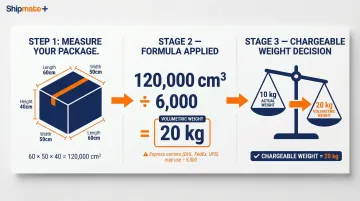
Carrier deviations: While 6000 is the IATA standard for general air freight, express couriers (DHL, UPS, FedEx) frequently apply a stricter divisor of 5000 for parcels and express shipments. A lower divisor increases the volumetric weight, heavily penalizing light, bulky shipments. Always compare carrier divisors before booking lightweight e-commerce goods.
Other Major Cost Variables
Route and demand: High-demand trade lanes carry different base rates. According to March 2026 spot rates:
- Asia to North America: approximately $6.69 per kilogram
- Europe to North America: approximately $2.74 per kilogram
Service level: Standard air freight vs. express delivery vs. same-day charter commands significantly different pricing tiers.
Fuel surcharges: Carriers adjust these dynamically based on published jet fuel indices. FedEx bases its air freight fuel surcharge on the weekly published U.S. Gulf Coast spot price for kerosene-type jet fuel, adjusting the percentage weekly according to tiered price bands.
Security surcharges and special handling fees: Applied for regulated or fragile cargo, including dangerous goods, temperature-controlled shipments, and oversized items.
When Air Freight Is Cost-Competitive
Those cost variables can look intimidating on paper. For small, high-value, or time-critical shipments—especially those under 150 kg—air freight often costs less than expected once you factor in:
- Reduced warehousing time
- Lower damage rates
- Faster inventory turnover
- Reduced capital tied up in transit
For individual shippers sending express parcels via FedEx, UPS, or USPS, pricing is typically pre-negotiated at authorized shipping centers—removing the guesswork entirely. For example, USPS Priority Mail Express International delivers in 3–5 business days, with Flat Rate Envelopes (up to 4 lbs) starting at $62.70.
When to Choose Air Cargo Shipping
Clear Use Cases for Air Freight
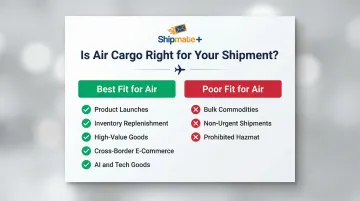
Air cargo is the right choice when:
- Product launches, seasonal inventory, or event-driven goods with hard delivery deadlines
- Fast-moving inventory replenishment where stockouts directly cut revenue
- High-value goods where transit time affects outcomes — pharmaceuticals, medical devices, critical components
- Cross-border e-commerce where customers expect delivery within days, not weeks — 55% of global consumers expect online orders within two days
- High-value tech and AI goods — in 2025, AI-related goods accounted for 53.5% of the total value of air-transported trade while representing just 7% of its volume
When Air Is the Wrong Choice
Avoid air freight for:
- Construction materials, industrial equipment, ores, and bulk commodities — too heavy and low-margin to justify air costs
- Non-urgent shipments where cost savings clearly outweigh speed
- Certain chemicals, oversized hazmat, and Division 1.3 explosives, which are strictly prohibited by major carriers like FedEx
When air isn't the right fit, ocean or ground freight will typically serve better on cost.
Getting Help with Carrier Selection
For individuals and small businesses shipping parcels or small freight by air, working with an authorized multi-carrier center simplifies the process considerably. Staff can compare FedEx, UPS, and USPS air service options side by side, verify packaging specs against carrier requirements, and prepare documentation correctly from the start — reducing the risk of rerouting or rejection at the carrier facility.
ShipMate+ in Vista, CA is an authorized FedEx, UPS, and USPS shipper that handles exactly this kind of guidance for both domestic and international air shipments.
Frequently Asked Questions
What is cargo on a plane?
Cargo on a plane refers to any goods or freight transported by aircraft—distinct from passenger luggage. It can travel in the lower belly hold of a passenger aircraft or in the main deck of a dedicated freighter, and is processed, documented, and handled separately from baggage under commercial shipping protocols.
How much does a cargo flight cost?
Air cargo costs are calculated per kilogram based on the higher of actual or volumetric weight. March 2026 spot rates ranged from approximately $2.74/kg for Europe-to-North America routes to $6.69/kg for Asia-to-North America routes. FedEx, UPS, and USPS offer tiered air service pricing accessible to individual shippers.
What types of goods are typically shipped by air cargo?
Common air cargo shipments include electronics, pharmaceuticals, perishables (fresh flowers, seafood), high-value goods, apparel, and e-commerce parcels—goods where speed, security, and reliability justify the premium over ground or ocean freight.
How long does air cargo shipping take?
Domestic air express typically delivers in 1-3 business days, while international air freight ranges from 1-5 days flight time, with customs clearance adding variable time depending on destination. FedEx and UPS often offer guaranteed delivery windows for time-sensitive shipments.
What is the difference between air cargo and express shipping?
Express shipping — such as FedEx, UPS, and DHL — is a door-to-door service managed by a single company, typically for shipments under 150 kg. International air freight handles larger commercial volumes that may pass through multiple carriers and freight forwarders. Express is faster and simpler to book; air freight scales up for bigger loads.
Do I need special documentation to ship by air?
All air shipments require an Air Waybill (AWB); international shipments additionally need a commercial invoice and packing list. Certain cargo types (dangerous goods, perishables, live animals) require supplementary regulatory documentation. Working with an authorized shipping center helps ensure all paperwork is complete and correct before drop-off.