

Major carriers like FedEx, UPS, and USPS don't always charge based solely on what your package weighs on a scale. Instead, they often bill you for the space it occupies in their trucks and planes. This pricing method, called dimensional (DIM) weight, can catch shippers off guard and inflate costs by 20-30% if you're not prepared.
This guide covers everything you need to know: what DIM weight is, how to calculate it step by step, how each major carrier applies it differently, and proven strategies to keep your shipping costs down without sacrificing protection.
TLDR: Key Takeaways
- Dimensional weight prices packages by size, not just scale weight—carriers charge whichever is greater
- FedEx and UPS use a DIM factor of 139 for most domestic shipments (L × W × H ÷ 139 = billed weight)
- USPS only applies DIM weight to Priority Mail packages over one cubic foot (divisor: 166, Zones 1–9)
- Trim box size to actual contents — right-sizing packaging is the fastest way to cut DIM charges
- Comparing carriers before you ship can cut costs — rates vary more than most people expect
What Is Dimensional Weight (DIM Weight)?
Dimensional weight (DIM weight) is a pricing technique used by freight and parcel carriers that calculates a theoretical weight based on a package's volume—length × width × height—rather than how heavy it actually is on a scale. You may also see it called volumetric weight or cubed weight; all three terms refer to the same concept.
Why carriers use DIM weight: When carriers charged only by actual weight, lightweight but bulky packages occupied valuable cargo space in trucks and aircraft without generating proportional revenue. A large box of bubble wrap might weigh just two pounds, yet consume the same space as a 20-pound box of books. DIM weight ensures carriers are fairly compensated for the space each package occupies, not just its actual weight.
A large box of popcorn and a small box of corn kernels can weigh the same on a scale, but the popcorn box takes up far more truck space. DIM weight charges the popcorn shipper more to reflect that space consumption.
How DIM Weight Became Standard
Air freight carriers adopted DIM weight first to manage limited cargo holds efficiently. Ground carriers followed as e-commerce growth drove down average package density—meaning more space consumed per dollar of freight revenue.
The tipping point came in late 2014 and early 2015:
- UPS: Applied DIM weight to all UPS Ground services on December 29, 2014
- FedEx: Expanded DIM weight pricing to all FedEx Ground shipments on January 1, 2015, removing the prior exemption for packages under three cubic feet
Both changes removed the last safe harbor for lightweight, high-volume shippers. With U.S. parcel volume reaching 22.37 billion shipments in 2024, understanding how DIM weight affects your rate—before you pack the box—is one of the most direct ways to cut shipping costs.
How to Calculate DIM Weight: The Formula Explained
Here's the formula carriers use to calculate dimensional weight:
DIM Weight = (Length × Width × Height) ÷ DIM Factor
Measure all dimensions in inches and round up to the nearest whole number before multiplying. The DIM factor (also called the dimensional divisor) is a carrier-set number that determines how much a given volume of space is worth as billable weight. For FedEx and UPS domestic shipments, the standard DIM factor is 139 cubic inches per pound.
Step-by-Step Example
Let's calculate DIM weight for a box measuring 18 × 16 × 12 inches:
- Multiply dimensions: 18 × 16 × 12 = 3,456 cubic inches
- Divide by DIM factor: 3,456 ÷ 139 = 24.86 pounds
- Round up: 24.86 rounds up to 25 pounds DIM weight
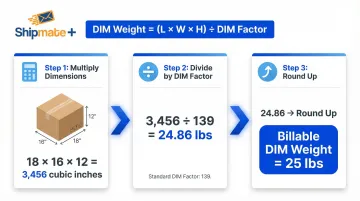
If this package actually weighs 10 pounds on a scale, the carrier will bill you for 25 pounds—the greater of the two.
Rounding Rules
- Each dimension: Round any fraction of an inch up to the next whole inch before calculating (effective August 18, 2025, UPS matches FedEx's rounding policy)
- Final DIM weight: Round up to the next whole pound
- Always calculate both actual weight and DIM weight—the billable weight is whichever is greater
International Shipments (Metric)
For packages measured in centimeters and billed in kilograms, FedEx and UPS use a metric DIM factor of 5,000 cm³/kg:
DIM Weight (kg) = (Length × Width × Height in cm) ÷ 5,000
This divisor applies to most international routes. When shipping internationally, confirm the exact DIM factor with your carrier before finalizing your shipment—rates on specialty routes can differ.
DIM Weight by Carrier: FedEx, UPS, and USPS Compared
While the DIM weight concept is universal, each carrier applies it with different divisors, thresholds, and service-level rules. Knowing these differences helps you choose the most cost-effective carrier for each shipment.
Here's a quick comparison before diving into the details:
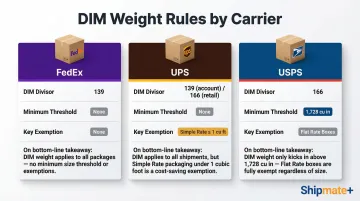
| Carrier | DIM Divisor | Minimum Threshold | Key Exemption |
|---|---|---|---|
| FedEx | 139 (in/lb); 5,000 (cm³/kg) | None — applies to all packages | None for standard boxes |
| UPS (account) | 139 | None | Simple Rate for packages ≤1 cubic foot |
| UPS (retail) | 166 | None | Simple Rate for packages ≤1 cubic foot |
| USPS | 166 | 1,728 cubic inches (1 cubic foot) | Flat Rate boxes exempt entirely |
FedEx DIM Weight
- Divisor: 139 cubic inches per pound (U.S., Puerto Rico, international in inches/pounds); 5,000 cm³/kg for metric shipments
- Applies to: All shipments in customer packaging — no minimum size threshold
- Billable weight: The greater of actual weight or DIM weight
Bottom line: FedEx applies DIM weight to every package, so there's no size cutoff to plan around.
UPS DIM Weight
- Divisor: 139 for account customers (Daily Rates); 166 for walk-in customers without an account (Retail Rates)
- Applies to: All domestic and international package services — the three-cubic-foot Ground exemption was eliminated in 2014
- Flat rate option: UPS Simple Rate covers packages up to 1 cubic foot (1,728 cubic inches) at flat pricing; larger packages use standard DIM weight
- Billable weight: The greater of actual or dimensional weight
Bottom line: Without a UPS account, your divisor is 166 — meaning lower DIM weight charges than account customers pay. Worth comparing for occasional shippers.
USPS DIM Weight
- Divisor: 166 cubic inches per pound for Priority Mail, Priority Mail Express, and Parcel Select
- Applies to: Packages over 1,728 cubic inches (1 cubic foot) shipped to Zones 1–9
- Rule change: Before June 23, 2019, USPS used a divisor of 194 and only applied DIM weight to Zones 5–9; the 2019 update expanded both the zone coverage and lowered the divisor
- Flat rate option: USPS Flat Rate Envelopes and Boxes (up to 70 lbs) are fully exempt from DIM weight calculations
- Billable weight: The greater of actual weight or DIM weight
Bottom line: The 1,728 cubic inch threshold gives smaller packages a free pass on DIM weight. For heavy, compact items, Flat Rate boxes offer predictable pricing worth comparing first.
Actual Weight vs. DIM Weight: Which One Do You Pay?
Carriers always calculate both actual (scale) weight and dimensional weight, then bill you for whichever number is higher. This is called the billable weight, and it applies across FedEx, UPS, and USPS (within applicable services).
Two Common Scenarios
Scenario 1: Actual weight wins A small box of bolts measuring 10 × 8 × 6 inches weighs 15 pounds.
- DIM weight: (10 × 8 × 6) ÷ 139 = 3.5 lbs, rounded to 4 lbs
- Actual weight: 15 lbs
- Billable weight: 15 lbs (actual weight is greater)
Scenario 2: DIM weight wins A large box of throw pillows measuring 24 × 20 × 18 inches weighs 8 pounds.
- DIM weight: (24 × 20 × 18) ÷ 139 = 62.2 lbs, rounded to 63 lbs
- Actual weight: 8 lbs
- Billable weight: 63 lbs (DIM weight is greater)
These scenarios aren't edge cases. Ignoring DIM weight can inflate your shipping bill by 20–30%, and weight or dimension errors are among the most common sources of carrier overcharges. Businesses forfeit over $2 billion in UPS and FedEx refunds each year due to billing mistakes.
Pro tip: Always compare both numbers before finalizing your packaging. If you're unsure which carrier offers the best rate for a specific box size, ShipMate+ in Vista, CA can run that comparison for you on the spot. As an authorized shipper for FedEx, UPS, and USPS, the team can match each package to the most cost-effective carrier and service level.
How to Reduce DIM Weight Shipping Charges
Dimensional weight charges aren't inevitable. A few strategic changes to your packing process can deliver immediate savings without compromising protection.
Right-size your box
The single most effective way to lower DIM weight is to use the smallest appropriate box for your item. Avoid the temptation to reuse oversized boxes from previous shipments—excess empty space directly inflates DIM weight and costs you money.
- Measure your item before selecting a box
- Choose a box that leaves just 1–2 inches of clearance on all sides for cushioning
- Stock multiple box sizes to match common product dimensions
ShipMate+ carries over 20 box sizes in single-wall and double-wall construction, plus specialty options for laptops, artwork, and equipment — all at discounted prices. If you're not sure which size fits best, the team can help you find the right match and avoid unnecessary surcharges.
Minimize internal packing material
Excessive void fill—air pillows, loose packing peanuts, crumpled paper—adds volume without adding meaningful protection. Consider form-fitting materials like bubble wrap that cushion items without adding much bulk.
- Use bubble wrap by the foot to wrap items snugly
- Fill voids with just enough material to prevent shifting
- Avoid overpacking, which wastes material and increases DIM weight
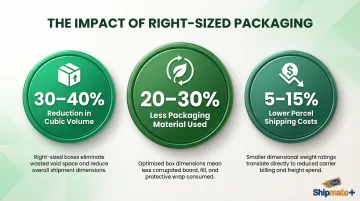
The numbers back this up: right-sized packaging typically reduces cubic volume by 30–40%, cuts packaging material use by 20–30%, and delivers a 5–15% reduction in parcel shipping costs by eliminating charges for wasted space.
Compare carriers and service levels before shipping
Because each carrier uses different DIM factors and thresholds, the cheapest option varies by package dimensions and destination zone. Comparing FedEx, UPS, and USPS rates side by side is one of the fastest ways to identify savings without changing your packaging at all.
- USPS exempts packages under one cubic foot from DIM weight
- UPS retail rates use a more favorable 166 divisor
- FedEx may offer better rates for certain zones or service levels
At ShipMate+, you can compare and ship under all three carriers from a single location at 1929 W Vista Way Suite F, Vista, CA 92083. The team can walk you through rates and service options to find what fits your deadline and budget. Call (760) 295-1074 or email info@shipmateplus.com to get a free shipping quote.
Frequently Asked Questions
What is a dimensional weight cost?
Dimensional weight cost is the shipping charge applied when a package's DIM weight (calculated from its dimensions) exceeds its actual scale weight. You pay for the space the package occupies in the carrier's vehicle, not just how heavy it is. Carriers always bill whichever weight is greater — actual or DIM.
How do you calculate DIM weight?
Multiply length × width × height (in inches), then divide by the carrier's DIM factor (commonly 139 for FedEx and UPS domestic). Round each dimension up to the nearest whole inch before calculating, and round the final result up to the next whole pound.
Does UPS charge by dimensional weight?
Yes, UPS charges by dimensional weight on all domestic shipments. The standard divisor is 139 cubic inches per pound for account-rate customers and 166 for retail-rate customers.
Does FedEx charge dimensional weight?
FedEx applies dimensional weight to all domestic and international shipments using a divisor of 139 cubic inches per pound. One distinction: FedEx sets no minimum cubic inch threshold, so DIM weight applies regardless of package size.
How do you calculate dimensional weight for USPS?
USPS applies DIM weight only to Priority Mail, Priority Mail Express, and Parcel Select packages over one cubic foot (1,728 cubic inches). Use the formula (L × W × H) ÷ 166. USPS Flat Rate boxes are exempt from DIM weight pricing.
What is the difference between volumetric weight and actual weight?
Actual weight is what a package registers on a scale. Volumetric (dimensional) weight is calculated from the package's size using the formula (L × W × H) ÷ DIM factor. Carriers bill whichever is greater to ensure fair compensation for cargo space.
Need help navigating DIM weight and choosing the right carrier? Visit ShipMate+ at 1929 W Vista Way Suite F, Vista, CA 92083, Monday–Friday 9 AM–6 PM or Saturday 9 AM–1 PM. As an authorized FedEx, UPS, and USPS shipper, ShipMate+ offers rate comparisons across all three carriers, packing services, and discounted packaging supplies to help you minimize shipping costs. Call (760) 295-1074 or email info@shipmateplus.com for a free quote today.