Introduction
You packed it carefully, paid for fast delivery, and waited—then got a notification that your package is lost or arrived shattered. Without shipping insurance, that financial loss lands entirely on you.
Most shippers assume carrier services include real coverage. They don't. Carriers typically provide only $100 in automatic liability protection, which is not the same as insurance. Knowing the difference before you ship determines whether you get reimbursed or absorb the loss yourself.
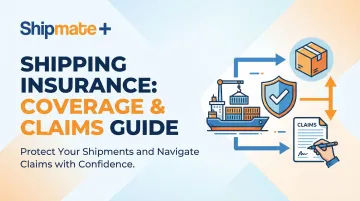
This guide covers what shipping insurance is, how declared value differs from real insurance, what's covered (and what isn't), carrier-by-carrier options for USPS, UPS, and FedEx, typical costs, and the exact steps to file a successful claim.
Key Takeaways
- Shipping insurance reimburses you for lost, stolen, or damaged packages—but carrier "declared value" is not the same as true insurance
- Most carriers include only $100 automatic coverage; high-value items require purchased additional protection
- Improper packaging is the leading cause of denied claims—professional packing protects your claim eligibility
- Third-party insurance (1–3% of declared value) often costs less than carrier coverage—and you don't need to prove carrier fault
- File claims quickly—carrier deadlines run from 21 to 60 days, and missing them voids your claim
What Is Shipping Insurance?
Shipping insurance is a purchased policy—offered by carriers or third-party providers—that reimburses the shipper when a package is lost, stolen, or damaged during transit, up to the item's declared value.
You declare the value of what you're shipping, pay a small premium (typically 1–3% of that value) at the time of shipping, and if something goes wrong, you file a claim with documentation to recover your loss.
That risk is significant. An estimated 104.3 million packages were stolen in 2024–2025, resulting in $37 billion in total economic impact. Damage rates aren't minor either—industry data shows 11% for UPS, 10% for USPS, and 7% for FedEx.
Two main sources of shipping insurance:
Carrier-provided insurance (purchased directly through USPS, UPS, or FedEx)
- Convenient—added at the time of shipping
- Can be more expensive and restrictive
- Requires proving carrier fault in many cases
Third-party insurance (purchased from independent providers like Shipsurance, U-PIC, or InsureShip)
- Often offers broader coverage and better rates
- Doesn't require proof of carrier negligence
- May cover items carriers exclude
If you're shipping from Vista, CA, ShipMate+ is an authorized shipper for all three carriers. You can compare options and add coverage in a single stop, without navigating three separate carrier websites.
Declared Value vs. Shipping Insurance: A Critical Distinction
Many carriers offer "declared value coverage" as a default, which is not the same as insurance.
Declared value is the maximum liability the carrier will accept—and reimbursement is not guaranteed. Key limitations:
- Often capped at $100 automatically
- FedEx explicitly states, "Declared value is not shipping insurance"
- You must prove the carrier was at fault to receive payment
- Payouts are limited to the lesser of repair cost, depreciated value, or replacement cost
True shipping insurance works differently:
- Pays out based on the item's declared value, regardless of proving carrier fault
- Covers situations where proving negligence would be difficult
- Offered by third-party providers as a true insurance policy
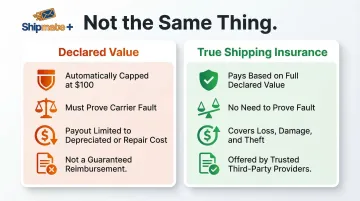
For high-value shipments, that difference can determine whether you recover your loss or absorb it.
What Does Shipping Insurance Cover — And What Doesn't It?
Standard shipping insurance and carrier declared value typically cover:
- Loss — package never arrives at its destination
- Damage — item arrives broken, crushed, or unusable
- Theft — package stolen before or after delivery
- Delivery delays (in some policies, though less common)
Coverage varies significantly by carrier and policy:
- Some policies cover international shipments; others are domestic-only
- Some cover fragile items if properly packed; others exclude them entirely
- USPS Priority Mail Express International includes up to $200 in automatic coverage
- Third-party providers like Shipsurance offer strong international coverage, including high-risk routes that carrier insurance often excludes
Coverage limits matter:
- Most basic carrier policies cap at $100 automatically
- Higher-value items require purchased additional coverage
- Some items have absolute limits regardless of how much coverage you buy
Common Exclusions to Know Before You Ship
Most carrier and third-party policies exclude:
- Improperly or insufficiently packed items (the leading cause of denied claims)
- Perishable goods — food, plants, and time-sensitive biologicals
- Fragile items not cushioned to carrier standards — glassware, ceramics, electronics
- Items prohibited by the carrier — antiques, artwork, certain electronics (varies by carrier)
- Losses due to inherent product defects — manufacturing flaws unrelated to shipping
Packaging is where most claims fall apart. Many denials happen not because the carrier lost a package, but because the item wasn't packed to the carrier's published standards. Carriers require strict adherence to packaging guidelines, and improper packing voids coverage even if you paid for insurance.
That's where professional packing makes a real difference. At ShipMate+, our team packs items to carrier standards — so your shipment is properly prepared and eligible for coverage before it ever leaves the counter.
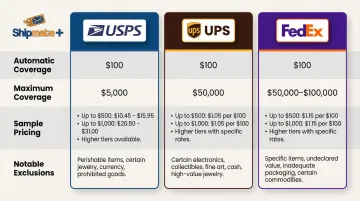
Carrier Insurance Options: USPS, UPS, and FedEx Compared
| Feature | USPS | UPS | FedEx |
|---|---|---|---|
| Automatic Coverage | Up to $100 on Priority Mail, Priority Mail Express, and Ground Advantage | $100 limit of liability included without declared value | $100 limit of liability included at no extra charge |
| Maximum Value | $5,000 for most items; up to $50,000 for Registered Mail | $50,000 per package (enhanced $70,000 for certain domestic packages) | $50,000 standard; up to $100,000 domestic / $25,000 international for jewelry via Declared Value Advantage |
| Pricing (2026) | Tiered: $0.01–$50 = $2.70; over $600 is $8.95 + $1.50 per $100 | $0.90 per $100 (or portion) over $100; $2.70 minimum | $4.95 for $100.01–$300; $1.65 per $100 above $300 |
| Notable Exclusions | Perishables, hazardous materials | Currency, items of unusual value, improper packaging | Cash, firearms, improper packaging |
A few details worth noting before you choose: USPS excludes certain perishables and fragile items deemed improperly packaged, while UPS prohibits antiques, live animals, and fine art from declared value coverage regardless of the amount declared.
ShipMate+ is an authorized shipper for all three carriers, so you can compare coverage options and add the right level of protection at the counter — no separate trips, no carrier websites to navigate.
How Much Does Shipping Insurance Cost?
Shipping insurance is typically calculated as a percentage of the declared value of the shipment. The general industry range is 1% to 3% of the package's declared value.
Factors that influence cost:
- Declared value — higher value means a higher premium
- Carrier chosen — USPS, UPS, and FedEx each price coverage differently
- Shipping destination — international shipments typically cost more to insure
- Item type — fragile or high-risk goods often carry a higher premium
- Coverage level — basic carrier liability vs. full all-risk policies
Third-party insurers often undercut carrier rates by a wide margin:
- U-PIC advertises rates up to 90% lower than carriers, with 2026 rates at $0.65 per $100 for UPS Domestic
- Shipsurance charges approximately $0.55 per $100 of declared value, with reported savings of 44% to 90% versus carrier pricing
For most everyday shipments, the math is straightforward. A $200 item insured at 2% costs $4 in coverage — and pays back the full $200 if the package is lost.
Is Shipping Insurance Worth It?
Insurance is almost always worth it for:
- High-value items — electronics, jewelry, collectibles
- Fragile goods with high replacement cost — glassware, artwork, antiques
- Irreplaceable items — sentimental gifts, custom-made products
- International shipments — where claims processes are more complex and risk is higher
Insurance may not be necessary for:
- Very low-value items where replacement cost is negligible
- Routine shipments well within the automatic $100 liability window
- Items you can easily and cheaply replace
Do a quick cost-benefit check before every shipment. If the premium is $3 and the item is worth $150, the decision is straightforward. If the item is worth $15 and insurance costs $2, skipping coverage makes sense.
Insurance also protects something harder to price: customer trust. When a gift or business order goes missing, a quick replacement or refund keeps the relationship intact — a negative review is far more costly than any premium.
How to File a Shipping Insurance Claim
First steps immediately after discovering a loss or damage:
- Document everything right away — photograph the damaged packaging and contents before discarding anything
- **Save all shipping receipts and tracking numbers** — you'll need these to prove purchase and track the shipment
- Note the date of delivery or the date the package was deemed lost — carriers enforce strict claim windows
Carrier-Specific Claim Deadlines
Missing these windows typically means forfeiting your claim regardless of coverage:
- USPS: File immediately but no later than 60 days from the mailing date for damaged or missing contents; lost articles have varying timeframes (e.g., Priority Mail is 15 to 60 days)
- UPS: Notice of claims must be received within 60 days after the scheduled delivery date; formal claims must be filed within 9 months
- FedEx: Claims for damaged or missing contents must be filed within 60 calendar days for U.S. packages and 21 days for international packages; lost shipments must be filed within 9 months
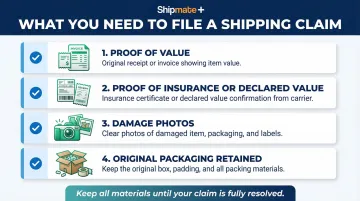
Documentation Required to Support a Successful Claim
All carriers require:
- Proof of value — original receipt, paid invoice, or repair estimate
- Proof of insurance/declared value — original mailing receipt or electronic label record
- Damage photos — clear photos of the damaged merchandise and the shipping container
- Keep all original packaging — hold onto the box, packing materials, and damaged goods until the claim is resolved, as a carrier may request physical inspection
Good recordkeeping on every shipment gives you a much stronger case if something goes wrong. If you shipped through ShipMate+, we can pull your shipping documentation and tracking records to help support your claim.
Frequently Asked Questions
How does shipping insurance work?
Shipping insurance reimburses the shipper when a package is lost, stolen, or damaged in transit. You purchase coverage at the time of shipping based on the item's declared value, then file a claim with documentation if something goes wrong. It's distinct from the default liability coverage automatically included with most carrier services.
How much does shipping insurance typically cost?
Cost is typically 1–3% of the declared value, varies by carrier and item type, and is generally a minor expense compared to the potential cost of an uninsured loss.
How do I determine the right declared value?
Declared value is the amount you state the shipment is worth at the time of shipping, which sets the maximum the carrier will pay out. It should reflect the item's actual replacement cost or purchase price, supported by a receipt or invoice.
Is package protection really worth it?
For high-value, fragile, or irreplaceable items, insurance is almost always worth the small added cost. For low-value shipments within the automatic $100 coverage window, it may not be necessary.
How does shipping insurance work with USPS?
USPS includes up to $100 in automatic coverage on Priority Mail and Priority Mail Express shipments, and additional insurance can be purchased up to $5,000 for most items at the time of mailing. Claims are filed directly with USPS with supporting documentation.
Need help adding insurance to your next shipment? Visit ShipMate+ at 1929 W Vista Way Suite F, Vista, CA 92083, or call (760) 295-1074. As an authorized shipper for FedEx, UPS, and USPS, ShipMate+ makes it easy to protect your packages with the right coverage—and our professional packing services ensure your items are packed to carrier standards, protecting your ability to file a successful claim.