Introduction
FCL (Full Container Load) is an ocean freight arrangement where a single shipper books and pays for an entire shipping container, regardless of whether it's completely full. For small business owners, importers, exporters, and individuals exploring international shipping, getting FCL right can mean the difference between controlling costs and absorbing expensive surprises.
Unlike shared shipping methods where multiple parties split container space, FCL gives you exclusive use of the container from origin to destination. That translates to faster transit, fewer handling touchpoints, and better security for your goods.
This article explains what FCL is, how the process works step-by-step, what container types are available, and when FCL is or isn't the right choice for your shipment.
Key Takeaways
- FCL means you rent the entire container exclusively—no shared space with other shippers
- Standard containers are 20ft (33.2 CBM) and 40ft (67.7 CBM); 40ft High Cube adds extra height for bulky cargo
- Faster transit and lower per-unit costs make FCL the better choice over LCL or air for large shipments
- Typical door-to-door timeline: 30–45 days including customs and delivery
- Use FCL when cargo fills 60–70% of a container — below that threshold, LCL usually costs less
What Is FCL Shipping?
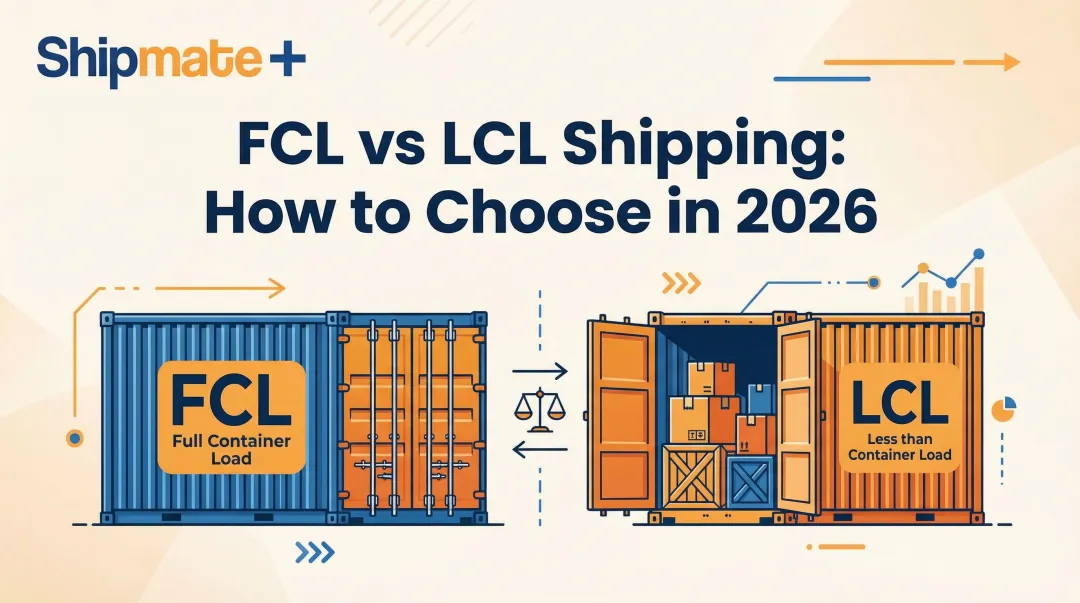
FCL stands for Full Container Load—a sea freight term where one shipper books an entire container exclusively. The container is sealed after loading at the origin and remains unopened until it reaches the final destination. You pay a flat rate per container, not per cubic meter, so the cost stays the same even if it's only half-full.
FCL vs. LCL in brief: In LCL (Less than Container Load), multiple shippers share space in the same container and each pays for the portion they use. FCL eliminates that sharing entirely, giving you full control and security.
FCL's role in global trade: Liner shipping transports approximately 60% of the value of global seaborne trade, moving more than $4 trillion worth of goods annually. The global container ship fleet reached a capacity of 30.3 million TEU by April 2025—a figure that reflects just how central containerized shipping has become to global commerce.
Core advantages of FCL:
- Reduced handling risk — containers are sealed at the factory and only opened at destination, minimizing damage or theft
- Faster transit — no consolidation or deconsolidation delays with other shippers' cargo
- Greater cargo security — ideal for high-value, fragile, or sensitive shipments
- Cost efficiency at scale — flat per-container pricing means lower per-unit costs for larger shipments
How the FCL Shipping Process Works
FCL shipments follow a defined sequence: booking, documentation, loading, export customs, ocean transit, import customs, and final delivery. A freight forwarder typically manages most of these steps on your behalf. Here's what happens at each stage.
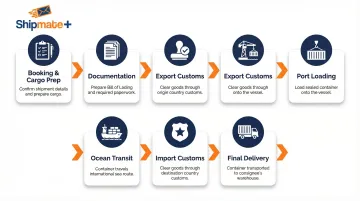
Booking and Cargo Preparation
The shipper contacts a freight forwarder (or carrier) to request a quote, specifying cargo dimensions, weight, type, and destination. Once booked, a container is allocated and a pickup is scheduled. This stage is also when shippers should ensure goods are properly packaged and labeled for international transit.
Proper commercial packaging, palletizing, and crating are critical at this stage — poor preparation is a leading cause of damage claims and customs delays. Small businesses coordinating outbound shipments can get packaging guidance from a local pack-and-ship center like ShipMate+ in Vista, CA before cargo hands off to the freight forwarder.
Documentation and Export
Key documents required for FCL shipments include:
- Bill of Lading (BOL) — the primary transport contract and receipt of cargo
- Commercial Invoice — details transaction value and HS codes for customs
- Packing List — itemizes cargo weights, dimensions, and packaging types
- Certificate of Origin (COO) — declares where goods were manufactured, affecting tariffs
- Importer Security Filing (ISF) — required by US Customs 24 hours before vessel departure
The sealed container is transported to the port of origin, passes through export customs inspection, and is loaded onto the vessel.
Ocean Transit and Import
Containers travel either on a direct vessel or via transshipment (multiple port stops). According to the Flexport Ocean Timeliness Indicator, median transit times are:
- China to US West Coast: 34 days
- China to US East Coast: 53.2 days
- China to North Europe: 58.2 days
Door-to-door FCL shipments typically take 30–45 days, including export haulage, port handling, ocean transit, and import customs clearance.
At the destination port, documents are reviewed, duties and taxes are assessed, and the container clears import customs. Delays here trigger two costly fees: demurrage (container sitting inside the terminal beyond free time) and detention (container held outside the terminal beyond free time).
To avoid these charges:
- File customs documentation before the vessel arrives
- Pre-book drayage trucks in advance
- Monitor "last free day" deadlines closely throughout transit
FCL Container Types and Sizes
Every FCL shipment relies on standardized container dimensions set by ISO 668 and ISO 1496 — which means you can plan cargo space and costs with precision before your shipment ever leaves the dock.
Standard Container Specifications
| Container Type | Internal Dimensions (L x W x H) | Internal Volume | Max Payload |
|---|---|---|---|
| 20ft Standard (TEU) | 5.898m x 2.352m x 2.393m | ~33.2 CBM | ~28,380 kg |
| 40ft Standard (FEU) | 12.032m x 2.352m x 2.393m | ~67.7 CBM | ~28,960 kg |
| 40ft High Cube (40HC) | 12.032m x 2.352m x 2.698m | ~76.4 CBM | ~28,800 kg |
A 40ft container holds more than twice the volume of a 20ft container but typically only costs 27% to 79% more to ship, depending on the trade lane. Shipping one 40ft container is far more cost-effective than shipping two 20ft containers.
The 40ft High Cube shares the same floor footprint as the standard 40ft but adds ~11 inches of interior height — making it well-suited for lightweight, bulky cargo like textiles, plastics, and e-commerce goods.
Specialized FCL Containers
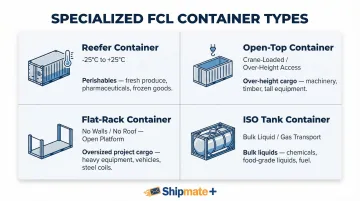
When standard dry containers can't accommodate your cargo's dimensions, temperature requirements, or liquid form, carriers offer purpose-built alternatives:
- Reefer containers — temperature-controlled (-25°C to +25°C) for perishables
- Open-top containers — removable tarpaulin roofs for over-height cargo loaded via crane
- Flat-rack containers — no side walls or roof; used for oversized or out-of-gauge project cargo
- ISO tank containers — cylindrical tanks in a 20ft steel framework for bulk liquids
FCL vs. LCL: Which Is Right for Your Shipment?
The right choice between FCL and LCL depends on how much cargo you're moving, what it costs per unit to ship, and how much handling risk you can accept.
The Volume Threshold
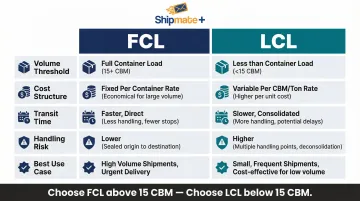
The industry standard rule of thumb: switch from LCL to FCL when a shipment reaches 13 to 15 CBM. While a 20ft container holds 33 CBM, the combined costs of LCL (charged per CBM plus origin/destination handling fees) quickly exceed the flat-rate cost of FCL once you pass the 15 CBM mark.
Cost Structure Comparison
- FCL pricing: Flat rate per container for the ocean leg, plus terminal handling and trucking per container
- LCL pricing: Charged per CBM or per revenue ton (whichever is higher), plus Container Freight Station (CFS) consolidation and deconsolidation fees
Transit Time and Handling Risk
FCL wins on both speed and security. LCL requires cargo to be consolidated at the origin warehouse and deconsolidated at the destination, adding one to two weeks to transit times. FCL containers are sealed at origin and remain unopened until final delivery, cutting handling touchpoints and the risk of damage or theft.
When to Choose Each Option
Choose LCL when:
- Shipment is well under 15 CBM
- Delivery timelines are flexible
- Shipping infrequently and can't fill a container even partially
Choose FCL when:
- Cargo fills 60–70% or more of a container
- Cargo is fragile, high-value, or time-sensitive
- Faster, more secure delivery is a priority
- Destination port is not serviced by LCL consolidators
Common FCL Misconceptions and When It May Not Be the Right Fit
Do FCL Containers Have to Be Full?
"Full Container Load" simply means the shipper has exclusive rights to the container — not that it needs to be packed wall-to-wall. Shippers routinely book FCL for shipments that only fill 60% to 70% of the box because the flat FCL rate is cheaper than the LCL volumetric rate, and it guarantees faster, more secure transit.
Is FCL Always the Cheaper Option?
Not for smaller loads. For shipments well under 15 CBM, LCL will almost always be more economical. FCL's cost advantage scales with volume. Once shipments grow past 15 CBM, clinging to LCL results in overpaying for freight.
When FCL Is Not Appropriate
FCL is not the right fit when:
- Shipment is a single item or very small (under 15 CBM)
- Delivery timelines are very flexible and you can wait for LCL consolidation
- Shipping infrequently and can't fill a container even partially
In those situations, LCL consolidation or air express will typically cost less and move just as fast.
Frequently Asked Questions
What is a FCL container?
An FCL container is a standard intermodal shipping container (typically 20ft or 40ft) booked exclusively by a single shipper for their cargo. It is sealed at loading and not shared with other shippers, providing greater security and faster transit.
What is the difference between FCL and LCL?
FCL means one shipper uses the entire container at a flat rate, while LCL (Less than Container Load) means multiple shippers share space and each pays per CBM. FCL is faster and safer for large shipments; LCL is more cost-effective for small volumes.
What is a 40 FCL container?
A 40ft FCL container (also called a FEU, or Forty-foot Equivalent Unit) offers approximately 67.7 CBM of internal volume and a max cargo weight of around 26,780 kg. It's the go-to option for high-volume shipments.
How long does FCL shipping take?
FCL transit times vary by route, but door-to-door shipments generally take 30–45 days. The timeline includes export haulage, port handling, ocean transit, and import customs clearance.
What does FCL shipping cost?
FCL pricing is quoted as a flat rate per container and varies based on container size, route, season, and surcharges (such as fuel, terminal handling, and customs fees). Request quotes from freight forwarders for accurate, route-specific pricing.
When should I choose FCL over LCL?
FCL makes sense when your cargo fills 60–70% or more of a container, when goods are fragile or high-value, or when speed and security matter most. Under that threshold, LCL is usually the more economical option.
Need help preparing your cargo for international ocean freight? ShipMate+ in Vista, CA offers packing and documentation services to get your shipment ready for FCL transit. Contact the freight specialists at (760) 295-1074 or email info@shipmateplus.com for expert guidance and free quotes.