Yet not every shipment can travel on the same type of truck. Using the wrong truck leads to damaged goods, delivery delays, or inflated costs. A perishable food shipment in a non-refrigerated trailer spoils before arrival. An oversized piece of machinery gets rejected at the loading dock because the carrier brought the wrong trailer type. Loose bulk materials become impossible to unload without specialized equipment.
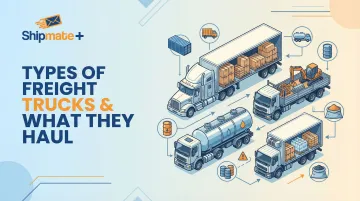
This guide breaks down the six most common freight truck types, what each one hauls, and how to figure out which is right for your shipment.
Key Takeaways
- A freight truck is a commercial vehicle designed to transport goods in bulk — most require a CDL to operate
- Each cargo type requires a specific truck built for those conditions
- The six most common freight trucks are dry vans, flatbeds, reefers, tankers, step decks, and box trucks
- Choosing the right truck depends on cargo type, size, weight, distance, and special handling requirements
- For smaller shipments, multi-carrier shipping through FedEx, UPS, or USPS is more practical and cost-effective
What Is a Freight Truck?
A freight truck is a large commercial vehicle built specifically to transport goods. Unlike passenger vehicles, these are distinguished from standard vehicles by size, weight capacity, and purpose. These trucks form the physical infrastructure of supply chains, moving everything from raw materials to finished retail products across regional and national networks.
Most freight trucks use a two-part structure: the tractor (cab and engine) and the trailer (where cargo is stored). The tractor provides the power and steering, while the trailer carries the load and can be detached and swapped out as needed.
This modular design lets carriers drop one loaded trailer at a warehouse and immediately hook up another, maximizing efficiency.
Not all freight trucks follow this semi-truck model. Box trucks, for example, are single-unit vehicles where the cab and cargo box are permanently attached to the same frame, making them ideal for urban deliveries where maneuverability matters more than maximum capacity.
CDL Requirements
Drivers operating vehicles over a certain weight threshold must hold a Commercial Driver's License (CDL). The Federal Motor Carrier Safety Administration (FMCSA) sets these requirements based on vehicle weight and configuration:
- Class A CDL: Required for combination vehicles with a gross combination weight rating (GCWR) of 26,001 pounds or more, where the towed unit exceeds 10,000 pounds
- Class B CDL: Required for single vehicles with a gross vehicle weight rating (GVWR) of 26,001 pounds or more
Certain cargo types require additional endorsements beyond the base CDL:
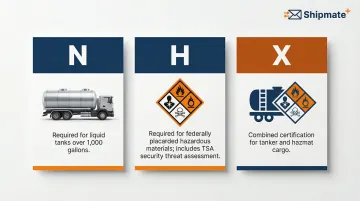
- Tank Vehicle (N) endorsement: Required for hauling liquids in tanks over 1,000 gallons
- Hazmat (H) endorsement: Required for transporting hazardous materials needing federal placarding — includes a TSA security threat assessment
- X endorsement: Combined certification for drivers hauling both tanker and hazmat cargo
Why the Right Truck Type Matters for Your Cargo
Matching cargo to the right truck type directly affects cargo safety, regulatory compliance, and on-time delivery. Getting it wrong is costly in ways that aren't always obvious until pickup day.
Concrete examples of what goes wrong with a mismatch:
- Perishable food loaded into a standard dry van spoils before reaching the distribution center, resulting in total product loss and potential FDA violations
- Oversized industrial equipment arrives at the pickup location, but the carrier brought a standard flatbed instead of a step deck, causing the load to exceed legal height limits and forcing a costly reschedule
- Bulk liquid chemicals arrive in a truck without proper tank endorsements, triggering regulatory violations and shipment rejection at the receiving facility
- Loose sand or grain delivered in an enclosed trailer cannot be unloaded because the facility lacks the equipment to extract material through rear doors
Why shippers—not just carriers—benefit from understanding truck types:
Shippers who understand truck types make better decisions about packaging, freight cost estimates, and what to ask a carrier before booking. Specifying "53-foot dry van with liftgate" upfront, for example, prevents a truck from showing up at a residential delivery without dock access.
Knowing that oversized machinery requires a step deck also means you can negotiate rates on the correct equipment type — not scramble to fix the mismatch on pickup day.
6 Common Types of Freight Trucks and What They Haul
Freight trucks are purpose-built, and the six types below cover the vast majority of commercial shipping needs across industries.
Dry Van
What it is: A fully enclosed, box-shaped trailer with no temperature control—the most common type of freight truck on U.S. highways. Standard dry vans measure 53 feet in length, 8.5 feet in width, and 9 feet in interior height, with a cargo capacity of up to 45,000 pounds or approximately 26 standard pallets.
What it hauls:
- Packaged consumer products (clothing, household goods, toys)
- Electronics and appliances
- Furniture and home furnishings
- Non-perishable food items (canned goods, dry pasta, packaged snacks)
- Palletized manufacturing components
- Retail inventory for stores and distribution centers
Best suited for: Standard long-haul and regional freight where cargo doesn't require climate control or special loading access. Dry vans are the default choice for most manufactured retail items and the entry-level option for new CDL drivers, requiring only a Class A CDL with no additional endorsements.
The enclosed design protects cargo from weather and theft—a key reason they're preferred for high-value electronics and consumer goods. Because dry vans make up the largest segment of available truck capacity, shippers generally find the most competitive rates and shortest lead times here.
When cargo is too large or awkwardly shaped to fit inside an enclosed trailer, the flatbed steps in.
Flatbed Truck
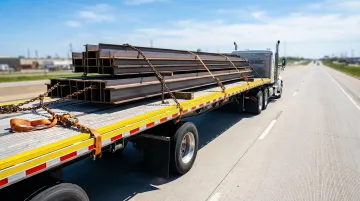
What it is: An open trailer with no walls or roof, designed to carry cargo that can't fit inside an enclosed trailer due to size, shape, or loading requirements. Standard flatbeds measure 48 or 53 feet in length with a deck height of approximately 60 inches off the ground.
What it hauls:
- Construction materials (lumber, steel beams, rebar, concrete forms)
- Heavy machinery and industrial equipment
- Large pipes and ductwork
- Prefabricated building components
- Steel coils and metal products
- Oversized crates and equipment
Best suited for: Oversized or irregularly shaped loads that need to be loaded from the side or top using cranes or forklifts. Flatbeds are essential when cargo dimensions exceed the 8-foot width or 9-foot height limits of enclosed trailers.
Key trade-off: Cargo is exposed to weather, so it must be weather-resistant or protected with heavy-duty tarps. The FMCSA's Cargo Securement Rules (49 CFR 393) require that all flatbed cargo be secured with straps, chains, or other devices capable of withstanding significant forces—0.8g deceleration forward, 0.5g acceleration rearward, and 0.5g laterally. Proper securement is critical to prevent cargo from shifting or falling during transit.
For cargo that must stay cold—or frozen—throughout the haul, a reefer trailer is the only option.
Refrigerated Truck (Reefer)
What it is: A trailer equipped with an insulated, temperature-controlled refrigeration unit that maintains a set temperature range throughout the haul. Reefer units can typically maintain temperatures from -20°F for deep-frozen goods up to 70°F for controlled-room-temperature items.
What it hauls:
- Perishable food (dairy, produce, meat, frozen foods)
- Pharmaceuticals and vaccines
- Fresh flowers and plants
- Temperature-sensitive chemicals
- Chocolate and confections
Delivery is time-critical since any temperature deviation can render cargo unusable. Drivers must monitor temperatures continuously and document compliance with FDA regulations.
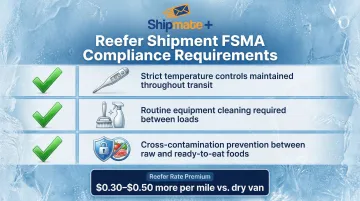
Key trade-off: Reefer shipments cost significantly more than dry van due to fuel for the refrigeration unit, specialized maintenance, and strict FDA compliance requirements. According to industry data, reefer rates average $0.30 to $0.50 more per mile than dry van rates.
The FDA's Food Safety Modernization Act (FSMA) adds another layer of compliance for shippers:
- Strict temperature controls maintained throughout transit
- Routine equipment cleaning between loads
- Measures to prevent cross-contamination between raw and ready-to-eat foods
Non-compliance risks product rejection and regulatory penalties, so verifying carrier FSMA compliance before booking is essential.
Tanker Truck
What it is: A truck with a cylindrical tank (rather than a box-shaped trailer) designed to carry liquid, gas, or dry bulk materials in bulk form. Tanker capacity ranges from 5,000 to 11,600 gallons for liquid loads.
What it hauls:
- Liquid tankers: Gasoline, diesel, chemicals, milk, water, vegetable oils, liquid fertilizers
- Dry bulk tankers: Grain, sand, flour, cement powder, plastic pellets (unloaded using compressed air)
Licensing note: Tanker drivers must obtain a Tank Vehicle (N) endorsement on their CDL. Handling liquid loads requires additional skill to manage the "liquid surge" or sloshing effect—when a partially filled tank stops, the liquid surges forward and backward, physically pushing the truck and potentially causing loss of control or rollovers.
Food-grade tankers (like milk haulers) must use un-baffled "smooth bore" tanks to comply with sanitation regulations—making them especially susceptible to dangerous surges.
Chemical and fuel tankers use internal baffles to slow that movement, but drivers must still account for shifting weight during braking and turns.
Step Deck (Drop Deck) Truck
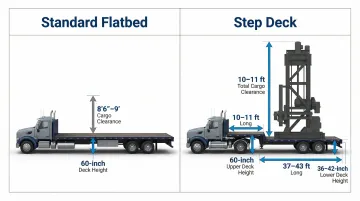
What it is: Similar to a flatbed but with two deck levels—an upper deck near the cab (10-11 feet long, ~60 inches high) and a lower dropped deck behind it (37-43 feet long, 36-42 inches high). This design provides extra vertical clearance for tall cargo.
What it hauls:
- Tall construction vehicles and tractors
- Industrial machinery and manufacturing equipment
- Large agricultural equipment
- Prefabricated structures
- Oversized crates that exceed standard flatbed height limits
Key advantage: Allows transport of taller loads without requiring special height permits in most cases. While most states cap maximum vehicle height at 13 feet 6 inches or 14 feet, a standard flatbed with a 60-inch deck height leaves only 8 feet 6 inches to 9 feet of vertical clearance for cargo. By dropping the deck height by roughly two feet, step decks allow shippers to transport cargo up to 10-11 feet tall while staying within legal limits.
Trade-off: Slightly more complex securement than a standard flatbed, and the upper deck has limited cargo space. Step deck rates typically run higher than standard flatbed due to the specialized equipment.
Box Truck (Straight Truck)
What it is: A single-unit vehicle where the cargo compartment is built directly onto the truck frame—unlike semi-trucks, the cab and box are one connected unit. Box trucks are categorized by their Gross Vehicle Weight Rating (GVWR), ranging from Class 3 (10,001-14,000 lbs) to Class 7 (26,001-33,000 lbs).
What it hauls:
- Furniture and appliance deliveries
- Moving and relocation services
- Food service and restaurant supply deliveries
- Last-mile e-commerce freight
- Local retail and wholesale distribution
- Residential package deliveries
Best suited for: Urban and residential areas where maneuverability matters. Box trucks can navigate tight city streets, back into residential driveways, and access locations where a 53-foot semi-trailer cannot physically fit.
CDL requirements: Box trucks under 26,001 lbs GVWR do not require a CDL, making them accessible to a wider driver pool. Box trucks exceeding 26,001 lbs GVWR require a Class B CDL, which limits the available driver pool and increases operational costs for carriers.
E-commerce growth has made Class 3-7 box trucks indispensable for last-mile delivery—maneuverable enough for residential streets, yet capable of carrying a full day's worth of packages in a single load.
How to Choose the Right Freight Truck for Your Shipment
Choosing the right freight truck starts with identifying your cargo's specific requirements, then matching those needs to the appropriate equipment type.
Start with Cargo Requirements
Does the cargo need temperature control?
- Yes → Refrigerated truck (reefer)
- No → Dry van, flatbed, step deck, tanker, or box truck
Is the cargo oversized or irregularly shaped?
- Exceeds 8 feet wide or 9 feet tall → Flatbed or step deck
- Taller than 8 feet 6 inches → Step deck (to avoid height permits)
- Standard palletized goods → Dry van or box truck
Is the cargo a liquid or bulk dry material?
- Liquid (fuel, chemicals, milk) → Liquid tanker
- Dry bulk (grain, sand, cement powder) → Dry bulk tanker
- Standard packaged goods → Dry van or box truck
Factor in Size and Weight
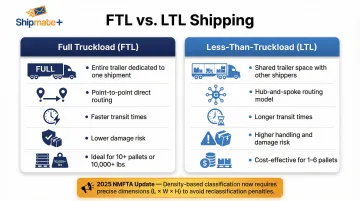
Full Truckload (FTL) means your shipment fills an entire trailer and ships point-to-point from origin to destination. FTL offers faster transit times and lower damage risk since freight is rarely handled during transport. FTL is ideal for shipments of 10+ pallets or 10,000+ pounds.
Less-Than-Truckload (LTL) shares trailer space with other shippers' freight, operating on a hub-and-spoke model where freight is loaded, unloaded, and transferred at multiple terminals. This keeps costs down for smaller shipments (1-6 pallets), but expect longer transit times and a higher chance of damage from frequent handling.
Pricing shift: In July 2025, the National Motor Freight Traffic Association (NMFTA) shifted to a strictly density-based classification system, expanding to 13 density classes. Shippers must now provide precise dimensions (Length x Width x Height) to avoid reclassification penalties and inflated LTL costs.
Consider Loading and Unloading Conditions
Facilities without a loading dock may require a truck with a liftgate, drop-down ramps, or open sides for forklift access. Warehouses with dock doors are set up for enclosed trailers like dry vans and reefers.
Questions to ask:
- Does the pickup or delivery location have a loading dock?
- Will a forklift be available, or does the driver need to hand-unload?
- Are there height or width restrictions at the facility entrance?
Account for Distance and Route
Box trucks are better for short-range urban deliveries (under 100 miles), while dry vans and reefers handle cross-country hauls efficiently. Step decks and flatbeds are used across all distances but require more route planning to account for height and weight restrictions, bridge clearances, and permit requirements.
Recognize When a Freight Truck Isn't the Right Solution
For smaller shipments—individual packages, small pallets, or items that don't fill even a portion of a freight trailer—working with a multi-carrier shipping provider offers an alternative.
ShipMate+ in Vista, CA gives you access to FedEx, UPS, and USPS under one roof, so you can compare rates and pick the best option without booking a full freight truck. For shipments that do require freight, ShipMate+ also coordinates LTL and freight services through partnerships with over 40 carriers.
Call (760) 295-1074 or stop by 1929 W Vista Way Suite F, Vista, CA 92083 to get rates and figure out the right shipping option for your load.
Conclusion
Freight trucks are purpose-built vehicles, and matching the right truck to the cargo is what keeps supply chains moving efficiently and cost-effectively. Each type serves a distinct role:
- Dry van — enclosed, all-purpose freight
- Flatbed — oversized, open-load materials
- Reefer — temperature-sensitive goods
- Tanker — liquids and gases
- Step deck — tall or heavy equipment
- Box truck — local and last-mile deliveries
Knowing the difference helps shippers ask better questions, plan smarter shipments, and avoid costly mismatches. If you need to ship freight and aren't sure where to start, ShipMate+ in Vista, CA offers freight forwarding services alongside FedEx, UPS, and USPS options — so you can find the right solution without making multiple stops.
Frequently Asked Questions
What is a freight truck?
A freight truck is a commercial vehicle designed to transport goods in bulk, made up of a tractor (cab and engine) and a trailer (cargo compartment). Most require a Commercial Driver's License (CDL) to operate legally on public roads.
What is a big freight truck called?
Large freight trucks go by several names—semi-truck, 18-wheeler, tractor-trailer, or big rig—all describing a cab pulling a detached trailer. The "18-wheeler" label refers to the standard wheel count: 10 on the tractor, 8 on the trailer.
What is freight vs cargo?
"Freight" refers to large commercial shipments moved by truck, rail, air, or sea for business purposes. "Cargo" is a broader term common in shipping and aviation contexts. The two are often used interchangeably across the industry.
What is the difference between a dry van and a reefer truck?
A dry van is a standard enclosed trailer with no temperature control, used for non-perishable goods like electronics, furniture, and packaged products. Reefer trucks, by contrast, run an active refrigeration unit that holds temperatures anywhere from -20°F to 70°F—essential for food, pharmaceuticals, and other perishables.
Do I need a CDL to drive a freight truck?
Yes, in most cases. A Class A CDL is required when the combined vehicle weight exceeds 26,001 pounds and the towed unit exceeds 10,000 pounds. Hauling hazardous materials or large liquid tanks also requires additional endorsements (Hazmat or Tank Vehicle) on top of the base CDL.
What is LTL vs FTL shipping?
FTL (Full Truckload) means a shipment fills an entire trailer and moves directly to its destination, offering faster transit and lower damage risk. LTL (Less Than Truckload) means a smaller shipment shares trailer space with other freight, typically at a lower cost but with longer transit times due to the hub-and-spoke model.