
Introduction
Picture this: you have 10 pallets of product to ship across the country. LTL quotes come back inflated because your freight is bulky. Full truckload means paying for 26 empty pallets of space. Neither option makes sense — and yet those are the only two most shippers know about.
That's where partial truckload (PTL) shipping comes in.
PTL is built for mid-sized freight — typically 6 to 18 pallets — that's too large to share a trailer efficiently under LTL rates but too small to fill a full truck. Shippers who switch to PTL often cut costs, reduce cargo damage, and shave days off delivery times.
This guide breaks down how PTL works, how it compares to LTL and full truckload, and when it's the right call for your freight.
Key Takeaways
- PTL handles shipments between 6–18 pallets or 5,000–27,500 lbs—too big for LTL, too small for a full truck
- Simpler than LTL: no freight classification required, less handling, and faster transit times
- More cost-effective than full truckload for mid-sized loads because you only pay for trailer space used
- Best fit for fragile, bulky, or low-density freight that gets hit with high LTL class surcharges
What Is Partial Truckload Shipping?
Partial truckload (PTL) is a freight shipping mode that occupies part of a trailer—not a full truck—and sits between less-than-truckload (LTL) and full truckload (FTL) in terms of size and cost. Some carriers call it "volume LTL," but the concept is the same: your freight shares trailer space with one or two other shipments while staying on the same truck from pickup to delivery.
Typical size thresholds for PTL:
- 6 to 18 pallets (though some carriers accept 5-25 pallets depending on capacity)
- 5,000 to 27,500 pounds (some carriers go up to 30,000 or 40,000 lbs)
- 12 to 30 linear feet of trailer space
These are guidelines, not hard rules. Exact thresholds vary by carrier and current capacity availability.
PTL Is NOT the Same as LTL
PTL and LTL operate very differently. PTL freight stays on one truck without being cross-docked through multiple terminals. Cross-docking means unloading freight at a terminal, sorting it with other shipments, and reloading it onto a different truck headed for the next hub.
LTL shipments often pass through 5-6 terminals before reaching their destination, meaning your pallets get handled repeatedly by forklifts and warehouse staff at each stop.
PTL uses a "load-to-ride" model: your freight is loaded once at origin and stays on the same truck until delivery. This eliminates the hub-and-spoke network entirely.
How PTL Pricing Works
PTL pricing is based on the space and weight your freight occupies on the trailer, plus distance and current market demand. PTL also does not require NMFC (National Motor Freight Classification) freight class codes, which are mandatory for LTL.
Freight class is a pricing system that assigns your shipment a code (50 to 500) based on density, handling difficulty, stowability, and liability. Low-density items like foam or furniture get high freight classes, which sharply increases LTL costs.
PTL bypasses this system entirely—making pricing more transparent and predictable, especially for shippers unfamiliar with freight codes.
To see where PTL fits relative to your shipment size and budget, it helps to map it against the full freight spectrum.
How PTL Fits Into the Freight Landscape
Understanding where PTL fits in the freight spectrum helps you choose the right mode:
- Parcel shipping: Small packages (under 150 lbs) via FedEx, UPS, USPS
- LTL: Consolidated freight from multiple shippers on one truck, 1-10 pallets, multiple terminal stops
- PTL: Fewer shippers, one truck, minimal stops, 6-18 pallets
- Full Truckload (FTL): One shipper, one truck, direct delivery, 15,000-44,000 lbs
PTL acts as a hybrid, offering the shared-cost benefits of LTL with the direct-transit benefits of FTL.
PTL vs. LTL vs. Full Truckload: How They Compare
The overlap between LTL, PTL, and FTL is where most shippers lose money—picking the wrong mode means overpaying or accepting unnecessary delays. Here's what separates each option.
LTL: Small Shipments, Shared Space
- Suited for 1–10 pallets up to 15,000 lbs
- Freight consolidated with other shippers' goods at multiple terminals
- Requires NMFC freight class assignment
- Multiple terminal stops mean more handling and longer transit times (typically 4-7 business days for 1,000 miles)
- Lower per-unit cost for small shipments, but costs rise sharply for larger or low-density loads
PTL: Mid-Volume Without the Full Trailer Price
- Suited for 6–18 pallets and 5,000–27,500 lbs
- Stays on one truck with minimal stops
- No freight class needed
- Faster than LTL (typically 2-3 days faster on comparable lanes)
- Costs less than FTL when you don't fill a trailer—typically 20–40% cheaper on comparable lanes
Full Truckload (FTL) Characteristics
- One shipper fills the entire trailer (15,000–44,000 lbs, up to 26 standard pallets)
- Fastest and most direct (1-2 days for 1,000 miles)
- Highest cost but economical when the full truck is needed
- Ideal for time-sensitive or high-volume shipments
Comparison Table
| Feature | LTL | PTL | FTL |
|---|---|---|---|
| Pallets | 1-10 | 6-18 | Up to 26 |
| Weight Range | 150-15,000 lbs | 5,000-27,500 lbs | 15,000-44,000 lbs |
| Transit Speed | Slowest (4-7 days) | Moderate (faster than LTL) | Fastest (1-2 days) |
| Handling Risk | High (5-6 terminal touches) | Low (minimal handling) | Lowest (direct load) |
| Freight Class Required | Yes (NMFC) | No | No |
| Pricing Basis | NMFC class, weight, dimensions | Space used, weight, market rate | Flat market rate for entire trailer |
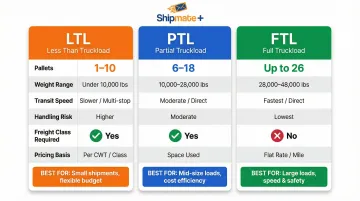
Key decision rule: Shipments that outgrow LTL economics—especially low-density or bulky freight hit hard by freight class penalties—but don't fill a trailer belong in PTL. It's the gap most shippers overlook.
Key Benefits of Partial Truckload Shipping
Cost Savings on Mid-Sized Loads
PTL lets you pay only for the trailer space you use, avoiding the cost of empty trailer space that comes with booking a full truck. For shipments in the 6-18 pallet range, this delivers significant savings.
Real-world data:
- Flock Freight reports shippers using their Shared Truckload (PTL) service save an average of 20% compared to traditional FTL options
- Mexicom Logistics documented a manufacturing client reducing transportation costs by 54% to 60% on cross-border lanes by switching from FTL to a combined FTL/PTL solution for 20,000 lb loads
- GEODIS achieved a 50% year-over-year reduction in LTL shipment costs for a client by optimizing mid-sized freight with competitive carrier rates
Reduced Cargo Damage
Because PTL freight is loaded once and stays on one truck with minimal stops, it is handled far less than LTL. Less handling directly correlates with lower damage rates.
Industry damage rate comparison:
- LTL damage rates: 2% to 5%
- FTL damage rates: 0.5% to 2%
- LTL involves 2.5x more risk of loss or damage compared to FTL
LTL's hub-and-spoke model creates numerous opportunities for drops, forklift punctures, and crushing. A typical LTL pallet is handled at least 5 times, passing through 5-6 different facilities before delivery.
PTL's load-to-ride model mirrors FTL's security, sharply reducing damage exposure—especially for fragile, oversized, or high-value goods.
Faster Transit Times Than LTL
PTL freight avoids the hub-and-terminal network that slows LTL down. In LTL, each terminal stop requires unloading, re-sorting, and reloading before the freight moves on—and a single cross-country shipment can pass through four or more of these stops. PTL skips that network entirely.
Transit time comparison:
- FTL (1,000 miles): 1-2 days
- PTL (1,000 miles): Typically 2-3 days faster than LTL
- LTL (1,000 miles): 4-7 business days
Each terminal touch adds roughly half a day to a full day of transit time. PTL skips these stops, accelerating delivery without the premium cost of dedicated FTL.
No Freight Classification Required
NMFC freight class is a cost trap for low-density goods. The system assigns higher freight classes (and higher costs per pound) to lightweight items that take up significant space.
Freight class examples:
| Item | Density (lbs/cu ft) | NMFC Class | Cost Impact |
|---|---|---|---|
| Bricks, steel rods | 50+ | Class 50 | Lowest cost |
| Unassembled furniture | 15-22.5 | Class 70 | Moderate cost |
| Packaged mattresses | 4-5 | Class 200 | High cost |
| Bamboo furniture | 3-4 | Class 250 | Very high cost |
| Ping-pong balls, foam | <1 | Class 500 | Highest cost |
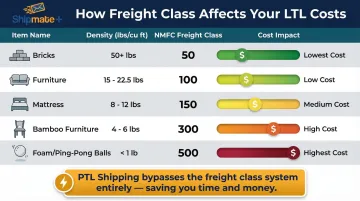
Shipping 10,000 pounds of lightweight foam via LTL triggers severe density penalties. PTL prices the same load strictly on the linear feet it occupies, eliminating this penalty entirely.
The reclassification trap: Over half of all LTL freight is misclassified, leading to costly reclassification fees and billing disputes. Up to 25% of LTL shipments undergo formal reclassification or reweighing, which can delay shipments by up to 72 hours and result in fees ranging from hundreds to thousands of dollars. PTL sidesteps the classification system altogether—no density calculations, no surprise fees, no billing disputes.
When Does Partial Truckload Make Sense for Your Business?
Scenario 1 — Low-Density or Bulky Freight
If your shipment is lightweight but takes up significant trailer space—furniture, foam, large packaging materials, display fixtures—LTL freight class rules can sharply increase cost. PTL eliminates this penalty.
Example: A furniture manufacturer shipping 12 pallets of unassembled office desks weighing 8,000 lbs total. Under LTL, the low density (15 lbs/cu ft) triggers Class 70 or higher, inflating the cost. PTL prices the shipment based on the 18 linear feet of trailer space it occupies, resulting in 20-30% savings.
Scenario 2 — Fragile or Damage-Sensitive Goods
Any shipment where cargo damage would be costly—electronics, display fixtures, glass items, custom products—benefits from the reduced handling of PTL. LTL's multi-stop model exposes freight to 5-6 terminal touches, raising the risk of drops and crushing at each transfer point.
Grand Stands, an ergonomic workstation manufacturer, shifted from LTL to PTL to address recurring damage. By avoiding hub-and-spoke transfers, they achieved a 100% damage-free rate and 100% on-time delivery rate.
Scenario 3 — Mid-Volume Regular Shipments from Small Businesses or Manufacturers
Businesses that ship 6–18 pallets regularly but can't consistently fill an entire truck are the classic PTL use case. It's a practical option for small businesses that need freight-level capacity without the overhead of managing full truckload contracts.
Case study: King Solutions, a nationwide construction distributor, faced severe dock congestion and high costs from sending multiple LTL shipments to the same destinations. By shifting to a consolidated PTL network, they reduced the number of trucks needed, maximized trailer utilization, and lowered transportation costs without sacrificing speed.
How to Quote and Book a Partial Truckload Shipment
Information You Need to Prepare
Before requesting a PTL quote, gather the following information. Exact dimensions are non-negotiable—carriers need this to confirm the freight fits the trailer.
Required inputs:
- Exact dimensions (length, width, height) of each pallet or item
- Total weight
- Origin and destination ZIP codes
- Desired pickup window
- Special handling requirements: stackable, fragile, temperature-sensitive, liftgate needed, residential delivery, inside pickup, hazardous materials
The Quoting Process
Shippers can get quotes through freight brokers, 3PL (third-party logistics) providers, or directly from carriers. Rates are typically based on trailer space used, distance, and current market demand.
Rate fluctuations: PTL and truckload rates are subject to market volatility and seasonal swings. For example, spot truckload rates surged in December 2025 due to holiday seasonality and severe weather, with van rates hitting $2.29 per mile (up 9% year-over-year). C.H. Robinson increased its 2026 dry van cost-per-mile forecast to +12% year-over-year due to winter storm disruptions and tightening capacity.
Recommendation: Get multiple quotes. Rates can vary by 10-20% between carriers depending on current capacity and lane availability.
Local Help for Vista, CA Shippers
If comparing carriers and negotiating rates sounds overwhelming, a local freight specialist can handle that legwork for you. ShipMate+ in Vista, CA is an authorized shipper for FedEx, UPS, and USPS with freight forwarding access across multiple carriers. Their team helps customers compare shipping modes and identify the right fit for their freight.
ShipMate+ freight specialists handle carrier selection, rate negotiation, and logistics coordination. They also provide professional commercial packaging, palletizing, and crating services to ensure freight arrives safely and intact.

Contact ShipMate+:
- Phone: (760) 295-1074
- Address: 1929 W Vista Way Suite F, Vista, CA 92083
- Hours: Monday-Friday 9AM-6PM, Saturday 9AM-1PM
Frequently Asked Questions
What does a partial load mean?
A partial load (or partial truckload) refers to a freight shipment that takes up only part of a trailer, typically 6–18 pallets or 5,000–27,500 lbs. It shares space with one or more other shippers while remaining on the same truck throughout transit, avoiding the terminal transfers common in LTL.
How do I quote a partial truckload?
To quote a PTL shipment, gather exact dimensions, total weight, pickup/delivery locations, and any special handling needs. Submit this information to a freight broker, 3PL, or carrier directly to receive a rate based on trailer space and distance. Multiple quotes are recommended due to market rate variability.
What are the two major types of truckload carriers?
The two main types are asset-based carriers, who own their trucks and trailers, and non-asset-based brokers, who arrange transportation through third-party fleets. Asset-based carriers offer more control and consistency; brokers provide broader capacity access and competitive pricing.
Is partial truckload cheaper than LTL?
PTL isn't always cheaper, but it often wins on cost for larger or low-density freight because it skips LTL classification fees, reclassification surcharges, and terminal-transfer handling costs. For shipments in the 6–18 pallet range, PTL typically saves 20–30% compared to LTL.
How many pallets is a partial truckload?
Most PTL shipments range from 6 to 18 pallets, depending on the carrier and pallet dimensions. That puts PTL above typical LTL thresholds (1–10 pallets) but short of a full 48- or 53-foot dry van, which holds up to 26 standard pallets.
What is the difference between partial truckload and LTL?
LTL freight is consolidated at multiple terminals with more handling and requires freight class codes. PTL stays on one truck with fewer stops, no freight class needed, and typically faster, safer delivery for mid-sized loads. PTL uses a load-to-ride model; LTL relies on a hub-and-spoke network.