Introduction
LTL (Less Than Truckload) shipping is the go-to option for businesses that need to move freight too large for parcel carriers but too small to fill an entire truck. After Yellow Corporation's 2023 exit removed roughly 10% of market capacity, LTL rates have remained elevated—the TD Cowen/AFS Freight Index shows rates hovering 67.9% above 2018 levels in late 2025. Getting an accurate quote means knowing what's actually moving the needle on price.
This guide covers what LTL freight quotes are, what typical rates look like, the key factors that drive costs up or down, and how to avoid the mistakes that lead to surprise charges at delivery.
Key Takeaways
- LTL rates typically range from $20–$50 per hundredweight (CWT); lighter shipments pay more per pound
- Weight, freight class, density, distance, and accessorials drive the final cost
- Palletize dense, heavy freight whenever possible — it earns the lowest per-pound rates
- Provide accurate shipment details upfront to avoid reclassification fees and surprise invoices
What Are LTL Freight Quotes and What Do They Typically Cost?
LTL freight quotes are estimates provided by carriers or freight brokers before booking, based on shipment-specific details like weight, dimensions, freight class, and origin/destination. These quotes are only as accurate as the information you provide—omit a liftgate requirement or misstate freight class, and your final invoice will reflect the real cost.
Less than truckload means shipments typically weighing between 150 and 20,000 lbs share trailer space with other shippers' freight. This shared-space model makes LTL more affordable than full truckload (FTL) for smaller loads, but it also introduces complexity in pricing.
Typical LTL Rate Ranges
LTL pricing is most commonly quoted in cost per hundredweight (CWT = per 100 lbs). The current average LTL contract rate across all tiers sits at $46.40/CWT, though actual rates vary significantly based on shipment characteristics.
Current market rate ranges by weight:
- Under 500 lbs: ~$40–50/CWT ($0.40–$0.50 per pound)
- 500–2,999 lbs: ~$30–40/CWT ($0.30–$0.40 per pound)
- 3,000–4,999 lbs: ~$25–30/CWT ($0.25–$0.30 per pound)
- 5,000+ lbs: ~$20–25/CWT ($0.20–$0.25 per pound)
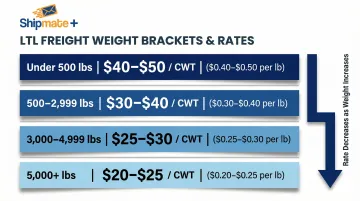
Heavier loads earn a lower per-pound rate because fixed carrier costs are distributed across more weight. A single 5,000 lb shipment will cost far less per pound than five separate 1,000 lb shipments moving individually.
The base rate covers terminal-to-terminal transport only. These charges are not included:
- Fuel surcharges — fluctuate weekly with diesel prices
- Accessorial fees — liftgates, residential delivery, inside delivery
- Special handling charges for oversized or fragile freight
Leave any of these out of your quote request, and the final invoice will reflect the difference.
When LTL Makes Sense vs. Other Shipping Methods
Choosing the wrong mode for borderline freight guarantees overpayment. Here's how to decide:
- Parcel shipping (FedEx/UPS): Best for items under 150 lbs and within 108 inches length/165 inches combined length and girth
- LTL: Cost-effective for 150–20,000 lb shipments that don't require dedicated trailer space
- FTL (Full Truckload): Better when freight exceeds 10,000–15,000 lbs or requires dedicated space and direct delivery
A 100 lb package should almost always move via parcel networks. If tendered to an LTL carrier, it triggers an Absolute Minimum Charge. Old Dominion's interstate minimum ranges from $159 to $245 depending on mileage; FedEx Freight enforces a $254 minimum for Priority shipments. That puts a 100 lb LTL shipment at $1.59–$2.54 per pound — far above typical parcel rates.
Key Factors That Affect LTL Freight Rates
LTL pricing is not a flat fee. Rates are calculated using a combination of technical and operational variables that can push a quote significantly higher or lower.
Shipment Weight and Weight Breaks
LTL carriers use pre-set weight brackets called weight breaks. As shipment weight crosses into a higher bracket, the per-pound rate typically drops.
Example: Shipping two separate 800 lb pallets might cost $40/CWT each ($320 per pallet, $640 total). Consolidating them into one 1,600 lb shipment could drop the rate to $32/CWT ($512 total)—a $128 saving simply by combining shipments.
Freight Class
Freight class (NMFC classes 50–500) is a standardized classification system maintained by the National Motor Freight Traffic Association. It's determined by four factors:
- Density: Weight per cubic foot
- Stowability: How easily freight fits with other cargo
- Handling: Ease or difficulty of moving the freight
- Liability: Risk of theft, damage, or perishability
Higher classes (bulkier, harder to handle) cost more. Class 50 freight (dense items like bricks or steel) costs substantially less than Class 500 (light, bulky items like ping pong balls).
Misclassifying freight during quoting leads to reclassification fees after delivery. FedEx Freight charges a $40 validation fee for weight or inspection corrections, while Old Dominion charges $25 per shipment for reweighing or reclassification—plus the corrected, often higher, freight rate.
Shipment Density
Density drives LTL pricing more than any other single variable. High-density freight costs less per pound to ship because it uses trailer space efficiently.
How to calculate density:
- Measure Length × Width × Height in inches
- Divide by 1,728 to convert to cubic feet
- Divide shipment weight (in pounds) by total cubic feet
Example: A 500 lb pallet measuring 48" × 40" × 48" has a volume of 92,160 cubic inches ÷ 1,728 = 53.3 cubic feet. Density = 500 lbs ÷ 53.3 = 9.4 lbs per cubic foot.
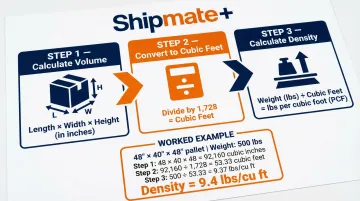
Poorly packed pallets that waste vertical space inflate cubic footage and hurt density calculations, pushing your freight into a higher class and higher rate.
Distance and Lane Type
Longer distances cost more, but the specific origin/destination matters too. Freight moving between major hubs (dense lanes like Los Angeles to Chicago) is generally cheaper than freight moving to rural areas or locations requiring special equipment for access.
Accessorial Charges
Accessorials are add-on fees for services beyond standard terminal-to-terminal transport. These are line-item additions on top of the base rate and vary by carrier.
Most common accessorials:
- Liftgate pickup/delivery: $75–$207 minimum (required when shipper or receiver lacks a loading dock)
- Residential delivery: $75–$243 per shipment
- Inside delivery: $100–$200 minimum (driver brings freight inside instead of curbside)
- Hazardous materials: $30–$61 per shipment
- After-hours delivery: Varies by carrier
- Driver load/unload: Additional labor charges
- Advance notification: $23.50–$65 per shipment
A 500 lb shipment requiring a liftgate and inside delivery to a residential address can easily incur over $300 in accessorial fees alone, sometimes exceeding the base linehaul cost entirely.
Fuel Surcharges and Market Conditions
Carriers apply a fuel surcharge (usually a percentage of the base rate) that fluctuates weekly or monthly with diesel prices. At a DOE diesel price of $3.50–$3.55 per gallon, surcharges vary significantly by carrier:
- Saia: 30.37% surcharge
- FedEx Freight: 42.00% surcharge
Broader market conditions also push base rates up or down. Since Yellow Corp's 2023 bankruptcy removed roughly 10% of national LTL capacity, the remaining carriers have held rates firm — and in many lanes, increased them.
How LTL Freight Rates Are Calculated
Understanding the math behind LTL pricing helps shippers anticipate costs and avoid post-shipment invoice surprises. Carriers start with a base rate (per CWT) and then apply discounts, surcharges, and accessorial fees to arrive at the final price.
The Base Rate and Discount Structure
Most LTL carriers publish a tariff (base rate card) and then offer negotiated percentage discounts off it. Because each carrier's base tariff is different, a larger percentage discount does not guarantee a cheaper rate.
Example: Carrier A offers an 80% discount off a $200/CWT base rate = $40/CWT net. Carrier B offers a 60% discount off a $90/CWT base rate = $36/CWT net. Despite the smaller discount percentage, Carrier B is cheaper.
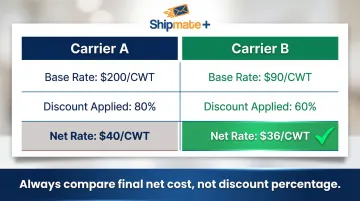
Always evaluate quotes based on the final net landed cost, not the discount percentage.
Minimum Charges
Discount structure is only part of the equation — every carrier also sets a minimum charge regardless of how light or small the shipment is. This covers fixed overhead and can make very small LTL shipments disproportionately expensive per pound.
| Carrier | Minimum Charge |
|---|---|
| Old Dominion (interstate direct) | $159–$245 (varies by mileage) |
| FedEx Freight Priority | $254 |
For shipments under 150 lbs, parcel carriers are typically more cost-effective.
How to Use an LTL Freight Calculator
To get an accurate quote, you need to input:
- Origin and destination zip codes
- Total shipment weight in pounds
- Pallet dimensions (length, width, height)
- Freight class based on NMFC classification
- Any accessorials needed: liftgate, residential delivery, inside delivery, etc.
Leaving out accessorials is the most common reason final invoices exceed initial quotes. No loading dock at the destination? Add the liftgate fee upfront. Delivering to a home or residential address? Include the residential surcharge from the start.
How to Compare and Secure the Best LTL Freight Quotes
Start by comparing multiple carriers, either directly or through a freight broker who pulls rates from several carriers at once. Price matters, but so does reliability — on-time delivery rates and damage rates should factor into the decision just as much as cost.
Before submitting for quotes, verify every shipment detail. Inaccurate information leads to reclassification fees, reweigh charges, and surprise surcharges that wipe out any savings. Check the following before booking:
- Confirm freight class using the NMFC directory
- Measure pallet dimensions and verify total weight
- List every accessorial service the shipment requires (liftgate, residential delivery, inside pickup, etc.)
Small businesses and first-time LTL shippers in Vista, CA can work with ShipMate+ to navigate the quoting process. Their team helps identify the right carrier from a network of over 40 LTL carriers, verifies freight class, and confirms shipment details are accurate before booking — reducing the risk of costly corrections after pickup. Reach them at (760) 295-1074 or stop by 1929 W Vista Way Suite F, Vista, CA 92083.
Repeat shippers with consistent volumes have more leverage than they often realize. Negotiating contracted rates directly with carriers typically beats spot quotes over time, and carriers will often discount accessorial charges for regular customers.
Common Mistakes When Getting LTL Freight Quotes
A few avoidable errors account for most LTL billing surprises. Watch out for these three:
- Wrong freight class: Carriers reclassify at delivery and bill at the corrected — often higher — class. Verify your NMFC class before submitting any quote request.
- Missing accessorial charges: Residential delivery fees, liftgate requirements, and inside delivery must all be declared upfront. Omitting any one of them turns an attractive quote into an inflated invoice.
- Picking on price alone: A carrier with a lower base rate but poor on-time performance or a high damage rate can end up costing more once chargebacks and replacements are factored in. Rate is one input — reliability is another.
Conclusion
LTL freight rates are shaped by several variables — weight, freight class, density, distance, accessorials, and current market conditions. Understanding each one is the difference between a quote that holds at delivery and one that triggers surprise invoice adjustments.
The right LTL rate isn't simply the lowest number on the screen. It's the one that reflects accurate shipment details, fits your service requirements, and comes from a carrier you can count on. Getting the details right upfront avoids invoice disputes and delivery delays later.
If you're in Vista, CA and need help booking or comparing LTL freight options, ShipMate+ offers freight shipping alongside its full range of packing and shipping services — no guesswork required.
Frequently Asked Questions
What is the going rate for LTL freight?
LTL rates are quoted per hundredweight (CWT), with current averages ranging from $20–$50/CWT — lighter shipments cost more per pound. The final rate depends on freight class, distance, and accessorials like liftgates or residential delivery.
How do you calculate LTL freight rates?
The calculation starts with a base rate (per CWT) applied to shipment weight, then adjusted by freight class, distance, fuel surcharges, and any accessorial fees. Enter accurate dimensions, freight class, and all accessorials into an LTL calculator to get a reliable quote.
How much does it cost to ship a 100 lb package?
A 100 lb shipment typically falls under parcel shipping and should move via FedEx or UPS. If tendered as LTL, it will trigger carrier minimum charges ($159–$254), making the effective rate $1.59–$2.54 per pound, well above standard parcel rates of $0.50–$1.00 per pound.
What is freight class and why does it matter for LTL quotes?
Freight class (NMFC 50–500) is a standardized rating based on density, handling, stowability, and liability. Higher classes cost more to ship. Incorrect classification leads to reclassification fees after delivery, often adding $25–$40 in penalties plus the corrected higher rate.
What is the difference between LTL and FTL shipping?
LTL shares trailer space with other shippers, making it cost-effective for 150–20,000 lb loads. FTL dedicates a full trailer to one shipment, used when freight exceeds 10,000–15,000 lbs or requires direct delivery without terminal stops.
What are accessorial charges in LTL shipping?
Accessorials are add-on fees for services beyond standard terminal-to-terminal transport, such as liftgate service ($75–$207), residential delivery ($75–$243), or inside delivery ($100–$200). These should always be included in the initial quote to avoid invoice surprises.