

Introduction
Picture this: you carefully pack a fragile gift for a loved one, drop it off at the carrier, and days later learn it arrived shattered. Or your business ships a high-value product only to face a costly damage claim—denied because the packaging didn't meet carrier standards. Both situations trace back to the same preventable cause: improper packaging.
With 22.37 billion parcels shipped in the U.S. in 2024 and an estimated 58 million packages stolen, the stakes for proper packaging have never been higher. Poor packaging doesn't just risk damage—it costs shippers money through denied claims, return fees, and lost customer trust.
What follows covers carrier-backed guidelines for every step: choosing the right box, selecting cushioning materials, sealing, labeling, and handling special items. Whether you're sending one package or managing regular shipments, these practices will protect your items and keep claims out of the denied pile.
TLDR: Packaging Best Practices at a Glance
- Use a new or like-new corrugated box with at least 2 inches of cushioning space on all sides
- Fill every gap with the right cushioning—bubble wrap for fragile items, packing peanuts for general void fill
- Seal all seams with 2-inch pressure-sensitive tape using the H-tape method
- Label the largest surface clearly and tuck a duplicate address card inside the box
- Wrap fragile electronics in anti-static materials before adding bubble wrap and cushioning
Why Proper Packaging Matters
Your package doesn't travel in a bubble. From the moment you hand it to a carrier, it enters a complex network of conveyor belts, sorting machines, delivery trucks, and manual handling. FedEx testing data shows that domestic shipments pass through up to two major sortation facilities, each subjecting packages to a 10-point drop cycle. International shipments face up to four sortations and 20 drop points. U.S. retailers processed $743 billion in merchandise returns in 2023, with transit damage representing a significant portion. When packaging fails, shippers face:
- Damaged goods requiring replacement shipments
- Denied insurance claims when carriers determine packaging didn't meet standards
- Return shipping fees that quickly add up
- Unhappy customers who may not order again
- Time costs of re-packing and re-shipping
The 4 Principles of Packaging cover every variable that determines whether a shipment arrives intact:
- Containment — The product stays securely inside the box throughout transit, no matter how the package is handled
- Protection — Adequate cushioning absorbs drops, compression, and jostling between sortation points
- Convenience — Packages are sized and shaped so carriers can handle, stack, and deliver them without difficulty
- Communication — Clear labels and handling instructions on the exterior reduce misrouting and rough treatment
Choosing the Right Box
The box is your first line of defense. Using the wrong box—whether too weak, too large, or previously damaged—is one of the most common packaging mistakes.
Use New or Like-New Corrugated Cardboard
Previously used boxes lose structural integrity through crushed corners, weakened flaps, and compromised edges. Before reusing any box, inspect it carefully:
- Check for holes, tears, or punctures in all panels
- Examine corners for crushing or deformation
- Test flaps to ensure they're not cracked or separated
- Verify that seams are intact and not split
If you reuse a box, completely remove or cover all old labels, barcodes, and shipping markings with heavy black marker. Old labels can cause misrouting and delivery delays.
The Right-Size Rule
Your box should be snug enough to prevent items from shifting, but large enough to accommodate at least 2 inches of cushioning material on all sides—top, bottom, and all four sides. This spacing absorbs impact from drops and prevents the item from contacting the box walls.
Avoid these common sizing mistakes:
- Forcing items into too-small boxes causes seams to burst under pressure
- Leaving excessive empty space allows items to shift and collide with box walls during transit
Single-Wall vs. Double-Wall Corrugated Boxes
Not all cardboard is created equal. Box strength must match your shipment's total weight.
UPS Box Strength Guidelines provide clear weight thresholds:
| Maximum Weight | Wall Type | Minimum Bursting Test | Minimum ECT |
|---|---|---|---|
| 0-30 lbs | Single Wall | 200 lbs/sq in | 32 lbs/in |
| 31-50 lbs | Single Wall | 250 lbs/sq in | 44 lbs/in |
| 51-80 lbs | Single Wall | 350 lbs/sq in | 55-61 lbs/in |
| 81-100 lbs | Double Wall | 350 lbs/sq in | 61 lbs/in |
| 101-150 lbs | Double Wall | 400-600 lbs/sq in | 71-82 lbs/in |
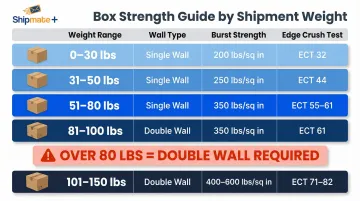
Any shipment over 80 lbs requires double-wall corrugated construction. Most shipping boxes print their maximum weight capacity on the bottom flap. Never exceed it.
The Two-Box Method for Fragile Items
Box strength handles weight, but fragile, sharp, or high-value items need an extra layer of protection. That's where the two-box (double-boxing) method comes in:
- Inner box: Pack the item with full cushioning on all sides
- Outer box: Place the sealed inner box inside a larger box with 3 inches of cushioning material surrounding it on all sides
UPS specifies that the outer box should have depth, width, and length 6 inches greater than the inner box to accommodate the required 3-inch buffer.
At ShipMate+, we carry a wide range of box sizes in both single-wall and double-wall construction, including specialty options for artwork, electronics, and oversized items. If you're not sure which box fits your shipment, our team can help you choose and pack it right.
Cushioning and Void Fill: Protecting What's Inside
Cushioning serves two critical purposes: preventing item movement inside the box and absorbing impact from drops and compression. The cardinal rule is simple—no empty space should remain in a packed box.
Cushioning Material Comparison
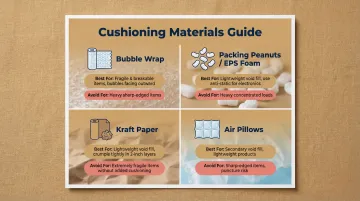
Not all cushioning works the same way. Here's how to match the right material to what you're shipping:
Bubble wrap — Best for wrapping individual fragile items like glassware, ceramics, and electronics. Place bubbles facing away from the product so the flat surface contacts your item, distributing pressure evenly. Pay extra attention to corners and edges, which take the hardest hits.
Packing peanuts (EPS foam) — Works well for lightweight items with irregular shapes. Standard EPS peanuts generate static electricity that can damage electronic circuit boards and sensitive components, so use anti-static peanuts for any electronics. Avoid them for dense, heavy items—they compress under weight and allow shifting.
Kraft paper (crumpled) — Works well as void fill for lightweight, non-fragile items. Crumple it tightly—loose wadding won't hold—and layer at least 2 inches thick between the item and box walls. It absorbs less shock than bubble wrap, so skip it for anything fragile.
Air pillows/inflatable bags — Useful as lightweight void fill around items already wrapped in bubble wrap. Keep in mind that temperature and altitude changes during air transport can affect them, and sharp-edged items may puncture the bags.
The 4-Foot Drop Test
Before sealing your box, run a quick test: drop your packed box from waist height (approximately 4 feet) onto a hard surface—flat on its base, top, two sides, and one corner. If the contents shift, make noise, or feel like they've moved, add more cushioning. This test simulates real handling conditions your package will face.
Special Guidance for Liquids
Shipping liquids requires extra containment layers to prevent leaks from damaging other packages:
- Place bottles or containers in sealed plastic bags before boxing
- Use cardboard dividers between multiple containers to prevent contact and breakage
- Include absorbent materials like paper towels or cellulose wadding to capture any leaks
- For containers over 4 ounces, USPS requires triple-packaging with a leakproof secondary container
How to Seal and Label Your Package Correctly
Even the best-packed box fails if improperly sealed. Carriers have strict requirements about tape types and application methods.
Proper Taping Technique
Use pressure-sensitive plastic shipping tape that is at least 2 inches wide. All major carriers — FedEx, UPS, and USPS — require this minimum standard.
The H-Tape Method: Apply three strips of tape to both the top and bottom of the box:
- One strip down the center seam where flaps meet
- One strip along each edge seam where flaps meet the box sides
This creates an "H" pattern that reinforces all closure points.
Prohibited Tapes: USPS, UPS, and FedEx all prohibit the following:
- Masking tape (insufficient adhesive strength)
- Duct tape (doesn't adhere well to corrugated surfaces)
- Cellophane tape (too weak for shipping)
- String, twine, or cord (creates handling hazards)
Once your box is sealed, labeling it correctly is just as critical — a package with a damaged or misread label has nowhere to go.
Proper Labeling
Exterior label placement:
- Place the shipping label flat on the largest top surface of the box
- Ensure the label is smooth, flat, and fully adhered—no bubbles or wrinkles
- Remove or completely cover any old labels, barcodes, or shipping markings from previous use
- Old labels can trigger automated sorting errors and cause misrouting
Interior label backup: Place a duplicate address label inside the box in case the exterior label is torn or damaged during transit. Include:
- Full recipient name and delivery address
- Complete return address
- Contact phone number
This simple step can save your package from being lost entirely if exterior labels are destroyed.
Packing Fragile, Oversized, and Special Items
Certain items require extra care beyond standard packaging practices.
Fragile Items (Glassware, Ceramics, Artwork)
- Wrap each piece individually in bubble wrap with bubbles facing outward
- Use the two-box method with 3 inches of cushioning between boxes
- Mark the outer box with "FRAGILE" on at least two sides
One critical caveat: UPS does not provide special handling for packages marked "Fragile". USPS offers a paid "Special Handling — Fragile" service, but it does not insure the item against damage. Labels are never a substitute for proper cushioning.
Electronics
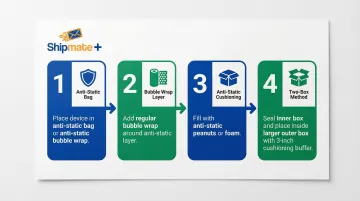
Standard packing peanuts generate static electricity that can destroy circuit boards and sensitive components. FedEx and UPS both require anti-static protection for electronics:
- Place the device in an anti-static bag or wrap it in anti-static bubble wrap
- Add regular bubble wrap around the anti-static layer
- Cushion with anti-static peanuts or foam
- Use the two-box method for high-value electronics
Professional Packing for Difficult Items
For irregularly shaped, heavy, oversized, or high-value items, ShipMate+ in Vista, CA provides professional packing with a trained team. Every item they pack is guaranteed for insurability — meaning your shipment meets carrier standards and qualifies for coverage if something goes wrong.
The store carries an extensive inventory of protective materials, including specialty boxes for artwork, laptops, golf clubs, and furniture, plus discounted packaging supplies. As an authorized drop-off location for FedEx, UPS, and USPS, it's a practical one-stop option for challenging shipments.
Stop by at 1929 W Vista Way Suite F, Vista, CA 92083 (Monday–Friday 9 AM–6 PM, Saturday 9 AM–1 PM), or call (760) 295-1074.
Frequently Asked Questions
Why is proper packaging important?
Packages pass through multiple handling stages where drops, compression, and jostling are common. Proper packaging protects items from damage, prevents costly insurance claim denials, and ensures recipients receive goods in perfect condition. Poor packaging costs shippers money through returns, re-shipments, and lost customer trust.
What are the 4 principles of packaging?
The four principles are:
- Containment — keeping the product secure inside the box
- Protection — shielding items from damage with adequate cushioning
- Convenience — making packages easy to handle and open
- Communication — providing clear labels and handling instructions on the exterior
What is the 5 4 3 2 1 rule packing?
This is a travel luggage rule and does not apply to shipping. For shipping, follow the 2-inch cushioning rule — at least 2 inches of protective material on all sides — and match your box's weight rating to the item inside.
What is the 3-5-7 rule in packing?
This is a travel luggage guideline, not a shipping standard. For shipping, focus on cushioning thickness (2 inches minimum for standard items, 3 inches for the two-box method) and choosing a box rated for your shipment's weight.
Will USPS let you use packing tape?
Yes, USPS allows clear pressure-sensitive plastic shipping tape and recommends at least 2-inch-wide tape. Masking tape, duct tape, cellophane tape, and string are not acceptable for sealing packages with any carrier including USPS, FedEx, or UPS. Use only pressure-sensitive plastic shipping tape.
What type of packaging can be recycled?
Corrugated cardboard, kraft paper, and paper-based void fill are widely recyclable in most curbside programs. Bubble wrap and plastic air pillows can often be recycled at plastic film drop-off locations at grocery stores. EPS foam (styrofoam) peanuts are generally not accepted in curbside recycling and require specialty drop-off locations.