
This guide covers purchase prices, rental rates, freight shipping costs, container types, and the hidden factors that drive final costs up or down—so you can plan your budget accurately and avoid common pitfalls like unexpected delivery charges, condition-grade confusion, and freight surcharges.
Key Takeaways
- New 20ft containers: $2,000–$5,000; used cargo-worthy units: $1,400–$3,000; wind-and-watertight: $1,300–$1,600
- Ocean freight (FCL): $1,700–$2,000 per 20ft container on Asia–U.S. West Coast routes; surcharges add $500–$1,200
- Delivery adds $400–$1,550 depending on distance; modifications run $1,200–$25,000; demand peaks August–October
- Renting beats buying for projects under 18 months — the break-even point is roughly 20 months
- FCL vs. LCL threshold: Book a full 20ft container when your cargo exceeds 15–18 cubic meters
How Much Does a 20ft Shipping Container Cost?
"20ft container cost" covers two distinct scenarios: buying or renting a physical container for storage or conversion, or paying to ship freight inside one via ocean carrier. Both involve layered pricing structures.
Buyers who don't anticipate the full cost picture often face unexpected delivery charges ($400–$1,550), condition-grade confusion (cargo-worthy vs. wind-and-watertight), or freight surcharges that inflate the final bill by 30–50%.
Buying a 20ft Container: New vs. Used
Container purchase prices are commodity-driven and fluctuate based on global supply, but the following tiers represent current 2024–2026 market ranges:
| Condition Grade | Price Range (USD) | What's Included | Best For |
|---|---|---|---|
| New / One-Trip | $2,000–$5,000 | Minimal wear, pristine interior, 30+ year lifespan | Long-term storage, conversions, customer-facing uses |
| Cargo-Worthy (CW) | $1,400–$3,000 | Certified for ocean transit, structurally sound, 10–15 years old | Export shipping, reliable storage, cost-conscious buyers |
| Wind & Watertight (WWT) | $1,300–$1,600 | Weatherproof but not export-certified, minor cosmetic wear | On-site storage, construction yards, non-shipping uses |
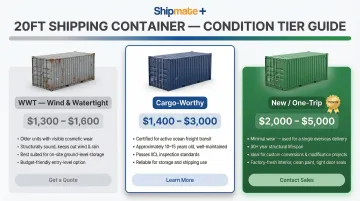
Condition grades explained:
- Inspection tip for CW containers: Check door seals, floor integrity, and the CSC plate (valid certification date). A surveyor's report adds $100–$200 but can save thousands on a bad purchase.
- WWT vs. CW in practice: If you'll never ship the container internationally, WWT units offer equivalent weatherproofing at a lower price — just don't expect to resell them into the export market.
The price gap between a WWT unit and a one-trip container is often under $1,500. If you plan to keep the container for 10+ years or convert it into a structure, that premium typically pays for itself in maintenance savings alone.
Not ready to commit to ownership? Renting offers more flexibility for shorter-term needs.
Renting a 20ft Container
Rental is a localized service where delivery and pickup fees often rival the monthly rate itself. Typical monthly rental rates in the U.S. range from $95 to $199, depending on location, container specifications (standard vs. double-door), and rental duration. Delivery charges add $150 to $500+ based on distance from the depot and site access requirements.
Break-even calculation:
With new 20ft containers priced around $2,349 and rentals averaging $119 per month, the break-even point for purchasing versus renting is approximately 20 months—excluding delivery and pickup fees. Renting is optimal for temporary projects under 18 months, such as seasonal storage, construction site use, or event logistics.
Key rental variables:
- Location: Urban depots near ports offer lower delivery costs
- Duration: Longer rental commitments sometimes reduce monthly rates
- Add-ons: Extra locks, shelving, or climate control increase monthly fees
Shipping Freight in a 20ft Container
Ocean freight rates for a 20ft FCL (Full Container Load) vary significantly by trade route and season. Current 2025–2026 benchmarks include:
| Route | 40ft Rate (FEU) | Estimated 20ft Rate | Notes |
|---|---|---|---|
| Asia to U.S. West Coast | $2,127–$2,503 | $1,700–$2,000 | 20ft rates are typically 20–25% lower than 40ft |
| Asia to U.S. East Coast | $3,069–$3,080 | $2,450–$2,465 | Includes Panama Canal transit or Suez alternative |
Surcharges routinely add 30–50% on top of the base rate. The most common ones to budget for:
- Bunker Adjustment Factor (BAF): $492 (West Coast) to $821 (East Coast) per 20ft container
- Peak Season Surcharge (PSS): Up to $800 per 20ft container during July–October demand spikes
- Terminal Handling Charges (THC): Origin THC from Shanghai averages ~$78 USD per 20ft container; destination THC varies by U.S. port
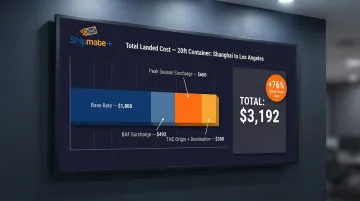
Total landed cost example: A 20ft container from Shanghai to Los Angeles with a base rate of $1,800, BAF of $492, PSS of $600, and origin/destination THC totaling $300 results in a final cost of $3,192—76% higher than the base rate.
For businesses or individuals in Vista, CA with smaller shipments that don't justify a full container, ShipMate+ offers multi-carrier freight options — including LCL (Less-than-Container-Load) bookings — so you only pay for the space you actually use.
Types of 20ft Containers and Their Pricing Impact
The type of container chosen directly affects both upfront cost and long-term suitability. Not all 20ft containers are priced the same, even at identical condition grades—specialized features and materials carry higher price tags over the baseline standard dry van.
Standard Dry Van
The standard 20ft ISO dry van is the baseline option: most affordable, most widely available, and best for general cargo, storage, and construction-site use. This is the benchmark price point all other types are compared against. Standard dry vans measure approximately 20ft long × 8ft wide × 8.5ft tall (exterior) and offer roughly 33.2 cubic meters of internal volume.
High-Cube
High-cube 20ft containers add approximately 1 foot of extra interior height, bringing the exterior to roughly 9'6" tall instead of the standard 8'6". This increased height boosts storage volume and suits tall cargo, warehouse racking, or conversion projects requiring standard ceiling heights. New high-cube 20ft units typically cost around $3,605—a premium of approximately $1,256 (53%) over standard new units priced at $2,349.
Refrigerated (Reefer) Containers
Reefer containers maintain temperature-controlled environments for perishable cargo like food, pharmaceuticals, and chemicals. They require 3-phase electrical power and specialized maintenance. Purchase costs range from $5,500 to $7,000 for new units and $3,500 to $4,500 for used—representing a premium of $3,000+ over standard dry vans. Freight costs are also higher due to power requirements and specialized handling.
Specialized Types: Open-Top and Flat-Rack
Both types handle out-of-gauge cargo that won't fit through standard container doors. Key differences:
| Type | Key Feature | Starting Price | Premium Over Standard |
|---|---|---|---|
| Open-Top | Removable tarpaulin roof; top-load access for oversized machinery | ~$4,900 | ~$2,500 |
| Flat-Rack | Collapsible end walls, no side walls; suits vehicles and equipment | ~$6,000 | ~$3,500 |
Both types are less commonly purchased, and pricing varies based on availability and condition.
Key Factors That Affect the Cost of a 20ft Container
Whether buying, renting, or shipping, the final cost of a 20ft container is shaped by a combination of technical, geographic, and market-driven factors. Understanding these levers helps buyers negotiate better prices and avoid budget overruns.
Container Condition and Age
Condition grades create a wide pricing spectrum across three tiers:
- WWT (Wind & Water Tight): $1,300–$1,600; older units (18–22 years) needing periodic rust treatment, door seal replacement, and roof checks
- Cargo-worthy: $1,400–$3,000; balances cost and reliability for most buyers
- New one-trip: $2,000–$5,000; maximum longevity and clean aesthetics
Evaluating condition vs. cost trade-offs:
- Long-term storage (5+ years): new or cargo-worthy units justify the premium through reduced maintenance
- Short-term construction use (1–2 years): WWT units offer sufficient weather protection at lower upfront cost
- Conversions (offices, homes): new or cargo-worthy units provide better structural integrity for cutting and reinforcement
Geographic Location and Distance from Depot/Port
Containers near major port cities — Los Angeles, Long Beach, New York — cost less to acquire and deliver than those in inland areas. Delivery distance is a major cost driver:
| Delivery Distance | Estimated Cost | Equipment & Notes |
|---|---|---|
| Local (<50 miles) | $400–$600 | Tilt-bed truck; ground-level offloading included |
| Long-haul (200–300+ miles) | $1,200–$1,550+ | Flatbed transport; buyer must provide crane or forklift |
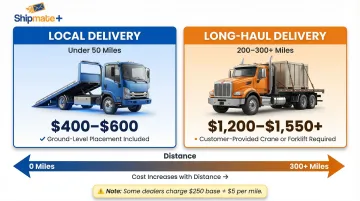
Some dealers use a base rate plus mileage model (e.g., $250 base + $5 per mile). Always confirm whether the quoted delivery fee includes ground-level placement (tilt-bed) or requires customer-provided offloading equipment (flatbed).
Market Conditions and Supply/Demand
Container pricing is cyclical. Demand spikes during peak shipping seasons (July–November) and around major holidays (Chinese New Year) can increase both purchase and freight costs by 25–40%. The COVID-era supply crunch demonstrated extreme volatility: the Drewry World Container Index peaked at $10,377 per 40ft container in September 2021—nearly 10× pre-pandemic levels.
2025–2026 market outlook:
Global container fleet capacity expanded by 10.1% in 2024 and is projected to grow by 6.7% in 2025 and 4.0% in 2026.
This structural overcapacity should push both purchase and freight rates lower once Red Sea traffic normalizes — though localized disruptions (port strikes, tariff changes) can still cause short-term spikes.
Modifications and Customizations
Common modifications layer significant costs onto the base container price:
| Modification Type | Cost Range | Notes |
|---|---|---|
| Windows | $200–$800 each | Standard vinyl; commercial aluminum frames cost $500–$1,500 |
| Doors | $800–$1,200 | Basic exterior steel man door |
| Insulation | $1,200–$4,500 | Rigid panels ($1,200–$3,000) vs. spray foam ($2,000–$4,500) |
| HVAC | $1,500–$3,000 | Ductless mini-split system |
| Electrical | $3,000–$7,000 | Service panels, wiring, outlets, fixtures |
| Basic Office Conversion | $15,000–$25,000 | Includes container, 1 door, 2-3 windows, insulation, electrical, finishes |
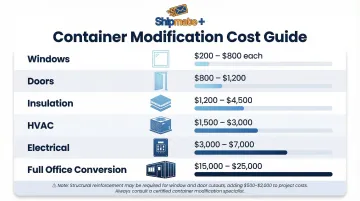
Cutting corrugated steel weakens the container's structural integrity, requiring steel frame reinforcement around every opening.
Delivery and Logistics Costs
Beyond distance, the type of delivery equipment required is where many buyers get caught off-guard. Road access, site clearance, and offloading capability each affect the final bill.
Delivery equipment options:
- Tilt-bed truck: Standard for residential and small business deliveries. Requires 60 feet of straight-line clearance to roll the container off the rear of the bed. Includes ground-level placement.
- Flatbed truck: Used for long-distance hauls (>200 miles). Cannot place containers on the ground; buyer must provide a forklift (rated for 10,000+ lbs) or crane.
- Crane truck (HIAB): Required for placing containers over fences, on elevated platforms, or stacking. Billed at hourly rates; evaluated case-by-case.
Hidden and Ongoing Costs to Budget For
The purchase or freight price is just the starting point. Several recurring and one-time costs often catch buyers off guard:
Delivery and Site Preparation
- Delivery charges ($400–$1,550+) are rarely included in quoted container prices
- Site leveling and ground preparation (gravel pads, concrete slabs) add $200–$1,000 depending on soil conditions and drainage requirements
- Containers placed directly on soil experience accelerated corrosion; elevating on gravel, concrete, or railroad ties extends lifespan
Permits and Zoning
Many jurisdictions require permits to place a shipping container on a property, especially for residential use or long-term placement. Permit costs vary by municipality:
- San Diego, CA: Building permit required; separate permits for electrical, mechanical, and plumbing if utilities are connected
- Portland, OR: Containers >200 sq ft or >10 ft tall require building permits; fees based on container valuation and installation work
- Seattle, WA: Containers in public right-of-way require a "ROW Simple" permit with a $209 base fee
- Los Angeles County, CA: Temporary storage containers in public right-of-way require encroachment permits with $214 issuance fee and $387 processing fee
Check your municipality's permit portal before purchasing — this step is easy to skip and often causes costly project delays.
Maintenance and Longevity
A properly maintained steel container can last 35–40 years on land, or up to 50 years when converted into a static structure. Containers retired from ocean freight after 10–12 years can still deliver 25+ more years of use with basic upkeep.
Annual maintenance costs are low but worth budgeting for:
- Spot rust treatment and patching: $100–$500
- Professional repainting: $800–$1,500 per 20ft container
- Replacement door gaskets: $144–$178
Buy, Rent, or Ship: Choosing the Right Option for Your Needs
The "right" 20ft container cost depends entirely on your use case. Buying locks in long-term value but requires upfront capital; renting offers flexibility for short-term needs; shipping freight in a container makes sense only when your load justifies a full FCL booking.
When each option makes financial sense:
Buy a container when:
- You need long-term storage (1+ year) and want to avoid recurring rental fees
- You're converting a container into an office, workshop, or living space
- Your construction site requires on-site storage for 18+ months
- You want to build equity in a durable asset that retains resale value
Rent a container when:
- Your project duration is under 18 months (below the ~20-month break-even point)
- You need seasonal storage (e.g., holiday inventory, summer equipment)
- Your job site is temporary and you'll need to return the container
- You want to test container storage before committing to a purchase
Ship FCL when:
- Your cargo consistently reaches 25+ cubic meters (CBM) or 15+ tonnes per shipment
- The same route repeats regularly, making a dedicated container cost-effective over time
- Your freight is time-sensitive or requires controlled loading conditions
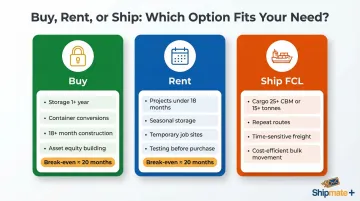
Below this threshold, LCL (Less-than-Container-Load) shipping is more cost-efficient. For smaller shipments, a local multi-carrier shipping outlet like ShipMate+ in Vista, CA can help you compare FedEx, UPS, USPS, and freight options without booking an entire container.
One of the most common budgeting errors is committing to a full FCL or outright purchase before accurately calculating your cargo volume or storage duration. Over-specifying costs you real money: a 20ft container holds 33.2 cubic meters, but cargo that only fills 12 CBM leaves you paying for 21 CBM of empty space on every shipment.
Frequently Asked Questions
How much does it cost to ship a 20-foot shipping container?
Ocean freight for a 20ft FCL container runs $1,700–$2,000 on Asia–U.S. West Coast routes and $2,450–$2,465 on Asia–U.S. East Coast routes. Surcharges for fuel, terminal handling, and congestion typically add $500–$1,200, pushing total costs 30–70% above base rates.
How long will a shipping container last sitting on the ground?
A well-maintained steel shipping container can last 25 to 35 years sitting on the ground, but direct soil contact accelerates corrosion. Placing containers on gravel, concrete pads, or railroad ties extends lifespan by preventing moisture accumulation and rust. Containers converted into static buildings can last 50+ years with proper maintenance.
What is the difference between a new and used 20ft shipping container?
New (one-trip) containers show minimal wear and cost the most ($2,000–$5,000). Used options range from cargo-worthy ($1,400–$3,000), certified for ocean transit, to wind-and-watertight ($1,300–$1,600), which suits storage but not export.
How much does it cost to rent a 20ft shipping container per month?
Monthly rental rates in the U.S. range from $95 to $199, depending on location, rental duration, and container specifications. Delivery charges add $150 to $500+ based on distance from the depot. Rentals exceeding 20 months approach or exceed the cost of purchasing a new container outright.
Is a 20ft or 40ft container more cost-effective?
A 40ft container offers nearly double the volume (67.6 vs. 33.2 cubic meters) for only 25–30% more cost. For heavy cargo, tight spaces, or smaller budgets, a 20ft container is the better fit — both share the same 30,480 kg maximum gross weight, so you may hit the weight limit before filling a 40ft unit.
What are the most common uses for a 20ft shipping container?
Common uses include residential and commercial storage, on-site construction offices, international freight shipping, container homes or workshops, and retail pop-up spaces. Their standardized dimensions and portability support both short-term and permanent setups.