Introduction
Every day, millions of shipments move across the United States—from raw materials to finished products. Most companies rely on a middleman they rarely think about to make that happen: the freight broker, one of the most essential yet least understood roles in the shipping industry.
With over one million for-hire motor carriers registered with the U.S. Department of Transportation, finding the right trucking company for a specific load is a real operational challenge. Shippers don't have the time, data, or relationships to vet carriers, negotiate rates, and manage logistics in-house—especially when demand fluctuates or new shipping lanes open up.
This guide explains exactly what a freight broker does, how the process works from start to finish, and when it makes sense to use one.
Key Takeaways
- A freight broker connects businesses needing to ship goods with trucking companies that haul freight
- Brokers handle logistics (sourcing carriers, negotiating rates, tracking shipments) without physically moving cargo
- Three main types exist: traditional (phone/email), digital (self-service portal), and hybrid brokers
- Regulated by the FMCSA, brokers must hold a $75,000 surety bond and operating authority
- Best for businesses with growing or unpredictable shipping volumes that need a wide carrier network without in-house logistics
What Is a Freight Broker?
A freight broker is a company or individual licensed by the Federal Motor Carrier Safety Administration (FMCSA) to act as an intermediary between shippers (businesses with goods to move) and motor carriers (trucking companies that haul freight). Brokers arrange shipments but never own or operate trucks themselves.
That definition points to a real problem: with over one million registered carriers in the U.S., shippers don't have the time, data, or relationships to find the right match for every load. Brokers close that gap — using carrier networks and market knowledge to match shippers with qualified trucks faster than most companies could on their own.
What a freight broker is not:
- They never take physical possession of freight (unlike a carrier)
- They're not freight forwarders — forwarders take on broader responsibility covering international shipping, customs, and multi-modal coordination
How brokers are licensed:
To operate legally, brokers must obtain FMCSA operating authority, a USDOT number, and a $75,000 surety bond — a financial guarantee that protects shippers and carriers from non-payment. You can verify any broker's legitimacy through the FMCSA's public database.
Broker specialization:
Most brokers focus on specific freight types — full truckload (FTL), less-than-truckload (LTL), flatbed, refrigerated, oversize, or auto transport. Matching the broker's specialty to your freight type has a direct impact on both pricing and service quality.
What Does a Freight Broker Do?
A freight broker's role operates through a defined sequence of actions, each critical to moving a load successfully from origin to destination.
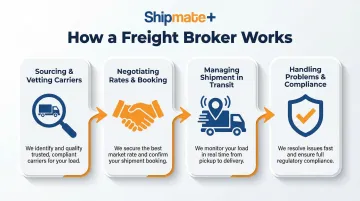
Sourcing and Vetting Carriers
A broker's first job is finding a qualified carrier for a specific load—tapping an established network of vetted trucking companies rather than searching from scratch. Vetting typically covers:
- FMCSA safety ratings and compliance history
- Insurance coverage verification
- Carrier reputation and performance record
- Specialization in relevant freight types or lanes
These ongoing relationships give shippers access to capacity they typically can't reach on their own—including smaller regional carriers that may serve specific lanes better than large national fleets.
Negotiating Rates and Booking the Load
Brokers use real-time knowledge of market rates to negotiate competitive pricing on behalf of shippers. Their buying power (from volume across multiple clients) can yield better rates than a shipper could secure independently.
Once a rate is agreed upon, the broker arranges all documentation and confirms carrier assignment, handling all carrier communication directly so the shipper doesn't have to manage multiple conversations.
Managing the Shipment in Transit
Brokers play an active role during transport: tracking load progress, monitoring delivery windows, and maintaining communication between shipper and carrier. The expectation is active engagement throughout the life of the load, not just at booking.
Experienced brokers proactively flag delays, rerouting needs, or carrier issues rather than waiting for the shipper to notice a problem. A shipper who's never heard about a delay until after delivery missed has likely worked with the wrong broker.
Handling Problems and Ensuring Compliance
When things go wrong—delayed pickups, damaged cargo, or a carrier issue mid-route—the broker coordinates the fix, whether that means sourcing a backup carrier or initiating a claim. This absorbs the problem-solving burden so the shipper can stay focused on their business.
Throughout the shipment, brokers also track carrier credentials and verify regulatory requirements are met—reducing the shipper's liability exposure from unqualified or uninsured carriers.
Types of Freight Brokers
Operational Models:
- Traditional brokers — Phone/email-based, high-touch, relationship-driven service
- Digital brokers — Self-service platforms where shippers book and track loads online, any time of day
- Hybrid brokers — Combine digital tools with human support
The right choice depends on your volume, complexity, and preference for hands-on service.
Asset Structure:
- Asset-backed brokers — Own some of their own trucks or equipment, giving them more capacity control; useful when carrier availability tightens
- Non-asset brokers — Work exclusively through their carrier network and make up the majority of the industry
Specialization Categories:
- Full truckload (FTL) — Captured 63.63% of brokerage revenue in 2025
- Less-than-truckload (LTL)
- Flatbed
- Refrigerated/temperature-controlled
- Oversize/heavy haul
- Intermodal
Sending refrigerated cargo through a general dry-van broker, for example, often results in higher costs and transit risk — specialty brokers carry pre-vetted carrier relationships that general brokers simply don't.
When Do You Need a Freight Broker?
Clear Value Scenarios:
- Businesses shipping regularly at medium-to-high volume who lack a dedicated logistics team
- Companies dealing with seasonal surges or unpredictable demand spikes (holidays, product launches)
- Shippers expanding into new lanes or geographic markets where they don't have established carrier relationships
Scaling Advantage:
Because brokers already have carrier contracts in place, shippers can increase or decrease volume without renegotiating new agreements every time. The broker's network absorbs that flexibility.
When a Freight Broker Is NOT the Right Fit:
For smaller, retail-scale shipments—parcels, boxes, or packages that fall outside commercial truckload territory—a local pack-and-ship service is often the faster, more cost-effective solution.
ShipMate+ in Vista, CA is one example — an independently owned ship center that gives individuals and small businesses access to FedEx, UPS, and USPS under one roof, without the overhead of a full freight arrangement.
Freight Broker vs. Freight Forwarder: Key Differences
A freight broker arranges domestic trucking by connecting shippers with motor carriers and never takes legal possession of the goods. A freight forwarder takes on a much broader role—often acting as the shipper of record, managing international logistics, customs clearance, documentation, and multi-modal transportation (ocean, air, rail, road).
Choosing between the two comes down to where your shipment is going:
- Use a freight broker for domestic truckload or LTL shipments within the US
- Use a freight forwarder when goods are crossing borders, require customs brokerage, or involve multi-leg international supply chains
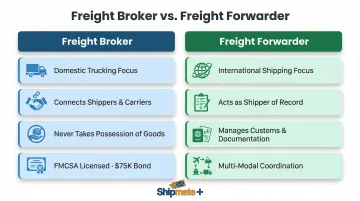
One thing worth clarifying: some companies are licensed as both brokers and forwarders, which can blur the lines. Under FMCSA rules, companies holding both authorities must file separate BMC-84 or BMC-85 bond forms for each operation. If a claim arises, which authority was active at the time of shipment determines who bears liability—so always confirm in writing before booking.
Frequently Asked Questions
What does a freight broker do?
A freight broker connects businesses that need goods transported with trucking carriers, handling carrier sourcing, rate negotiation, load booking, shipment tracking, and problem resolution—without physically handling the freight.
What are the 4 types of freight?
The four main freight categories are full truckload (FTL), less-than-truckload (LTL), intermodal (using multiple transport modes like rail and truck), and expedited freight. Brokers often specialize in one or more of these categories.
How does a freight broker make money?
Freight brokers earn revenue by collecting a margin between the rate they charge the shipper and the rate they pay the carrier. This spread is their commission, and it varies based on market conditions, lane, and load type. Recent data shows margins have compressed to around 9.91% in late 2025.
What is the difference between a freight broker and a freight forwarder?
Freight brokers arrange domestic trucking without taking possession of goods. Freight forwarders take on broader responsibility—international shipping, customs documentation, and multi-modal coordination. They typically act as the shipper of record and assume cargo liability.
Do freight brokers need a license?
Yes, freight brokers in the U.S. must be licensed by the FMCSA, hold a USDOT number, and secure a $75,000 surety bond. Shippers can verify a broker's credentials through the FMCSA's public licensing database.
Is a freight broker the same as a 3PL?
Freight brokers are a type of third-party logistics (3PL) provider, but 3PLs can also offer warehousing, fulfillment, inventory management, and other supply chain services. That makes 3PL the broader category, with brokerage as one piece of it.